
Share


Flavor, tenderness, juiciness, and marbling are usually the first attributes that come to mind when talking about beef. But the value of this food goes far beyond the sensory experience. From a nutritional standpoint, red meat holds a strategic place in human diet as one of the few natural, reliable, efficient, and highly bioavailable sources of vitamin B12 — an essential micronutrient that the body is unable to produce on its own, as is also the case with vitamin B2.
Also known as cobalamin, B12 plays a role in the formation of red blood cells, DNA synthesis, and the proper functioning of the nervous system. Its absence or inadequate intake is associated with anemia, fatigue, neurological changes, and cognitive impairment. For this reason, it must be obtained exclusively through diet — particularly by pregnant and breastfeeding women, whose daily requirement for this nutrient is higher compared to the general adult population.
The importance of vitamin B12 for pregnant and breastfeeding women
Although essential at every stage of life, vitamin B12 takes on an even more critical role during pregnancy and lactation. During these periods, nutritional demands increase to support fetal and neonatal development, especially with regard to the nervous system and blood cell production. In these cases, B12 is essential for:
- DNA synthesis, indispensable for rapid cell growth during pregnancy;
- Red blood cell formation, helping to prevent maternal anemia;
- Neurological development of the baby, both in utero and during the first months of life.
Deficiency of this nutrient in pregnant women is associated with risks such as maternal anemia, neurological changes, and impaired infant cognitive development, according to reviews published on PubMed.
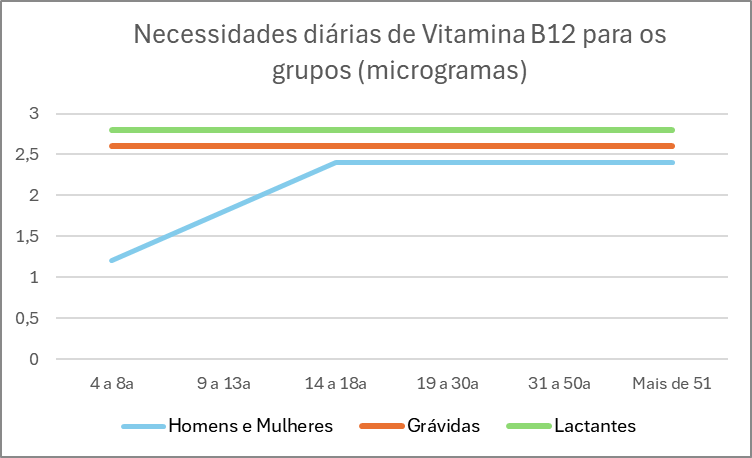
According to the National Institutes of Health (NIH), the recommended daily intake of vitamin B12 is 2.6 mcg for pregnant women and 2.8 mcg for breastfeeding women — values higher than those recommended for the general population (1.2 mcg to 2.4 mcg, for ages 4 through 50 and older), as shown in the table below, prepared by Adeca Agronegócios — a consulting group affiliated with ESALQ/USP and linked to Cepea — based on recommendations from the USDA (United States Department of Agriculture):
Beef: a natural and highly bioavailable source of vitamin B12

According to data from the Food and Nutrition Board in the United States, 100 grams of beef provide, on average, 2.5 mcg to 2.6 mcg of vitamin B12 — an amount that can meet the daily recommendation in some cases, particularly for adults — although pregnant and breastfeeding women have slightly higher demands.
Beyond the absolute quantity, the bioavailability of the nutrient is also of paramount importance — that is, the fraction of it that the body is able to absorb and use. This requires a two-step chemical process within the digestive system.
The first step is carried out by gastric acid and digestive enzymes, which act as chemical solvents, breaking down the structure of food and releasing the vitamin so it can continue its flow through the body.
Once “freed” from the proteins, B12 still faces an obstacle: it cannot cross the intestinal wall on its own. To overcome this, the stomach produces a special protein called intrinsic factor, which enables efficient absorption in the intestine, as described by the National Institutes of Health. When B12 binds to intrinsic factor, it forms a combination that is easily recognized and accepted by the cells of the small intestine. Without this specific connection, even if a person consumes large amounts of the vitamin, the nutrient would not be utilized.
Evidence compiled by the NIH shows that absorption decreases significantly when the capacity of the intrinsic factor is exceeded, which occurs at around 1–2 mcg of B12 per meal.
- Bioavailability varies depending on the source: dairy products show absorption rates approximately three times higher than meat, fish, and poultry;
- Vitamin B12 in supplements has approximately 50% higher bioavailability than that found in food.
Even so, animal-based sources remain the only reliable natural sources of the nutrient, as plant-based foods do not naturally contain B12. Only fortified products — such as certain breakfast cereals and nutritional yeasts — provide the micronutrient in a bioavailable form.
B12 in beef vs. plant-based foods
According to the Harvard T.H. Chan School of Public Health, unfortified plant-based foods do not provide biologically relevant amounts of the nutrient. As a result, plant-based diets require fortification or supplementation, especially during stages of higher nutritional demand, such as pregnancy and lactation. In other words, it would not be possible to meet the recommended daily intake of vitamin B12 through unfortified plant foods alone.
Among beef cuts, liver stands out prominently. According to the NIH, while a standard steak provides approximately 2.4 mcg to 3.0 mcg of vitamin B12, 100 g of beef liver offers around 70.7 mcg — representing more than 2,900% of the recommended daily value for an adult.
It is this combination of factors — nutrient quantity and bioavailability — that reinforces the importance of animal-based foods in human nutrition, especially for groups with greater nutritional demands, such as pregnant and breastfeeding women, but most importantly, by combining foods of different types for truly complete and balanced nutrition.
Reference sources: