Share


An article published in the journal Animals, presenting a study conducted by Minerva Foods in partnership with the Welfare Footprint Institute, concluded that providing adequate shade, both in confined and open spaces, reduces cattle exposure to severe heat stress by about 85%.
According to the researchers, heat stress affects the animal welfare and productivity in tropical regions. This happens because the environment imposes a heat load far greater than the animals’ physiological capacity to dissipate it. The study shows that, in 65% of the regions analyzed, covering 636 municipalities in Brazil, Argentina, Colombia, Paraguay and Uruguay, cattle face 280 to 2,800 annual hours of moderate to severe thermal discomfort, which leads to reduced feed intake, digestive problems, immunosuppression and higher risk of infectious diseases, as well as increased mortality.
The advantages are not limited to thermal comfort: they also translate into economic benefits. The article references a study that focused on the finishing phase (110 – 120 days), in which weight gain is more pronounced: Nelore (Bos indicus) cattle with access to customized shade structures gained up to 8 kg of hot carcass weight (the animal’s weight immediately after slaughter and dressing) more compared with the group without shade control during the same period.
According to the study, even if animals record a more conservative weight gain of, for example, 5 kg, it is possible to generate between US$ 15 and US$ 19 more revenue in the same finishing periods (three times a year). Net profit (subtracting the average cost of shade, which is US$ 2.3 per animal) is around US$ 12 to US$ 16 per animal, that is, about US$ 12,000 to US$ 15,700 per thousand finished animals.
Why does heat stress affect even adapted breeds so strongly?
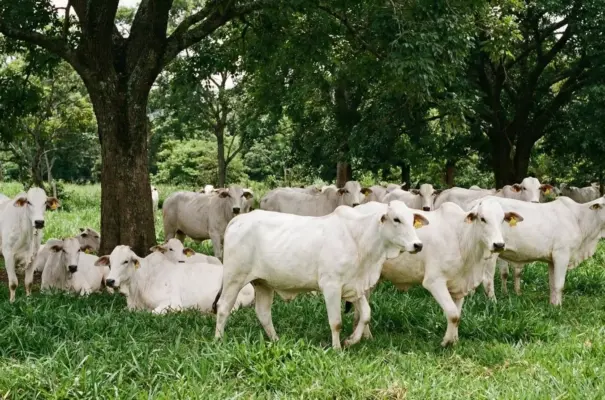
Even “adapted” breeds, such as Nelore, cannot cope with direct sun heat, which makes the thermal sensation on the animal exceed 40 °C, in addition to high humidity that prevents efficient evaporation, and weeks (or even months) of exposure to the sun without relief. Characterized by light coat, greater sweating capacity and lower metabolic heat production, this was the main breed analyzed by the researchers.
Shade, therefore, is configured as a strategic tool in livestock production, with a direct impact on weight gain and reproductive efficiency. Its application allows the control of environmental variables that directly affect the animals’ metabolism. By reducing heat load, it enables cattle to reduce the energy they spend on thermoregulation, that is, maintaining a stable body temperature. In this way, energy is “free” to perform productive functions — such as weight gain and milk production. “Cattle with access to shade showed a 5 °C lower body surface temperature, a respiratory rate 10 breaths per minute lower (technical term referring to breathing frequency) and a daily water intake 3.4 L lower compared with animals without shade, as well as a 4.5% improvement in feed conversion,” the study states.
Read also: Animal welfare also impacts meat quality
Reference sources:
- Minerva Foods leads solutions for heat stress in livestock and demonstrates the positive impact of shade on animal welfare
- The Welfare Impact of Heat Stress in South American Beef Cattle and the Cost-Effectiveness of Shade Provision
- Conscious meat: what you need to know about animal welfare
- Better livestock production improves family well-being and acts against climate change in Uruguay
- Brazil surpasses the USA and becomes the world’s largest beef producer, says US Department of Agriculture