Share


Beef cattle farming is reducing poverty worldwide by enabling the socioeconomic development of small rural producers. One example is a project in the Chipinge district of Zimbabwe, a country in southern Africa. There, the introduction of modern livestock practices through a government project resulted in economic improvement for 96% of local producers and increased food security for 95% of them.
The case is detailed in the literature review Carne Bem-Criada, produced by Adeca Agronegócios, a consultancy group from the Luiz de Queiroz Higher School of Agriculture, University of São Paulo (Esalq/USP), based on the research The Contribution of Smallholder Beef Cattle Farming to Household Development in Chipinge Rural District, Zimbabwe, published in the Journal of Economic Impact in 2022. According to this research, local cattle farming in Zimbabwe was subsistence-based, low-tech and with little formal training until the 2000s, when the government carried out a training project that transformed local cattle raising, increasing not only marketing but also productivity.
The study was based on questionnaires applied to 174 cattle farms in Zimbabwe and showed that, before the project, the income of 18% of livestock families was in the range of US$2,000 to US$2,500. After the initiative, that percentage rose to 55%, which resulted in improvements in the local population’s food security. To give an idea, 51.8% of the revenue was allocated to the purchase of staple foods, plus another 11% allocated to non-staple foods. Agricultural inputs (11.9%), education (10.6%) and clothing (2.7%) are other items to which the income was directed.
Livestock also emerged as an essential activity for greater resilience in times of crisis, being the main source of income in those moments for 80.7% of the study participants.
Beef cattle farming guarantees income and opportunities with rising demand
The Agricultural Outlook 2025-2034 prepared by the Food and Agriculture Organization of the United Nations (FAO) and the Organisation for Economic Co-operation and Development (OECD), published in July 2025, projects that to meet the growing demand for food from animal and fish sources, global production must grow 14% over the next decade, which will drive the expansion of cropland and the cattle herd. The global per capita caloric intake of animal and fish products will increase by 6% in the next decade, driven mainly by a rapid rise in lower-middle-income countries, where the report forecasts growth of 24%—almost four times faster than the global average.
Africa, like South Asia, the document says, are the regions with the greatest growth potential. “These structural changes in production will be driven by a combination of gradual adoption of improved and innovative technologies, capital investments and more intensive use of fertilizers, feeds and other inputs in middle-income countries. Growth in agricultural production will be based mainly on productivity gains, but an expansion of cropland and the cattle herd is also expected, particularly in Africa and South Asia, where constraints on access to modern agricultural technologies persist,” the document notes.
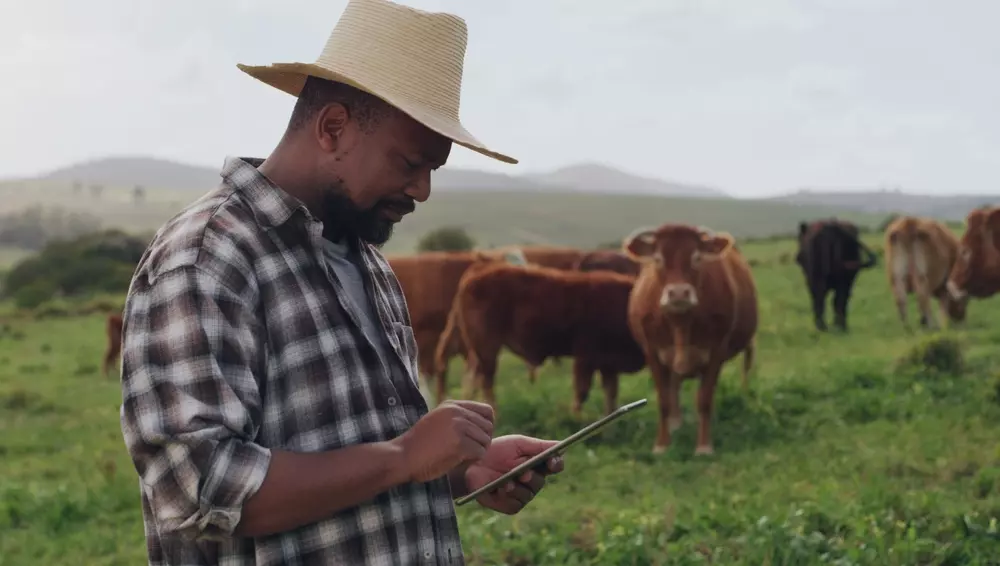
In Brazil, technology is also a great ally, generating productivity gains, sustainability and profit without needing to scale the operation — and it also helps meet the growing demand for traceability and animal welfare.
A study published in the book “A Journey Through Brazil’s Contrasts: One Hundred Years of the Agricultural Census”, produced by the Ministry of Agriculture (Mapa), in partnership with the Institute for Applied Economic Research (Ipea) and the Brazilian Institute of Geography and Statistics (IBGE), using agricultural census data between 1995 and 2017, shows that the adoption of digital technologies accounted for more than 60% of the growth of Brazilian agriculture in the period.
When combined with technical training and rural connectivity, this technological transformation benefits producers of all sizes — including smallholders. This is one of the objectives of Renove, Minerva’s program currently developed with 91 properties in five South American countries (Brazil, Argentina, Colombia, Paraguay and Uruguay) to promote the sustainable development of livestock.
Through the initiative, the company provides training and technical assistance to cattle farmers, with incentives for implementing low-carbon technologies, believing that capacity building and technical assistance are essential to ensure the proper implementation and maintenance of good practices in the sector. The Renove Program supports partnerships and rural extension activities, technology transfer and training so that rural technicians and producers have the best tools and knowledge.
Persistent inequalities
Although the increase in intake of nutrient-rich foods in lower-middle-income countries raises the average per capita intake to 364 kcal per day, persistent inequalities within and between countries will continue to be a challenge.
In low-income countries, the average daily per capita intake of animal-source foods is projected at 143 kcal, well below the reference (300 kcal) used by the FAO to analyze the cost and affordability of a healthy diet. This reinforces the importance of initiatives such as training beef producers in low-income nations, where more modern production practices could contribute to economic development and the population’s nutritional security.
The results of investments made to improve livestock have already shown their impact, demonstrating that beef cattle farming guarantees income, but also better living conditions, health and daily routines for small farmers, contributing to poverty reduction in the regions. Rising demand is the opportunity for a new era of socioeconomic development.
Sources:
- Carne Bem-Criada – literature review by Adeca Agronegócios (Esalq/USP)
- The Contribution of Smallholder Beef Cattle Farming to Household Development in Chipinge Rural District, Zimbabwe – Journal of Economic Impact (2022)
- OECD-FAO Agricultural Outlook 2025-2034
- A Journey Through Brazil’s Contrasts: One Hundred Years of the Agricultural Census – Ministry of Agriculture and Livestock (Mapa), Institute for Applied Economic Research (Ipea) and Brazilian Institute of Geography and Statistics (IBGE)
- Renove Program – Minerva Foods