
Share


When it comes to traceability in cattle ranching, public debate is dominated by pressure for environmental compliance, driven by agreements such as Terms of Conduct Adjustment (TACs) and the new European Union Deforestation Regulation (EUDR). Traceability is quickly ceasing to be a differentiator and becoming a “license to operate.” But this technology also benefits two other pillars: animal welfare and food safety.
The data infrastructure was built mainly to address deforestation-related issues. But the same “ear tag” or “chip” that serves as proof of deforestation-free origin is the tool that enables monitoring of individual health and ensures sanitary chain of custody. Thus, the environmental agenda is, in practice, financing and accelerating the adoption of technologies that raise the entire chain’s standard.
From the hot iron to the biomonitor
The history of bovine identification in Brazil is marked by technological evolution. For centuries the starting point was branding with a hot iron. Its sole purpose was proof of ownership. However, this technique causes pain and stress to the animal, makes it susceptible to infections and permanently damages the hide, reducing its commercial value.
The first element to help reduce the use of this practice was the creation of the Brazilian System for Individual Identification of Cattle and Buffaloes (Sisbov), which introduced the visual ear tag as a standard—an advance over branding, but still a passive system.
The measure was driven by food safety and market access—a response to sanitary crises that occurred in Europe in the 1990s, such as “mad cow disease” (bovine spongiform encephalopathy). Importing countries, especially the European Union, began to require the ability to trace the animal “from farm to fork” as a condition of purchase.
The next stage was driven by electronic identification (EID). The introduction of Radio Frequency Identification (RFID) technology enabled automated data collection. Electronic ear tags and the intraruminal bolus (a ceramic transponder that lodges in the animal’s rumen, containing a chip) eliminated typing errors and automated management records like weighing and vaccination.
Today, in the era of Precision Livestock Farming (PLF), identification evolves from a “number” to a “biomonitor.” Electronic collars that monitor rumination time (a primary health indicator) and temperature sensors—some developed by Embrapa and placed in the animal’s ear canal—allow real-time health monitoring.
The end of branding: the example of São Paulo
In the state of São Paulo, branding was historically used for various purposes, including vaccination control. In 2024, the São Paulo Secretariat of Agriculture and Supply (SAA) published Resolution SAA No. 78/24, which eliminated the obligation to brand female cattle and buffalo vaccinated against brucellosis. The new resolution established an alternative model based on buttons (ear tags) in specific colors (yellow or blue, depending on the vaccine strain).
The official rationale from the São Paulo government for the change was the pursuit of a “more humane approach” and a drastic “reduction of stress in animals.” The state executive also highlighted that the change “adds value to São Paulo livestock, promoting good practices” and, crucially, “opening new opportunities in the international market.” However, males remain susceptible to branding, since the resolution makes no direct mention of them.
Precision livestock farming and measurable welfare
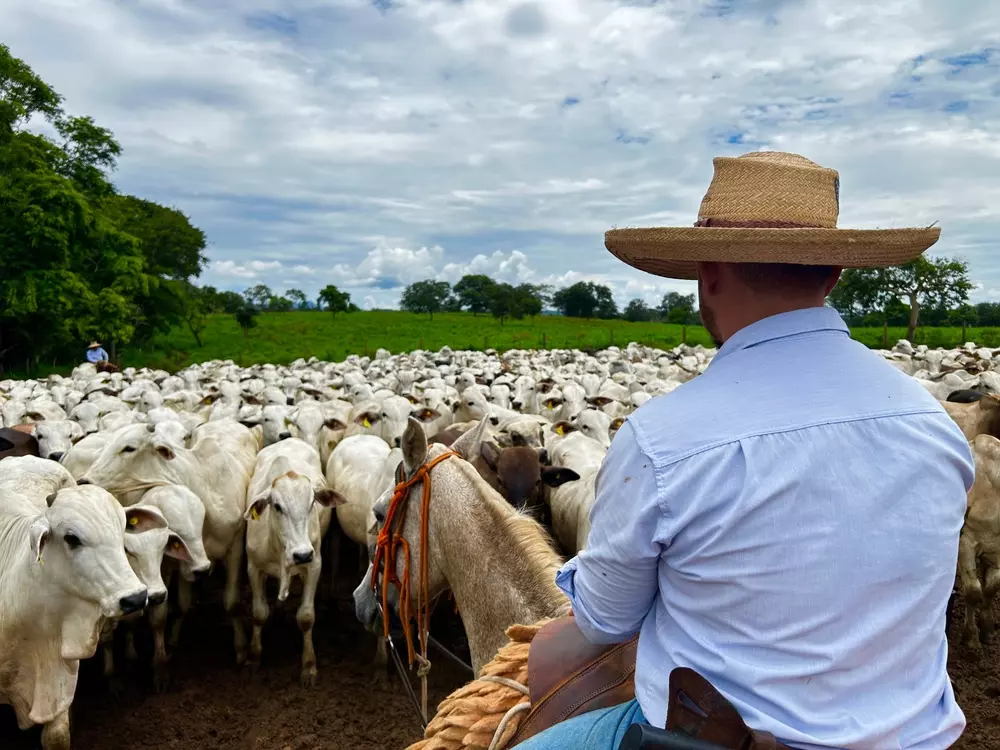
Precision Livestock Farming (PLF) applies monitoring technologies to manage animal health and production individually rather than by herd averages. Scientific studies demonstrate direct correlations between animal behavior (such as reactivity in the chute) and physiological stress indicators like elevated cortisol levels.
PLF technology enables this real-time management. Rumination sensors in collars or temperature sensors in ear tags and boluses allow early disease detection, days before visual symptoms (such as isolation or loss of appetite). This results in three gains:
- Welfare gain: animal suffering is reduced. Minerva Foods, for example, aligns its animal welfare commitment with the five internationally recognized domains, materializing it in policies and continuous monitoring.
- Economic gain: early treatment is more effective and mortality rates drop.
- Food safety gain: the use of antibiotics becomes more targeted and reduced, benefiting the entire chain.
Individual identification as a pillar of food safety
Individual identification is currently the most effective risk management tool in livestock, acting in two ways:
- Prevention: the system is the basis for monitoring “critical points.” It allows recording the use of veterinary drugs, ensuring compliance with withdrawal periods and avoiding chemical residues in meat. It also validates vaccination history and each animal’s sanitary status, ensuring compliance with mandatory certifications such as the Federal Inspection Service (SIF).
- Reaction (recall): in an outbreak scenario, such as Foot-and-Mouth Disease, or a microbiological contamination, traceability makes it possible to identify exactly which animals, from which farms, had contact with the problem. This enables a recall, protecting public health and saving the rest of the market.
Challenges to universal identification
Although there have been advances in traceability of the Brazilian herd, implementing a universal individual tracking system faces structural challenges.
The first is cost. Implementing electronic ear tags, readers and software represents an expense borne by the producer. And there is not always a guarantee of a “premium” (additional payment) for traced meat.
The second challenge is inclusion of smallholders. Brazilian livestock farming is fragmented, with millions of properties. Many producers at the base of the chain have less capital, infrastructure and technological familiarity to adopt and manage digital systems.
The third, and most complex, is the “indirect supplier” bottleneck. The chain is segmented: slaughterhouses buy from direct suppliers (feedlots), who in turn buy from indirect suppliers (breeding and backgrounding). It is in this fragmentation that “cattle laundering” can occur—animals from illegal (deforested) areas are moved to a legalized farm before final sale, breaking traceability.
Convergence and transparency in the chain
Solving these challenges is the current focus of industry and the public sector. Governance solutions, such as the Indirect Suppliers Working Group (GTFI), seek to cross-reference public data, like the Animal Transit Guide (GTA) and the Rural Environmental Registry (CAR), to map cattle flows.
At the same time, technology is advancing. Blockchain-based platforms are being used to create immutable records, ensuring supplier transparency. Industry initiatives, such as Minerva Foods’ Renove Program, already work with livestock farmers to implement advanced practices that include emissions measurement and traceability as part of more sustainable production.
Reference sources:
- Bovines and Buffaloes (SISBOV) in the perception of rural producers in Goiás
- Guidance document for participation in the Public Consultation on controls applied to traceability in the beef and buffalo meat production chain in Brazil
- Slaughterhouses Marfrig, Minerva and Rio Maria lead in chain control against Amazon deforestation
- Greater traceability of indirect suppliers in livestock helps meet European market demands
- Branding of vaccinated cattle is no longer mandatory in São Paulo
- The Brazilian program for traceability of cattle production – review and critical analysis
- Rural producers bet on the “ear tag” to monitor cattle | LIVE CNN
- Cattle traceability: advantages and disadvantages of the Brazilian Individual Identification System
- Identification systems of dairy cattle: bibliographic review