Share


Women have always been present in livestock farming — but rarely in visible roles. They take part in the daily routines of farms, in family administration and in production decisions, even if, most of the time, away from the spotlight.
This female invisibility is so structural that there are no recent data on the subject. The last IBGE Agricultural Census, which states that 19% of Brazilian agricultural establishments are headed by women, dates from 2017. According to Stéphanie Ferreira Gobato, president of the National Women in Agribusiness Commission of the Confederation of Agriculture and Livestock of Brazil, the main challenge is precisely formal under-representation. Many women already handle the day-to-day management of properties, deal with numbers, contracts, teams and planning, but still do not appear officially as legal responsible parties.
Within the Commission, Stéphanie has worked to change this reality in different ways, starting from this base, engaging with public authorities to include issues aimed at identifying the real role, participation and challenges of women in agribusiness. “When we talk about rural unions, which are the entities that defend and represent the rural producer, the member is usually the husband; often the woman inherits the family property, the husband takes over and she does not consider herself a producer. The same goes for daughters of producers who also do not see themselves as active on that farm, in that management,” she says.
Female leadership, transformation and positive impact

The study “Rural Producers and Innovation in the Field“, conducted by consultancy Quiddity in partnership with Bayer, indicates that female rural producers play a relevant role in innovation and the sustainable modernization of Brazilian agribusiness.
At the international level, the Food and Agriculture Organization of the United Nations (FAO) highlights that more resilient agri-food systems depend on the inclusion of women in strategic decisions. In a report published in 2025, the agency emphasizes that women in rural areas tend to adopt more sustainable practices, diversify productive activities and strengthen food security, noting that, according to the research, if women had the same access to productive resources as men, they could increase their farms’ productivity by 20% to 30%, raising total agricultural output in developing countries by 2.5% to 4%.
The study also reveals hierarchical disparities. While “globally, women make up 37% of the agricultural labor force and, in developing countries, produce up to 80% of the food, less than one in five landowners in the world is female. Of the 525 million smallholders (who own land under two hectares), fewer than 15% are women” — the classification being largely defined based on land ownership.
In Brazil, the Embrapa + UN Women partnership integrates data, science and public policies to expand gender equality in rural areas. The Organization for Economic Cooperation and Development (OECD) observatory highlights female leadership as a driver of institutional innovation in the countryside.
In the month when International Women’s Day is celebrated, we gathered stories that illustrate this transformation across four complementary fronts: productive management, institutional leadership, applied science and evidence-based communication.
Inside the gate: succession, management and productive innovation
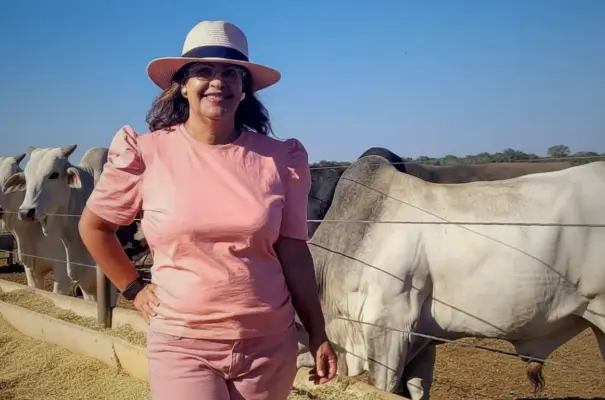
At Fazenda São José, in Bela Vista de Goiás/GO, Luzanir Luíza de Moura Peixoto’s path symbolizes this change. After her husband’s death in 2023, she took over management of the property alongside her daughters. What could have been a moment of withdrawal became a structural reorganization.
The farm underwent process formalization, strict financial control and strategic investments in technology. On the productive side, adoption of integrated Crop-Livestock systems (Crop-Livestock Integration – CLI) was deepened — a sustainable production system that combines agricultural crops (such as soy and corn) with pasture. As part of a circular production cycle, cattle manure is reused as organomineral fertilizer, mitigating environmental externalities while reducing dependence on external inputs.
The experience demonstrates how female leadership can integrate organization, systemic vision and sustainability, redefining the production model inside the gate.
Representation and institutional leadership

If transformation on farms happens in practice, outside them it needs structure and recognition. “A lack of confidence in one’s own potential is one of the biggest barriers to advancing the female cause in the sector,” says Stéphanie Gobato.
The National Women in Agribusiness Commission, launched in 2023, works on leadership development and encourages occupying strategic positions within the union system. “We want more women in decision-making roles, not only within institutions but also within families and on farms.” According to Stéphanie, expanding this participation strengthens governance and contributes to a more structured and representative agribusiness.
Science and evidence: from the lab to the table
The transformation of agribusiness also passes through scientific knowledge. Physician and researcher Luciana Haddad, with nearly 30 years of career, highlights that doing science in Brazil is already a challenge and that, historically, women face additional barriers.
Trained in surgery and digestive surgery, she began her journey in predominantly male environments. “I was the only woman among the residents. And I experienced many situations that today would not go without being reported.”
In that environment, for a long time she felt the need to constantly prove her competence. Therefore, she was the first to arrive and the last to leave. She always said yes. She thought she needed to be better to be considered equal. Today, in addition to hospital and academic work, Luciana is dedicated to science communication. For her, if knowledge does not improve people’s lives, it makes no sense.
Science, in this context, functions as a bridge between responsible production and public health.
Scientific communication: confronting myths and expanding the debate
Producing science is essential, but communicating science has become equally strategic. Science communicator Lívia Padilha, who holds a PhD in behavioral economics from the University of Adelaide (Australia), and is a speaker, professor and communication consultant, says there is a very simplified narrative that meat is a villain for health. “When we look at the data, the reality is much more complex.”
Among the most recurring myths, she highlights the discussion about bovine methane and climate change. “Methane is part of a natural carbon cycle. Livestock can be part of the solution when animals are managed correctly.”
Host of the programs “In Defense of Meat” and “The Agronauts,” Lívia works to make debates that often remain confined to academia accessible. “If we don’t translate science for the public, someone else will translate it incorrectly.”
Her work shows that the contest over narratives about food and sustainability requires data, responsibility and clear communication.
Four fronts, one movement
Productive management, institutional leadership, applied science and evidence-based communication are interconnected dimensions of the same transformation process.
On the farm, Luzanir reorganizes systems and implements sustainable practices.
At the institutional level, Stéphanie strengthens representation and data.
In science, Luciana connects research, health and knowledge sharing.
In communication, Lívia broadens public debate and confronts myths.
The advancement of women in Brazilian livestock farming is not just a matter of presence, but of strategic influence. The agribusiness of today and tomorrow is built with technology, data, sustainability and with female leaders who act inside and outside the gate, in laboratories, in institutions and in the public debate, broadening views, perspectives and creating a fairer and more equitable sector.
Read more: Stéphanie Ferreira: strategy, listening and representation of women in agribusiness
Read more: How Luzanir Turned Grief into Innovation in the Cerrado
Read more: Luciana Haddad: leadership in high-complexity medicine and active voice for equity in science
Reference link:
Censo Agro 2017
Pesquisa inédita revela que produtoras rurais têm papel importante na inovação e sustentabilidade do agro
Rightfully HERS: Strengthening women’s participation in agriculture
O papel do Brasil na segurança alimentar global
Embrapa e ONU Mulheres formalizam aliança voltada à igualdade de gênero no meio rural brasileiro
Brazilian Rural Women’s Observatory
ILPF: produtividade, resiliência e renda no campo
Esterco: do descarte a insumo agrícola e energia
A pecuária é o grande vilão do efeito estufa? Entenda o ciclo do metano bovino