Share


The global livestock industry is not limited to meat production: offal, hide, bones, blood, fat, carcass – everything is utilized, one way or another, in a process of circularity. This means items not used for human nutrition, which is the industry’s main business, gain other uses, serving as raw material for various productive chains, such as the pharmaceutical, automotive and biofuels sectors.
According to a report by Exame, there are about 250 byproducts derived from cattle. The liver is the most consumed, while leather remains the most used non-consumable good.
This gives the bovine high economic and logistical relevance, especially for Brazil, the world’s third-largest exporter of the product.
From skin to collagen: cosmetics and biomaterials
Although leather remains one of the byproducts with the highest added value in the fashion or automotive industries, it is also rich in collagen and proteins used in cosmetics and health-oriented biomaterials. Dressings and scaffolds (porous three-dimensional structures that serve as supports for tissue or organ regeneration) for tissue engineering are produced through industrial processes that add value to parts previously considered disposable.
Gelatin derived from the animals’ tendons and ligaments is used as an ingredient in chewing gum, radiographic films and medicines.
Livestock is fundamental for insulin
Physician Frank Banting, in the 1920s, theorized that the pancreas produced a substance capable of controlling blood sugar. He joined student Charles Best, biochemist James Collip and physiologist John Macleod of the University of Toronto to begin the first tests. In January of 2022, a 14-year-old student in a diabetic coma received an experimental injection of insulin and improved rapidly.
It was, according to the Revista Questão de Ciência, a solution obtained from a macerate of animal pancreas. This means that the organized and sustainable growth of livestock activities allows the development of the drug, whose importance is unquestionable: the 11th edition of the IDF Diabetes Atlas estimates that about 589 million adults will live with the disease by 2050.
Horns, bones and… fire extinguishers
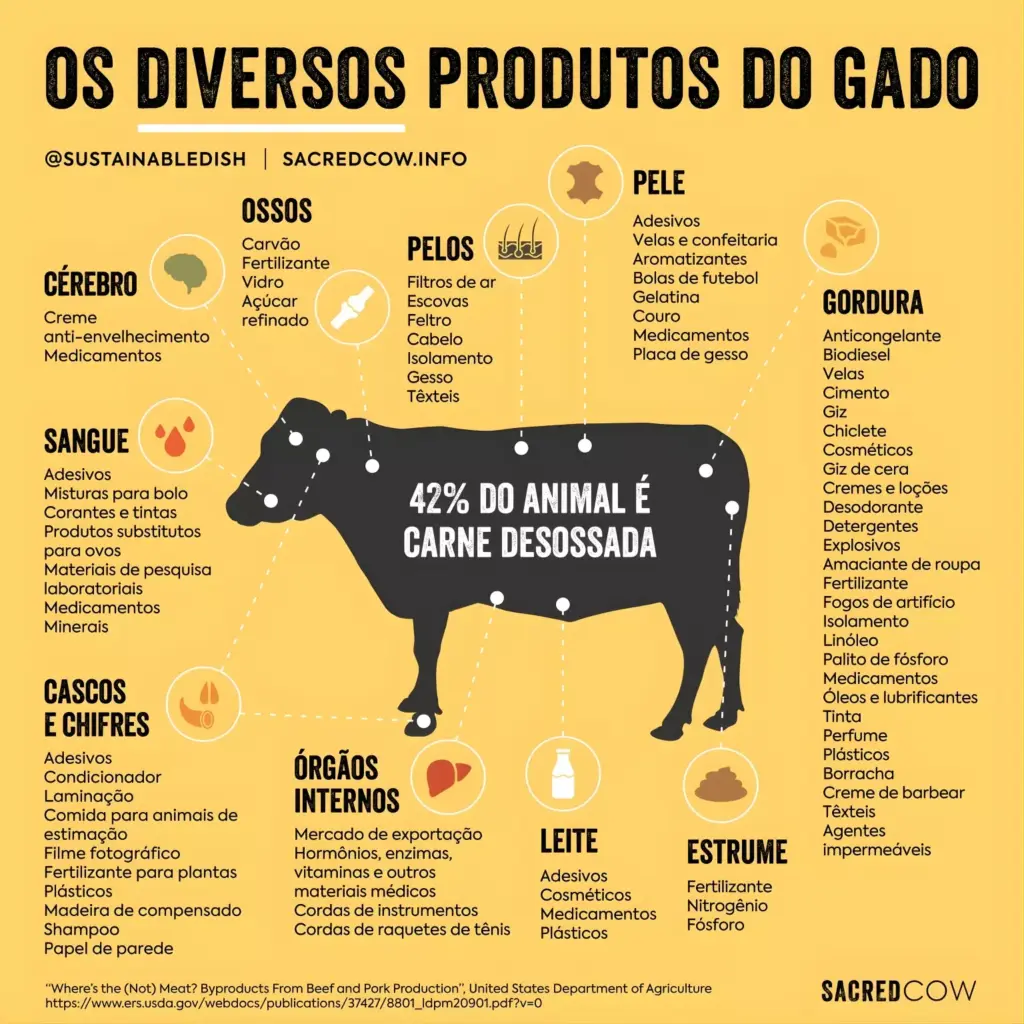
Technical surveys indicate that components extracted from bovine horns and bones can be used as raw material in the formulation of dry powder fire extinguishers, although there are few scenarios in which cattle horn is still used for this purpose. The most common uses are in the making of combs and buttons, as well as other artisanal products.
Bones, which are a rich source of calcium and iron, are widely used in the production of feed and animal meals. They can also be calcined to produce ceramics and porcelain — two common materials in civil construction.
In the refined sugar production process, bovine bones can also be used as an energy source for boilers.
Fat and tallow feed and fill the tank
Fat is used in the formulation of ice cream, as well as other confectionery products. Perfumed soaps, candles and soap bars incorporate animal tallow, as do cleaning products, varnishes, lubricants and cosmetics.
Biodiesel production uses up to 20% bovine fat with vegetable oils to prevent the fuel from solidifying, according to information from Embrapa. It is, therefore, the second most used raw material in the production process.
Both tallow and bovine fat are versatile and exemplify how livestock can integrate practices of total animal utilization and circular economy.
The methane cycle
Even the methane gas emitted by the digestive process of cattle is grounded in the principle of circularity. The methane (CH₄) emitted by the animal’s digestion is produced from the carbon in the plants it consumed — that is, carbon previously removed from the atmosphere by natural photosynthesis. That methane remains in the atmosphere for a short time and, through natural oxidation reactions, is converted into carbon gas (CO₂), which is then absorbed by plants, restarting the cycle. Thus, it is not a matter of adding “new” carbon to the system, but of recirculating the same biogenic carbon in a short cycle. Furthermore, it is worth highlighting the benefits of carbon in the soil: improved fertility and soil structure, increased water and nutrient retention, and reduced erosion.
Does stopping the consumption of beef change anything?
The full utilization of the bovine supplies diverse and essential sectors, such as the pharmaceutical industry. Choosing companies committed to technological innovation for greater efficiency, good management practices, and urging public authorities for measures and investments that help mitigate the adverse impacts of the agroindustrial process is the best way to enhance the sector’s contributions to society, the economy and the environment.
In the book “The Meat of Our Daily Lives,” Diana Rodgers and Robb Wolf explain that meat, when produced responsibly, is essential for human health, environmental sustainability and social ethics. The authors point out that animal-derived foods provide nutrients often deficient in vegetarian or vegan diets, such as iron and vitamin B12. They also stress that pasture-raised animals are a fundamental part of natural cycles, contributing to soil fertility and the process of carbon capture.
A study mentioned in Chapter 6 examined the nutritional and environmental consequences of removing all cattle from the United States food system. In that scenario, GHG emissions would decrease by only 2.6%, and the impact on nutrient availability would be devastating. Because sources of animal protein have greater nutritional density than plant sources, it would be necessary to consume many more vegetables to obtain the same amount of nutrients, vitamins, minerals and amino acids.
In that scenario, overall calories would increase, per capita grain consumption would grow tenfold, and there would be deficiencies in calcium, vitamins A and B12, EPA, DHA and arachidonic acid. In short, there would be more diseases related to malnutrition. The researchers concluded: “When animals are allowed to convert some calorie-dense, micronutrient-poor crops (such as grains) into foods richer in micronutrients (meat, milk and eggs), the food production system increases its capacity to meet the population’s micronutrient needs.”
Therefore, even conventional beef is, nutritionally, a central element of the food system. By improving production and finishing cattle in a well-managed pasture system, which helps substantially reduce emissions, climate benefits become tangible. Thus, the solution is not to eliminate all animals from the food system: cattle simply need to be managed appropriately.