Share


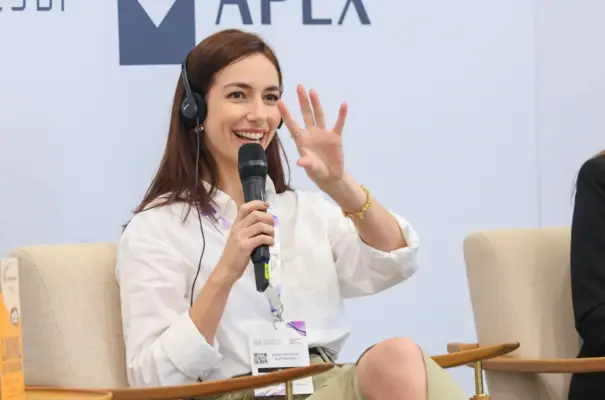
Browsing Lívia Padilha’s social media, female voices are a constant presence in the podcasts she hosts. In “Os Agronautas”, she shares hosting duties with other professionals connected to livestock, two of whom are women. Among the program’s occasional guests are rural producers, researchers and sector professionals who sit at the center of the debate. On “Em Defesa da Carne”, which she leads solo, she predominantly invites specialists — many of them women — to discuss science, nutrition and sustainability in animal production.
Asked about this recurring presence, Lívia is surprised by the observation, since she explains it was not intentional. Guest selection has always been based on technical relevance and the quality of contributions. Even so, the result is consistent: by occupying the role of host, she expands the table and shows the impact of a woman in the space she occupies: more women, which means a greater multiplicity of perspectives and viewpoints. Thus, other women become sources, protagonists and references in a sector historically associated with male leadership.
On “Os Agronautas”, the format is collaborative with other professionals. The shared hosting reinforces the idea of complementary perspectives. It is not about dividing protagonism, but about adding repertoires. The aim is to bring multiple views on management, family succession, innovation and sustainability in the field.
“Em Defesa da Carne” was born out of discussions around the book Sacred Cow (in Portuguese, A carne nossa de cada dia), by nutritionist Diana Rodgers. What began as conversations to deepen the book’s arguments evolved into a structured interview channel, now in its second season. The editorial line is straightforward: address meat and livestock based on science, confront myths and analyze the topic beyond simplified narratives.
This approach echoes Lívia’s own trajectory. Trained in foreign trade, she had her first contact with the beef chain in the leather sector in Rio Grande do Sul. Her undergraduate thesis already dealt with design ecology and sustainability applied to leather. Later, she delved into management and sustainability and went on to study nutrition.
Her concern with the public debate on meat — often fragmented between environmental and nutritional arguments — led her to a PhD at the University of Adelaide, Australia, with a full scholarship. There she joined a center dedicated to global studies on food and natural resources. Her research investigated how consumers interpret different narratives about meat, including plant-based alternatives and lab-grown meat, combining nearly one hundred face-to-face interviews and periodic quantitative surveys.
The central axis was to understand what consumers mean by “sustainable meat” based on environmental, social and economic pillars. The same logic that guides her research runs through her podcasts: broaden the debate, integrate perspectives and improve the quality of information. By taking the microphone, Lívia not only leads the conversation — she redefines who takes part in it.
Breaking myths and amplifying voices
When addressing meat and livestock on her podcasts — especially on “Em Defesa da Carne” — Lívia Padilha maintains the same line that guided her academic path: start from science to improve the public debate. In an interview with the My Minerva Foods portal, she emphasized that many discussions still rely on simplified perceptions.
One recurring topic is methane and greenhouse gas emissions. According to her, part of the criticism overlooks the functioning of the biogenic carbon cycle and the dynamics of carbon sequestration in certain production systems. “People always come back to the methane issue,” she notes. For Lívia, understanding the natural cycle is a basic condition to raise the level of the conversation.
On the nutritional side, another frequent point is the idea that beef consumption is excessively high worldwide. She points out that global data indicate average stability in consumption, with regional variations associated with socioeconomic factors. In other words, the picture is more complex than the generalized narrative usually suggests.
This concern with translating technical information has accompanied her work since her PhD. During the research, she used infographics and visual representations to explain complex concepts to interviewees. The experience consolidated a conviction that now runs through her podcasts: science communication is a key tool to bring countryside and city closer together — and to dismantle myths that persist due to lack of context.
The female presence that marks her programs also permeated her academic training. During her doctorate, she was supervised by an economist and co-supervised by a nutritionist, both researchers dedicated to the study of meat consumption. The environment encouraged not only scientific production, but communication with non-academic audiences — something Lívia adopted as practice.
Among her references is nutritionist and author Diana Rodgers, whose work included the infographics Lívia translated and adapted, and her technical review of the Portuguese text. For Lívia, the combination of scientific rigor and clarity in communication is strategic to broaden public understanding of livestock.
Female protagonism is also evident in the stories she follows in the sector. She cites the case of a rural producer who, upon taking over the management of a farm at a very young age, faced explicit resistance for being a woman. Situations like that reveal historical challenges in agribusiness, but also indicate transformations underway.
“Today, more and more diverse and qualified voices are emerging in livestock,” she says. For her, it is necessary to multiply these voices committed to the truth, in defense of ever more sustainable livestock. Improving, thus, a debate that is still often reduced to slogans.
Breaking myths and barriers
Throughout the interview with My Minerva Foods, Lívia highlights that many public debates about meat still rely on simplified perceptions.
According to her, part of the criticism disregards the functioning of the biogenic carbon cycle and the dynamics of carbon sequestration in productive systems. “People always come back to the methane issue,” she observes. For her, understanding the natural cycle is central to qualifying the debate.
On the nutritional dimension, another recurring point is the idea that beef consumption is excessively high worldwide. Lívia emphasizes that global data show average stability in consumption, with regional variations related to socioeconomic factors.
Her communication work seeks precisely to translate this technical information. During her research, she used infographics and visual representations to explain complex concepts to interviewees. The experience reinforced her conviction that science communication is a key piece for dialogue between countryside and city, and to break myths.
Moving between academia, communication and the productive sector, Lívia argues that the debate about meat cannot be fragmented. Nutrition, sustainability and consumer behavior are interdependent dimensions.
Her work, whether in research or in podcasts, seeks to bring these worlds closer together. By giving voice to producers, doctors, nutritionists and researchers, she contributes to elevating the public conversation about the production of animal-origin food.
At the center of this work is a conviction: evidence-based information is the path to more conscious decisions, both in the countryside and in the city. And, in this process, the female perspective is not only representative, but strategic to broaden perspectives and strengthen dialogue in agribusiness.