Share


Producing more food with fewer resources has become one of the main challenges for the global food system. Population growth and rising incomes increase demand for food, especially nutrient-dense proteins, while intensifying pressure on land, water and production inputs.
The IPCC Chapter 5 on Food Security indicates this system already operates under severe strain: since 1961 food production has risen by about 30%, accompanied by an approximately 800% increase in fertilizer use and a doubling of water used for irrigation. Yet 821 million people remain undernourished while another 2 billion are overweight, highlighting imbalances in distribution and consumption patterns.
Beyond demand pressure, the effects of climate change are now directly impacting productive capacity. Rising temperatures, droughts and extreme events already reduce agricultural productivity in many regions, especially for crops such as maize and wheat at lower latitudes and in more vulnerable areas.
At the same time, the food system itself contributes to worsening these conditions, accounting for roughly 21% to 37% of global greenhouse gas (GHG) emissions. This creates a feedback loop in which climate change affects food production and is simultaneously intensified by it, directly impacting livelihoods—especially of populations dependent on livestock, who already face declining pasture productivity, biodiversity loss and reproductive impacts on animals.
In this context, the concept of “doing more with less” ceases to be merely an efficiency guideline and becomes a necessity for food systems, guiding the transition to more resilient production models with lower resource intensity and reduced environmental impact.
It is within this movement that beef cattle farming is repositioning itself. In modern agribusiness vocabulary, the word “efficiency” has changed context: where the focus once was on expanding pasture areas and herd size, producing more today necessarily means producing better.
Applied intelligence in resource use becomes the engine of productive transformation. This is a systemic approach that spans from soil management to the consumer’s table, where every drop of water, every kilogram of feed and every step of logistics are optimized to generate the maximum value with the lowest possible socio-environmental impact.
This paradigm shift is driven not only by environmental or productive pressures but also by market demands. As global value chains become stricter on traceability, performance and sustainability criteria, production efficiency becomes a decisive competitiveness factor.
In this scenario, adopting more efficient and sustainable practices in Brazilian livestock goes beyond operational gains and becomes a gateway to more demanding, higher-value international markets, such as premium segments. Producing more with less therefore consolidates not only as a response to global challenges but as a strategic differentiator for Brazil’s qualified insertion into global food chains.
Recovery and intensification of farmland
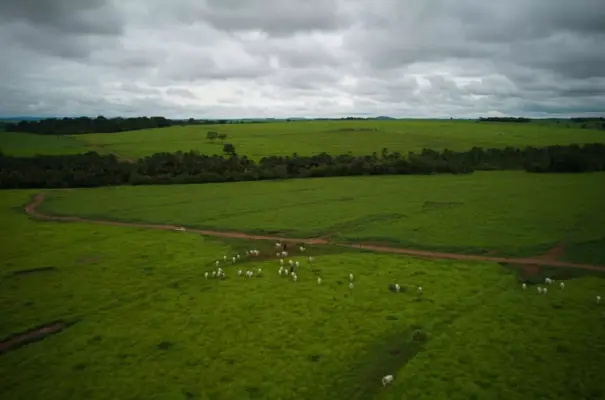
The key is productivity per hectare, not opening new areas of native vegetation to expand production—a concept known as sustainable intensification. According to Embrapa Gado de Corte, the national cattle herd more than doubled over four decades. Data consolidated in the Tropical Sustainable Agriculture report show that while the area occupied by pastures remained stable—between 160 and 190 million hectares—beef production increased by over 240%, rising from about 3.5 million to 12 million tonnes of carcass equivalent (TEC).
This phenomenon produced what experts call the land-sparing effect. Without it, an estimated additional 397 million hectares would have been needed to sustain current production levels if productivity had remained at 1990 levels. Considering a longer timeframe—from 1950 to 2006—the estimate reaches 525 million hectares. To give an idea of the magnitude, that area is 25% larger than Brazil’s Amazon biome.
Recovering degraded soils also involves better pasture management, which allows producers to turn unproductive land into highly nutritious areas for animals.
According to Embrapa, revitalizing soil not only improves animal welfare but also turns it into a carbon sink. Systems like Crop-Livestock Integration enable production of meat and grains in the same space, for example. This can reduce the need for costly feed supplements and other inputs, favoring the use of organic and healthier materials; it also offers economic benefits to producers, who, by maximizing land use, gain multiple revenue streams and a more stable cash flow throughout the year.
Precision nutrition: science at the trough

While soil management handles the foundation, precision nutrition handles performance. A study published in the Journal of Animal Health and Production shows that precision feeding led to a 42.86% reduction in feed waste and an 18% increase in daily weight gain in feedlot systems.
Automation technologies were validated by a study carried out by the Centro Integral de Nutrição de Pecuária de Corte (CINPEC). According to researchers, 87% to 91% of production costs in feedlots relate to animal nutrition; with sensors and automated individual measurements it becomes possible to understand each animal’s real feed conversion, eliminating the “batch average.”
Another technical guide, published in the Journal of Information Systems Engineering & Management, explains that the use of boluses, GPS collars and predictive algorithms allows rations to be reformulated based on growth stage and health status, potentially reducing unnecessary protein intake by up to 25%.
Circularity is also a strategy for efficiency and sustainability
Principles of the circular economy also integrate efficiency and sustainability in Brazilian livestock. Driven by initiatives like the National Circular Economy Plan (PLANEC), the sector is reusing manure and other organic residues to produce biogas, biomethane and biofertilizers, reducing emissions and optimizing resource use.
In this way, the model closes production cycles: what was once an environmental liability becomes a source of energy, soil fertility and operational efficiency. Biodigestion, for example, captures methane and converts it into energy, while the remaining material returns to the soil as organic fertilizer, reinforcing nutrient cycling.
Beyond environmental gains, circularity strengthens competitiveness by lowering costs, reducing dependence on external inputs and generating measurable performance indicators. In this context, efficiency becomes a market attribute aligned with increasingly stringent international requirements—consolidating sustainability as a direct value driver for Brazilian livestock.
Water management: efficiency also passes through water
The pursuit of greater efficiency in livestock also involves more strategic water use, one of the central resources for food production. In practice, this means reducing waste, improving distribution and adopting technologies that allow greater control over consumption, since the decisive factor for pastures—the rainfall regime—is outside the producer’s control.
More efficient watering systems, proper pasture management and soil recovery help increase infiltration and water retention, reducing the need for external abstraction and making properties more resilient to drought periods.
Additionally, strategies such as water reuse and integration between production systems optimize resource use along the entire chain, avoiding losses and increasing efficiency per unit produced.
The ability to measure, monitor and optimize water use adds to other efficiency indicators, reinforcing the concept of “doing more with less” as the basis for the sustainability and competitiveness of livestock.
Learn more: Water efficiency in livestock production: sustainability as a strategy for the future
Renove program seeks to facilitate the transition
From eyeballing management to data- and precision-driven systems, there is a trajectory that is not traveled the same way by everyone. For small and medium producers, the journey is more challenging due to technical, financial and information-access limitations. It is in this context that programs like Minerva Foods’ Renove make a difference.
By offering technical training and practical guidance, the initiative helps reduce asymmetries and enable the adoption of more efficient technologies and practices on the farm, aiming to promote low-carbon livestock and regenerative practices in South America, with a focus on transforming farms into more productive and sustainable units.
As part of the program, producers receive specific training on regenerative practices such as pasture management, recovery of degraded soils and sustainable intensification, and systems like Crop-Livestock-Forest Integration (ILPF), which contribute to increasing properties’ climate resilience.
Thus, the transition to more efficient production models becomes a practiced reality and generates management and performance gains. At the same time, adopting these initiatives helps meet increasingly demanding market criteria, expanding access to global chains and premium markets, such as the European Union.
In this context, efficiency and sustainability converge as competitiveness vectors. Producing more with less consolidates, then, as a strategy that articulates productive gains, impact reduction and qualified insertion into the international market.
It is, therefore, a win-win strategy where science and technology work to optimize what nature already provides. By embracing precision nutrition, regenerative management, and intelligent use or reuse of resources, the productive sector proves that tomorrow’s profitability is intrinsically linked to today’s preservation.
Sources:
- The pilot beef traceability project created by Brazil and China
- Strategies for Recovery and Renovation of Degraded Pastures in the Cerrado
- Economic, social, human and environmental impacts of degraded pasture recovery in Brazil
- Impact of Precision Livestock Farming on Animal Welfare and Productivity
- Precision livestock with Intergado Efficiency highlighted at CNPA 2025
- Using Precision Feeding to Improve Livestock Health and Profit Margins: A Nutritional Risk Management Strategy
- Route Optimization of Multimodal Transport Considering Regional Differences under Carbon Tax Policy
- Practical uses of blockchain technology in livestock