
Share


Seeking to combine family well-being with environmental preservation, the Uruguayan project “Ganadería y Clima”, promoted by the Food and Agriculture Organization of the United Nations (FAO) in partnership with local ministries, demonstrated that implementing climate-smart livestock practices on native grasslands yields significant financial and ecological results.
About 60% of producer households managed to significantly increase their net income, according to a report by the FAO from 2022. The results show an average 7% reduction in costs, as well as an average increase in income of approximately 50% in the project’s first year. Additionally, cattle production per hectare rose by an average of 10.3% and sheep production by 15%.
The transformation process began with the support of rural extension agents, professional consultants who work individually with the families (more than 60 in total) to analyze each farm’s situation, identify their goals and support them in achieving them. As many properties suffered from low productivity due to forage shortages for the herd and the presence of degraded soils, producers learned strategies focused on improving the soil and managing natural resources more sustainably. The major asset was increasing the availability of forage, which proved essential to improving the efficiency of the entire system, even when facing recent adverse climatic conditions such as severe droughts and water scarcity.
Forage planning consists of the technique of adjusting the amount of forage offered to the animals’ body condition and avoiding overgrazing. In this way, livestock is not kept in the same area to the point of degrading it. Thus, the potential for natural regeneration of the vegetation cover increases, with the consequent expansion of the photosynthetic area of the pastures and carbon retention in the plants’ leaves and roots.
This combination of factors resulted in a 16% reduction in the intensity of greenhouse gas emissions per kilogram of meat, proving that climate adaptation goes hand in hand with productive efficiency. In addition to mitigating emissions, this practice also produced a visible increase in flora, bird presence and overall biodiversity on the properties.
International symbiosis
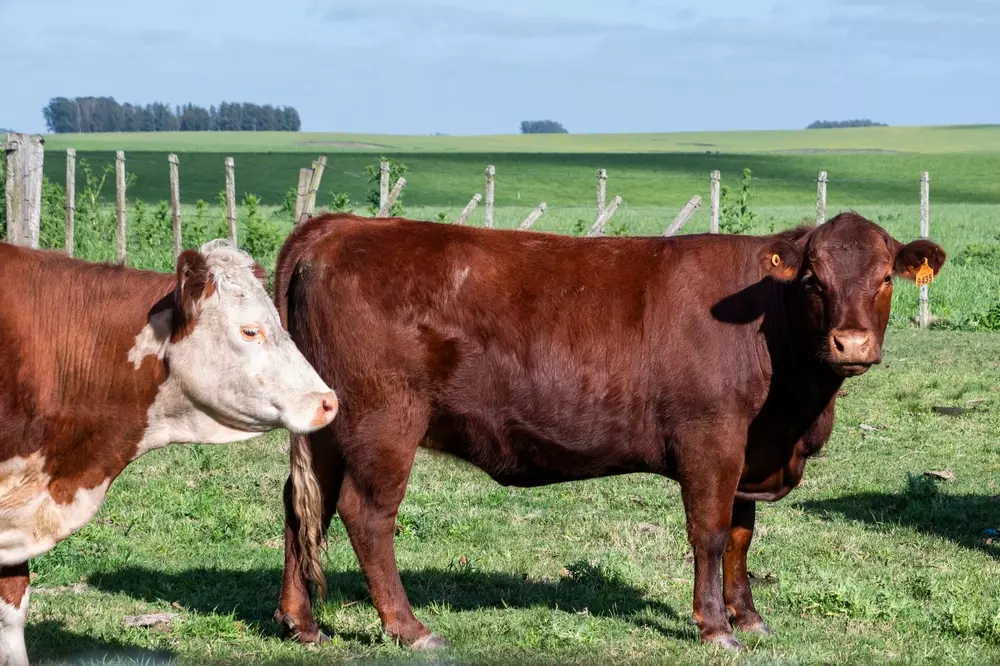
The case of success shows that the livestock of the future does not need to expand into large areas to maintain productivity, but rather requires applied intelligence. For producers, this means more arrobas and greater herd resilience in years of extreme climate events; for the sector as a whole, progress is tied to the consolidation of production models that combine economic performance with a reduced environmental footprint and the generation of added value.
In Brazil, the Plano ABC+ (2020 – 2030) stands as the main public policy aligned, to some extent, with the Uruguayan model, by articulating productive targets and climate commitments. Coordinated by the Ministry of Agriculture, it promotes technologies that increase productivity while reducing GHG emissions.
Its main pillars are the recovery of degraded pastures, Crop-Livestock-Forestry Integration (ILPF), sustainable management, biological nitrogen fixation in the soil, planted forests and agroforestry systems. Implementation occurs primarily through economic and financial instruments, with emphasis on specific lines of credit within the Plano Safra, aligned with national mitigation targets.
Despite convergences in terms of guidelines, there are structural differences between the ABC and Ganadería plans: while the Uruguayan government targets family farmers directly, offering continuous technical assistance and detailed environmental monitoring, the Brazilian policy functions as a broad-based program, covering different producer profiles and production systems, with greater flexibility but a lower degree of individualized targeting.
Sources: