Share


According to the official population estimates and projections of the United Nations Department of Economic and Social Affairs (UN DESA), revised in 2024, the world population is expected to reach around 9.7 billion in 2050. This scenario, combined with the growing limitation of natural resources and pressure on production systems, poses profound challenges to global food security – one of the 17 UN Sustainable Development Goals.
Already known as the “breadbasket of the world”, Brazil has the potential to meet this demand with productivity, efficiency and sustainability.
8.2 billion people and strained resources
Considering that in 2025 the global population is estimated at 8.2 billion, the projected increase over the next 25 years represents growth of approximately 18%. Although the population growth rate over the last 25 years has been around 34% — highlighting a slowdown as a result of declining fertility rates in several regions — the fact that agricultural land, fertile soils and water resources are increasingly scarce and degraded makes the scenario challenging for food security.
A study by the Food and Agriculture Organization of the United Nations (FAO) shows that land, soil and water systems are “at a breaking point” due to unsustainable use, undermining agricultural productivity.
According to the document, “human-induced degradation affects 34% of agricultural land”. This information is corroborated by the second edition of the Global Land Outlook, published by the United Nations Environment Programme (UNEP), in collaboration with FAO and the United Nations Convention to Combat Desertification and Mitigate the Effects of Drought (UNCCD, in its English acronym). The report shows that between 20% and 40% of the world’s land area is degraded or in the process of degrading to varying extents and degrees.
The limitation of productive land and soil degradation are growing obstacles to the expansion of agricultural and livestock production. As a result, demand for food tends to grow at a faster pace than the expansion of new arable areas — which today is practically stagnant due to the limitation of available land and the need to preserve natural ecosystems.
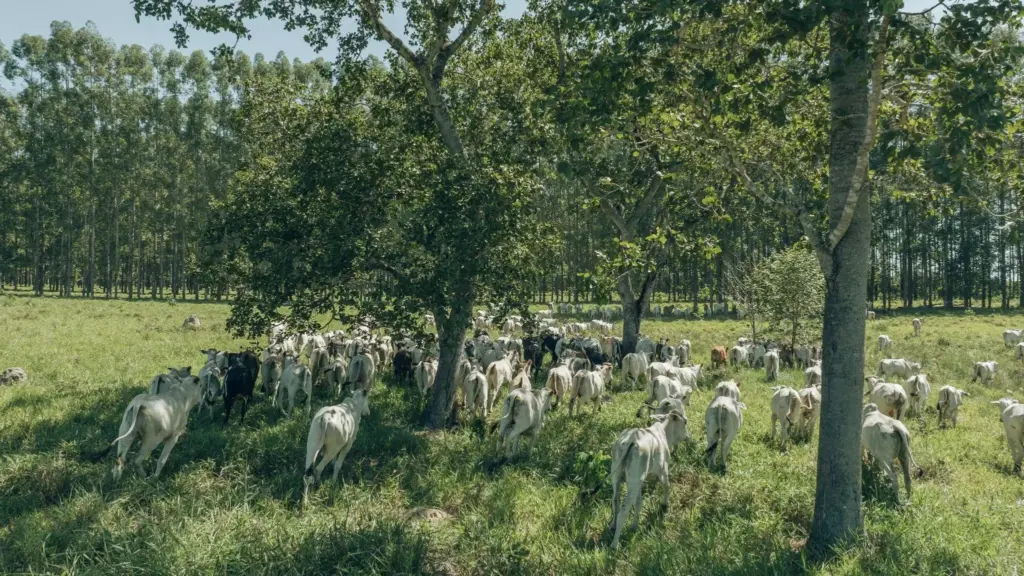
Photo: Minerva Foods
Food security in the context of a growing world population
In this scenario, the challenge of feeding a growing world population in a safe and sustainable way places Brazil in a leading role. Known as the breadbasket of the world, the country is the largest exporter of beef and the second-largest producer. By exporting to more than 160 countries, it demonstrates its ability to meet different demands, including the most stringent ones, whether in terms of sustainability, food safety or product quality.
Brazil’s leading role
This leading position stems from a rare combination of factors, starting with nature itself. Brazil has favorable natural conditions, such as an abundance of fresh water, plentiful rainfall, a tropical climate and vast consolidated agricultural areas.
Supported by significant technological advances in agricultural and livestock production, the country has increased its productivity without the need to convert new areas, as demonstrated by the “Efeito Poupa-Terra”, an indicator of Brazilian agricultural efficiency recognized by FAO and the Institute for Applied Economic Research (Ipea).
This result is driven by continuous investment in genetic improvement, sustainable pasture management, crop-livestock-forestry integration (ILPF) and the rational use of bio-inputs — practices that reduce greenhouse gas emissions, regenerate soil, promote resource circularity and generate other benefits.
In addition, a predominantly renewable energy matrix and international recognition in low-carbon practices strengthen Brazil’s credibility as a strategic supplier of food, fiber and energy in a world that simultaneously seeks food security and environmental sustainability.
Food security and technology as the engine of Brazil’s leadership
The growth of Brazilian livestock farming has occurred not only in scale, but also in efficiency, sustainability and quality. This progress is the direct result of continuous investment in technology, traceability and animal health.
According to the GS1 Brasil Agrotech Index 2025, over the last five years the adoption of technology in the field has grown significantly, with emphasis on automation, remote monitoring and precision nutritional control. Considering the different stages of the cycle, including soil preparation and management, as well as herd rearing and feeding, livestock farming has recorded a 29% increase in automation.
These innovations are reinforced by public and private programs such as the Plano ABC+, which promotes low-emission practices, and Minerva Foods’ Renove Program, which drives sustainable, profitable and low-carbon agriculture and livestock.
The combination of agricultural tradition and science also leads to significant advances. As the UN highlights in its context for SDG 2 – food security and nutrition and sustainable agriculture – “there are many elements of farmers’ traditional knowledge that, when enriched by the latest scientific knowledge, can support productive food systems through solid and sustainable management of soil, land, water, nutrients and pests, as well as broader use of organic fertilizers.”
Traceability: a new advance underway
One ongoing advance is traceability, which is no longer a competitive advantage and is becoming a requirement.
Currently, Brazil already has two official tracking systems for livestock: the Brazilian System of Identification and Certification of Bovine and Bubaline Livestock (SISBOV), which arose from a demand by the European Union and later expanded to other markets, and SISBOV 076, applied to live animals destined for international markets. The number 76 is a national identifier for every traced Brazilian bovine, followed by 12 digits. Registration is carried out using implantable microchips, electronic ear tags, intraruminal boluses or buttons, which allow radiofrequency reading.
Although they represent an important step forward in transparency and sanitary control, these systems still need to evolve in terms of integration, coverage and digitalization. That is precisely what the National Livestock Traceability Plan, launched in 2024 by the Ministry of Agriculture and Livestock (Mapa), aims to address, by establishing a unified national platform and gradual adherence targets through 2032.
The measure is intended not only to meet new requirements from international markets – such as the European Union, which will start demanding proof of zero deforestation – but also to add value to Brazilian beef, reinforcing its image as a safe, sustainable and competitive product.
Between potential and challenges
According to the OECD-FAO Agricultural Outlook 2024–2033, Latin America and the Caribbean play a central role in global food supply. Between 2021 and 2023, the region accounted for 13% of the net value of global agricultural and fisheries production and 18% of total exports, a result driven mainly by South America. The document highlights that “given its favorable resource conditions, Latin America and the Caribbean are major contributors to world agriculture”, underscoring the potential of the bloc — and especially Brazil — as a strategic supplier of food on a global scale.
Projections indicate that Brazil, like the United States, will each account for around 20% of global meat exports by 2033, consolidating Brazil’s role in this global chain.
The future competitiveness of the region, however, will depend on factors such as efficient use of inputs, openness to trade and effective strategies for mitigating and adapting to climate change.
At the same time, FAO warns that land, soil and water are under severe pressure, requiring gains in productivity and efficiency (rather than simple expansion of area) to sustain the global food supply. In Brazil’s case, production potential is reinforced by structural advantages such as the availability of fresh water (around 12% of the planet’s surface reserves, according to OECD/ANA studies) and by recent gains in competitiveness and scale in animal protein, with record beef exports reported by sector entities.
Food security and internal challenges to be overcome
To consolidate this leading role, however, Brazil — like its neighbors — must overcome persistent structural and social challenges. The FAO report recalls that “food security is an ongoing challenge” and that the advances achieved since the early 2000s began to reverse after 2014, when progress in poverty reduction stalled.
The combination of successive crises, such as the COVID-19 pandemic, the war in Ukraine, food inflation and rising living costs, has increased food vulnerability throughout the region, especially affecting women and rural populations.
Although economic recovery and social protection programs have mitigated part of the impact, the document points out that inequality, macroeconomic instability and dependence on external trade continue to limit the pace of improvement.
With regional GDP per capita projected to reach US$10.9 thousand by 2033, still 20% below the global average, the OECD and FAO conclude that future growth will depend on consistent policies for social inclusion, economic stability and environmental sustainability.
Brazil’s potential as a food provider to the world is clear, but realizing it requires reducing inequality, strengthening productive resilience and maintaining a balance between competitiveness and environmental preservation.
References:
- World Population Prospects 2024
- The State of the World’s Land and Water Resources for Food and Agriculture – Systems at breaking point
- Global Land Outlook
- De celeiro do mundo a provedor de soluções: o desafio do Brasil na COP30
- Com Efeito Poupa-Terra, pecuária bovina brasileira cresce sem pressionar florestas
- Sustentabilidade que vem de berço
- ILPF é estratégia para reduzir emissões na agropecuária e ampliar acesso ao mercado de carbono
- Upcycling bovino: gado transforma recursos não comestíveis em proteína de alto valor
- Blockchain, satélites e IA: a origem da carne no radar
- Rastreabilidade no agro: 10 motivos para investir agora
- Food security and nutrition and sustainable agriculture
- OECD-FAO Agricultural Outlook 2024-2033
- The state of the world’s land and water resources for food and agriculture: Systems at breaking point
- Water Resources Governance in Brazil