

Share


When comparing the environmental impact of different foods, the most commonly used indicator is straightforward: kilograms of CO₂ equivalent per kilogram of product. This metric has the advantage of being clear and comparable. The problem is that it overlooks a fundamental variable: the nutritional composition of that kilogram. One kilogram of beef and one kilogram of lentils do not provide the same nutritional package to the human body. By disregarding this difference, environmental comparisons based solely on mass create distortions that influence public debate, food policy, and market decisions.
Over the past decade, academic researchers have developed an alternative methodology specifically designed to address this gap: Nutritional Life Cycle Assessment (nLCA).
What mass-based metrics fail to capture
The most frequently cited reference study in this debate is that of Poore and Nemecek, published in Science, which analyzed data from 38,700 farms across 119 countries. Its findings are clear: beef has, on average, one of the highest carbon footprints per kilogram of product and per kilogram of protein among food categories. The study is widely used as an argument against meat consumption, and its data are valid within the scope for which they were produced.
What the per-kilogram metric does not capture, however, is protein quality and micronutrient bioavailability. People do not eat to consume kilograms of food; they eat to obtain the nutrients they need. And those nutrients are not distributed equally across foods. As noted by Our World in Data, the metrics used by Poore and Nemecek were calculated based on mass and total protein, but total protein and bioavailable protein are not the same thing.
Protein quality matters—and it can be measured
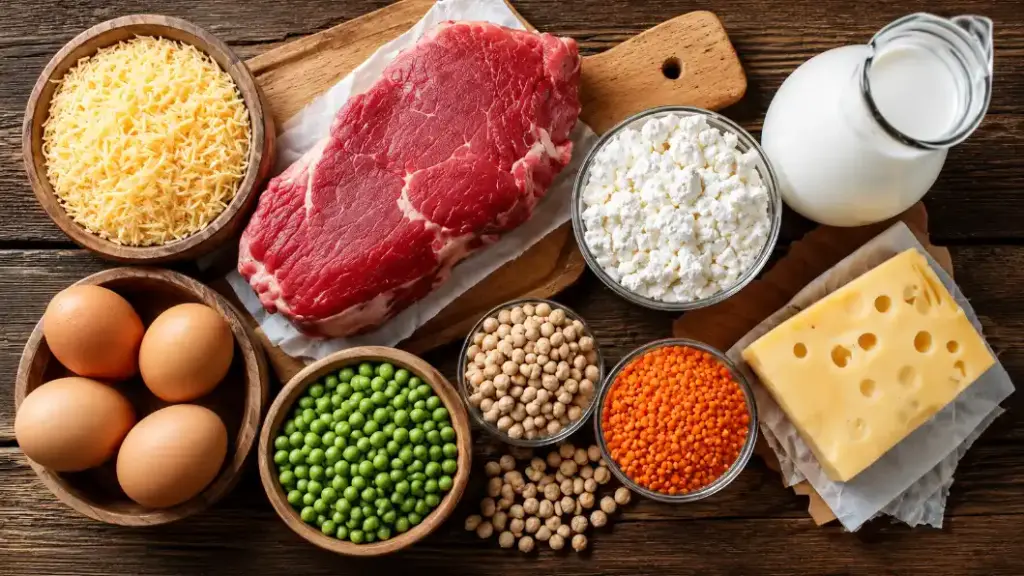
Digitally generated image
The indicator recommended by the World Health Organization (WHO) for measuring protein quality is the Digestible Indispensable Amino Acid Score (DIAAS), although it is not currently the standard used by Brazil’s National Health Surveillance Agency (Anvisa) for nutrition labeling. This scale considers not only the quantity of protein in a food but also its digestibility—that is, how much of this macronutrient can actually be absorbed by the human body—as well as the profile of essential amino acids that the body can effectively utilize.
A review published in Critical Reviews in Food Science and Nutrition found that animal-source foods consistently achieve higher DIAAS values than plant-based foods. The authors concluded that none of the alternative protein sources examined were able to reach DIAAS values comparable to animal proteins, with the exception of soybeans (DIAAS > 90%), soy-based meat analogues (DIAAS = 107%), and mycoproteins produced from the cultivated fungus Fusarium venenatum (PDCAAS = 100%).
To illustrate, lentils, peas, and chickpeas typically present DIAAS values ranging from 46% to 73%, while beef scores between 92% and 130%, providing all essential amino acids in adequate amounts, according to an article published in PMC. This difference is also related to the lower digestibility of grains compared with meat, since the thick and resistant cell walls of legumes can limit protein absorption when the plant tissue is consumed intact.
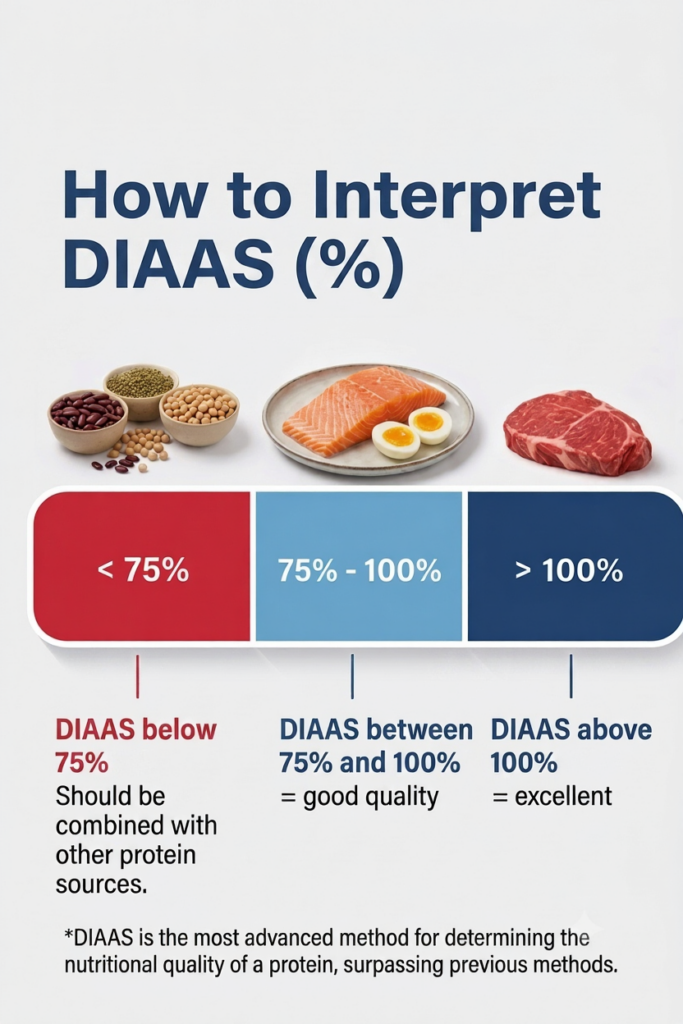
According to FAO classifications, proteins can be categorized as follows:
Professor Michael Lee’s work: a new metric
It was precisely this gap that Professor Michael R. F. Lee, a researcher in sustainable livestock systems at Harper Adams University, sought to address. In research published and presented at a Sustainable Food Trust conference, Lee proposed incorporating Recommended Dietary Intakes (RDIs) as the functional unit in life cycle assessment. In other words, instead of asking, “How much CO₂ is emitted to produce one kilogram of beef?”, the question becomes, “How much CO₂ is emitted to provide the amount of this food required to meet a person’s nutritional needs?”
When this adjustment is applied, the results change substantially. As reported by Farmers Weekly, when nutritional density is taken into account, grass-fed beef showed lower Carbon Dioxide Yield per kilogram of digestible protein (RDI-based) than free-range chicken—reversing the ranking suggested by mass-based metrics. Harper Adams University summarized Lee’s central argument as follows: “Beef may have a larger environmental footprint per unit of mass, yet still be part of a sustainable diet because of the key nutrients it provides.”
The scientific field of nLCA: a decade of development
Lee’s work is part of a rapidly expanding scientific field. In 2018, Graham McAuliffe, Taro Takahashi, and Lee published the first systematic framework for incorporating nutritional value into life cycle assessments of livestock systems in Food and Energy Security, using data from seven production systems involving cattle, sheep, pigs, and poultry. The results showed that incorporating nutritional density as the functional unit can dramatically alter relative emissions rankings across production systems, with cattle outperforming pigs and poultry in some scenarios.
In a review published in 2023 in Food and Energy Security, the research team summarized six years of methodological development in Nutritional Life Cycle Assessment (nLCA), demonstrating how the choice of functional unit—mass, total protein, DIAAS-adjusted protein quality, or a set of RDIs for multiple nutrients—can produce markedly different results. An editorial published in Frontiers in Sustainable Food Systems highlighted that nLCA has emerged as a consolidated subfield of Life Cycle Assessment (LCA), focused on exploring the relationship between nutrition and environmental performance, and argued that food system decisions cannot be confidently guided using only mass, volume, or land area as measurement units.
A recent synthesis published by the European platform FoodTimes summarized the issue succinctly: protein quality is essential, yet often overlooked in nLCA studies. When DIAAS is incorporated as an adjustment factor, the carbon footprint and land-use results for animal-source foods become closer to those of plant-based foods than mass-based metrics alone would suggest.
The micronutrient challenge: bioavailability is not the same across foods
A food bioavailability review published in the National Library of Medicine reports iron absorption rates of approximately 20% for ruminant meats, 15% for other animal-source foods, and only 10% for plant-based foods. This reflects the difference between heme iron, which predominates in meat, and non-heme iron, which predominates in plants. For zinc, phytates present in legumes and cereals reduce absorption compared with animal-based sources.
This means that larger quantities of plant-based foods may be required to provide the same amount of bioavailable iron and zinc supplied by a serving of beef. Producing those larger volumes requires additional land, water, and agricultural inputs.
An analysis published in the National Library of Medicine that modeled optimized diets to meet the nutritional requirements of different population groups in the United States concluded that, when nutrient bioavailability is considered, animal-source foods—including beef—consistently appear in the lowest-cost and most nutritionally efficient dietary patterns.
Why this matters beyond research
The choice of measurement unit is not merely a technical issue. It directly influences how public debates are framed, how food policies are designed, and how public and private funding for agricultural research is allocated. If the dominant metric underestimates the nutritional efficiency of beef while overestimating that of plant proteins, it may not fully reflect differences in nutritional density and bioavailability, potentially leading to policies based on incomplete assessments.
nLCA does not solve every question—it does not replace traditional metrics but rather complements them. What it offers is a broader perspective on the trade-offs between environmental impact and nutritional value delivered by different food systems.
This does not mean livestock production should not reduce its emissions. It means that the comparisons used to guide that transition must be methodologically robust, and that a metric that ignores what is contained within the kilogram being measured may, on its own, be insufficient to support decisions with such far-reaching consequences.
- Drewnowski A et al. – Considering the nutritional benefits and health implications of red meat in the era of meatless initiatives (PMC, 2025)
- Drewnowski A et al. – The Role of Beef for the Lowest Cost and Adequate Provision of Bioavailable Nutrients in Modeled Diets at a Population Level in the United States (PMC, 2025)
- Estevez M et al. – Protein transition: focus on protein quality in sustainable alternative sources (Critical Reviews in Food Science and Nutrition, 2024)
- Farmers Weekly – Nutrient-dense beef production emissions lower than chicken (2020)
- Frontiers in Sustainable Food Systems – Editorial: Pushing the Frontiers of nutritional Life Cycle Assessment (nLCA) (2024)
- Harper Adams University – New research shows how temperate grassland beef provides key nutrients for human health – and could help reassess its environmental impact (2021)
- Lee MRF – Perfil acadêmico: Harper Adams University, Deputy Vice Chancellor
- LinkedIn – Professor Michael R. F. Lee, Harper Adams University
- McAuliffe GA, Takahashi T, Lee MRF et al. – A commentary on key methodological developments related to nutritional Life Cycle Assessment (nLCA) (Food and Energy Security, 2023)
- McAuliffe GA, Takahashi T, Lee MRF et al. – Framework for life cycle assessment of livestock production systems to account for the nutritional quality of final products (Food and Energy Security, 2018)
- Nutritional LCA: the next step in measuring food sustainability (FoodTimes, 2025)
- Our World in Data / Hannah Ritchie – FAQs on the environmental impacts of food (2022)
- Poore J, Nemecek T – Reducing food's environmental impacts through producers and consumers (Science, 2018)
- Vossenaar M et al. – Priority Micronutrient Density in Foods (PMC, 2022)