Share


Browse the content:
- Leaders are not born: links in the chain need to be close to move forward
- Predictability, a shared wish and challenge
- Governance brought more security, but there is still room to improve
- From trust to applied intelligence
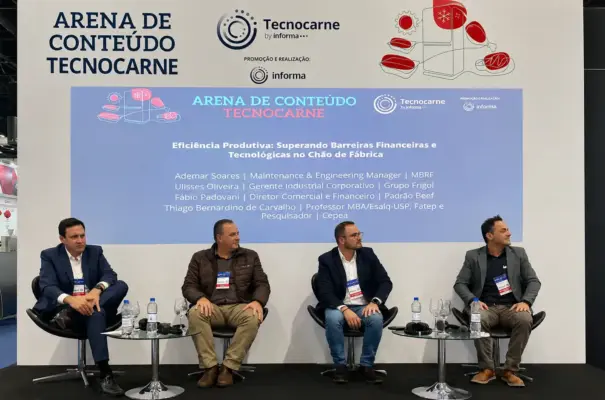
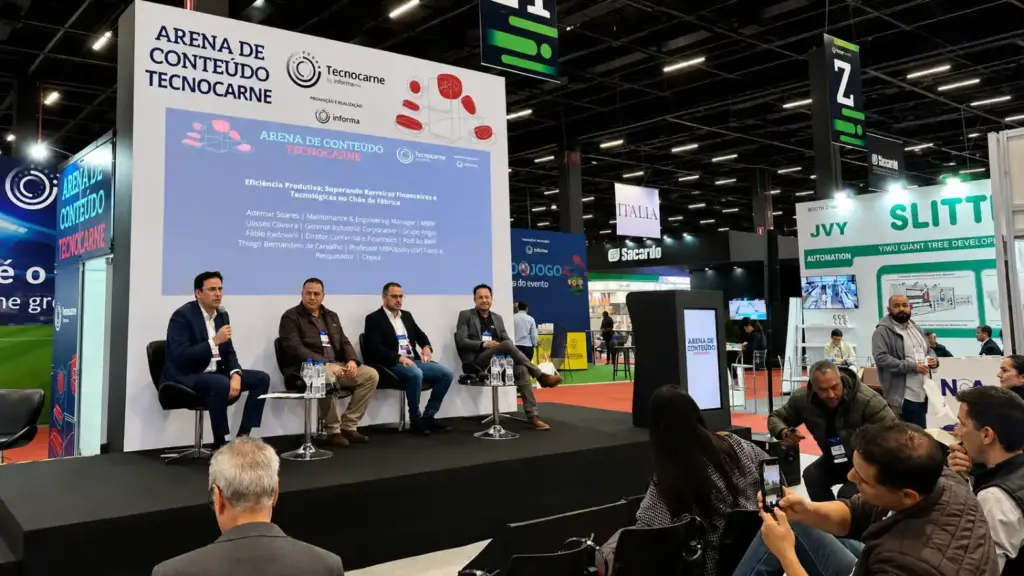
It took Brazil decades to establish itself as the world’s largest beef exporter, after starting out as a country that needed to import the meat. Along this journey, it developed an ability to adapt that today allows quick responses to new market demands. Producers’ adjustment to the requirements imposed by China became one of the main examples presented during the panel Industry and its Indicators: The Meatpacking Industry in the Past, Present and Future – Challenges and Opportunities, held at Tecnocarne in São Paulo on June 16 and 17.
“The China steer is a good example of how quickly the market can adjust. That steer didn’t exist in Brazil,” said Juan Lebrón, head of the International Department at the Brazilian Association of Zebu Breeders (ABCZ). “Then this steer appeared with age requirements, among other specifications, and producers responded with absurd speed.”
For Lebrón, the experience shows the Brazilian producer’s ability to adapt in step with the chain’s evolution. The challenge, he said, lies in building mechanisms capable of translating market demands into clear, objective and predictable information. “When there is a demand that is complete, predictable and objective, the producer responds,” he summed up.
Leaders are not born: links in the chain need to be close to move forward
“Brazil did not wake up a leader,” Lebrón said. “What built that was the producer, industry and research.” His remarks sum up the transformation of Brazilian cattle ranching over recent decades, directly linked to the sanitary advances that began in the 1990s, especially in the fight against foot-and-mouth disease. This progress allowed the country to reach increasingly demanding markets and consolidate its position as a global leader in beef exports.
It was in this context that the debate raised a reflection on the need to bring the different links in the production chain closer together. “If there is no clarity about what is wanted, who it is for and what I have to produce, we need to organize this chain in general so that everyone understands a bit about the other,” Lebrón said. “There is a lack of knowledge between the parties, a need to better understand what the other does.”
This closeness becomes even more important in a scenario in which different markets demand specific standards for production, traceability, animal age and sanitary requirements.
Predictability, a shared wish and challenge
Predictability emerged as one of the central topics in the debate, both for producers and for the industry. “The biggest desire is predictability,” Lebrón said.
According to him, this need has become even more evident with the growth of feedlots in Brazil, a system that requires upfront investment in feed, management and production infrastructure. “If you get that predictability from the buyer, including on price, you can see your margin and know that you can invest in something that will have a safe return. Everything becomes easier,” he explained.
The industry, however, also depends on that certainty. “The greater the closeness between industry and producer, the greater the possibilities of predictability for everyone in this market,” he added.
Paulo Mustefaga, consultant and institutional relations director at the Brazilian Association of Meatpackers (Abrafrigo), noted, however, that this search for stability takes place in an environment subject to numerous external variables. In addition to the sanitary requirements imposed by strategic markets such as China, the sector deals with geopolitical swings capable of altering logistics costs and trade routes. “We are talking about a market that detects a substance and that company is suspended. If it is the main buyer in a state, all predictability goes down the drain,” he observed.
Governance brought more security, but there is still room to improve
Predictability has advanced in recent years because of changes in the structure of meatpacking companies themselves. According to Lebrón, the relationship between cattle ranchers and industry was once marked by greater uncertainty, especially in the 1980s and 1990s, when there was a higher risk regarding companies’ liquidity. “Today you have much greater security, and the opening of capital was a huge transformation, by gaining transparency and security,” he said.
The move by large meatpackers to go public, intensified in the 2000s, brought with it requirements related to earnings disclosure, independent audits, internal controls and stronger corporate governance practices, helping to build trust among the different agents in the chain.
In the executive’s view, although this process has improved the average relationship between producers and industry, the way animals are purchased has changed little over time. “The average has improved, but the way of buying remains the same. There is a lack of a bit of intelligence placed within this buying process,” he observed.
From trust to applied intelligence
In Lebrón’s view, there is still room to improve how animals are assessed and how this information is fed back to producers, allowing more precise adjustments to production systems. “The industry’s weakest intelligence lies in buying intelligence,” he said.
According to him, despite advances in governance and transparency, many decisions are still based on buyers’ individual experience, as they need to assess production traits, farming systems and regional supply patterns. “You buy what is offered to you,” he said.
For the executive, there is room for tools to monitor more precisely the animals’ yield, the returns obtained by the industry and the raw material’s compliance with the requirements of different markets. In addition to improving buying decisions, this type of information could help producers identify opportunities for improvement and direct investment toward serving specific markets. “The biggest difficulty for a cattle buyer is managing the relationship between producer and industry,” he summed up.
It is precisely in this gap that initiatives focused on knowledge sharing and technical support can help bring the links in the chain closer together. At Minerva Foods, the Laço de Confiança program seeks to replace a relationship based exclusively on buying and selling with an ongoing agenda of training, active listening and exchange of experiences between industry and suppliers. In an article about the program, the company’s executive manager of Cattle Rancher Relations, Rostyner Costa, said he believes that “the sector evolves when there is trust and cooperation between industry and rural producers.” The initiative offers support in areas such as animal nutrition, sanitary management, farm management and herd traceability, as well as field days, training sessions and technical visits tailored to the specific needs of each region.
At the end of the debate, participants converged on the same conclusion: in an increasingly globalized chain subject to rapid change, the competitive edge may lie less in the ability to increase production and more in the ability to build trust-based relationships, share information and establish common goals among producers, industry and consumers.