
Share


From the consumer who chooses only a few cuts at the supermarket to the cattle rancher who must decide in advance when to market his animals, the beef supply chain brings together agents who operate at different paces, respond to different market signals and live with thin margins. Coordinating these stages has become one of the main challenges to increase the sector’s competitiveness.
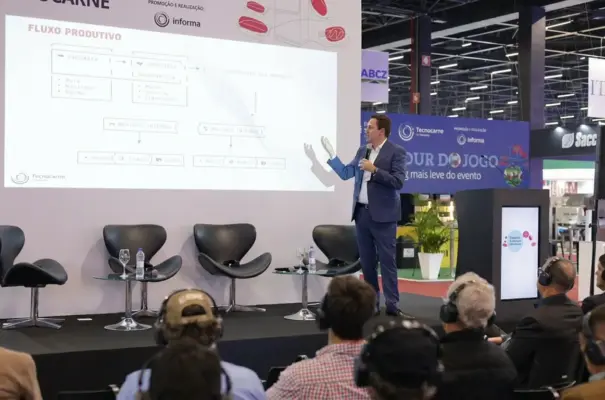
This was one of the main points presented by Thiago Bernardino de Carvalho, a researcher at the Center for Advanced Studies in Applied Economics (Cepea) and a professor at Esalq/USP and Fatep, during the lecture From Pasture to Plate: an analysis of efficiency in the production, industrial and commercial links, held at Tecnocarne in São Paulo from June 16 to 18.
Throughout the presentation, Carvalho showed that the chain’s efficiency does not depend only on the performance of a specific link, but on the ability to integrate decisions made in livestock production, industry, wholesale, retail and even consumer behavior. “You can’t look at just one link,” he summed up.
A chain that operates at different speeds
The path taken by beef to reach the consumer’s plate involves a succession of stages that require planning and synchronization among the different agents in the chain.
According to the researcher, animals can be purchased between two and fifteen days before slaughter, while transport to the processing plant is usually done in a single day. The time animals remain before processing varies from two to three days, and can reach nine days in some cases to reduce the effects of pre-slaughter stress.
After processing, times lengthen again. In the domestic market, meat can take one to four days to reach commercial channels. For exports, the timeframe varies between three and 25 days, and can reach up to 60 days for shipments destined for China.
More than cutting steps, the challenge is to align processes that depend on scheduling, predictability and coordination among different links. This dynamic is also reflected in the chain’s financial flow. While the rancher usually receives payment between two and 30 days after the sale of the animals, retailers can make payments in terms ranging from ten to 120 days.
Carvalho noted that in large-scale operations, the capital required to sustain this mismatch between payments and receipts can reach billions in just one month of activity. “It’s a huge turnover,” he observed.
Exports help balance the carcass

The presentation also drew attention to the complementarity among different consumer markets.
According to Carvalho, European countries concentrate their purchases on roughly five higher-value cuts, while China and Chile predominantly absorb forequarter cuts. The domestic market, for its part, accounts for demand for a variety of other products.
The interdependence between markets means that changes in trade flows affect the profitability of the entire chain. Discussing export dynamics, the researcher provoked the audience by asking how certain cuts would be absorbed if traditional buyers reduced their demand. Beyond increasing exported volume, market diversification helps improve the economic utilization of the whole animal.
The consumer buys cuts, but the chain needs to value the whole animal
Another aspect addressed during the lecture was the difference between how consumers make their choices and how the chain needs to manage the raw material.
Specialty butcher shops tend to concentrate their sales on a few higher-value cuts, while supermarkets have been investing in modernizing their meat counters to win back consumers who migrated to specialized stores.
At the same time, the industry needs to find ways to make the whole carcass profitable. Carvalho noted that sales of the tenderloin (filé mignon) have a significant influence on the profitability of the set of cuts. “When the tenderloin isn’t selling, that surplus causes overall profitability to fall,” he commented.
This trend takes place in a context of changing consumption patterns. As beef prices rise, some consumers have sought substitute proteins, especially chicken and pork. In retail, a 1% increase in the price of beef is associated with roughly a 0.60% increase in demand for chicken and a 0.62% increase in demand for pork. These results are part of a price-elasticity of demand analysis presented by Carvalho during the lecture.
Governance reduces uncertainties in a heterogeneous chain

Besides consumption-related factors, Carvalho emphasized the importance of coordination mechanisms between producers and industries.
Animal procurement strategies include owned herds, forward contracts, which allow predefining conditions such as price and delivery volume, long-term supply agreements and spot market operations, characterized by one-off purchases of animals available for immediate or short-term delivery, still quite common in Brazilian cattle farming.
According to the researcher, the diversity of suppliers, differences between production systems, climate fluctuations and occasional contract breaches increase the complexity of operations. Some companies work with hundreds of suppliers, while others maintain commercial relationships with thousands of ranchers.
Carvalho also stressed that the heterogeneity of production systems makes standardizing raw material more challenging, especially in larger operations with more stringent sanitary and commercial requirements. “There is a lot of complexity in large operations,” he summed up.
Efficiency is a continuous exercise
The study showed that operational efficiency has become a determining factor in a segment characterized by high assets and low profitability.
In the plants analyzed, average use of installed capacity is around 70%, indicating roughly 30% idleness, although there are units operating at levels close to 90%.
The deboning stage was identified as strategic for companies’ results, requiring skilled labor, ongoing training and monitoring of productivity per employee. On average, deboning yields about 76% of the carcass weight. “Small efficiency gains in processes like this can make a difference in a sector that operates with narrow margins,” he highlighted.
Data compiled by the researcher show that the net margin of the sector’s main companies remained between 0.5% and 2.6% in 2025. The researcher also noted that the financial conversion cycle can take, on average, about 20 days, a period during which the company has already purchased animals, financed inventories and supported operations until actual funds from sales are received.
In an environment of narrow margins and high capital needs, productivity gains, technological advances and greater commercial predictability can help increase the competitiveness of the entire chain.
Throughout the presentation, Carvalho reinforced that efficiency is no longer associated only with the individual performance of the production, industrial or commercial links. In an increasingly connected chain, competitiveness has come to mean the ability to coordinate.