Share


Imagine two bulls with the same weight, the same breed and the same time at the feed trough. One of them consumes almost one third less feed and still reaches slaughter with the same weight gain as its companion. It seems contradictory, but the phenomenon has a name and was the subject of a study conducted with young Nelore cattle by researchers at the Federal University of Uberlândia (UFU). It is Residual Feed Intake (RFI), which is at the center of one of the most promising frontiers of Brazilian cattle ranching: genetic improvement aimed not only at the animal that gains more weight, but at the animal that shows better production efficiency, consuming less feed.
What is Residual Feed Intake?
RFI is calculated as the difference between an animal’s actual feed intake and the expected intake based on body weight and growth rate. An animal with a negative RFI is considered “efficient” because it consumes less than predicted to maintain body weight and expected growth. A bull with a positive RFI consumes more than expected for the same result.
The main advantage of RFI over other measures of efficiency, such as traditional feed conversion, is that it is independent of body weight and weight gain. This means that by selecting animals with negative RFI, the producer is not necessarily choosing smaller animals or animals with lower performance, but rather animals that are biologically more economical. As explained in an article published on BeefPoint, screening for RFI selects animals with lower maintenance requirements and lower intake without altering weight gain or adult weight.
What the UFU study showed
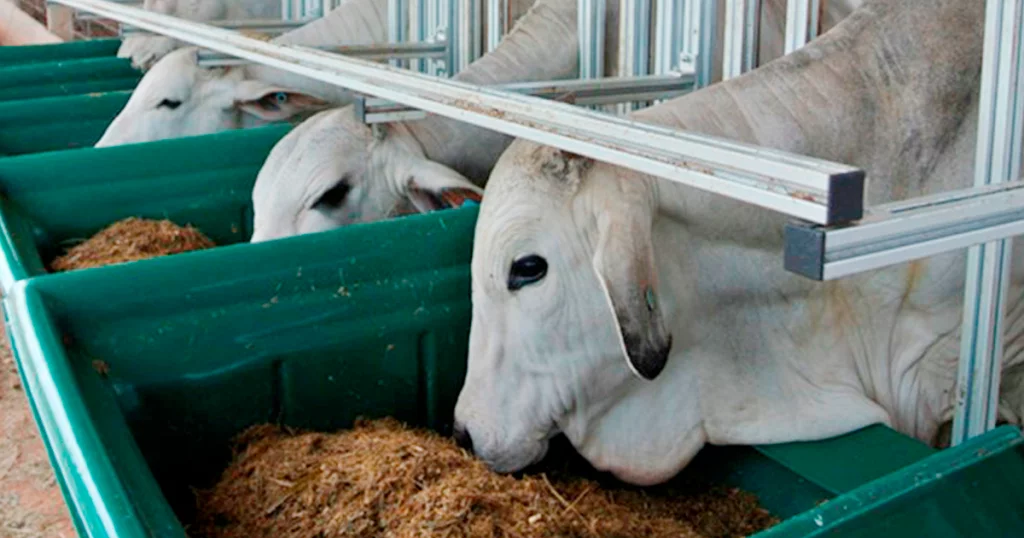
Research conducted at the Fazenda Capim Branco of UFU used the GrowSafe electronic feedlot system, a Canadian technology that identifies each animal via radio-frequency identification (RFID) ear tags and automatically records individual intake, to evaluate young Nelore bulls in 70-day feed efficiency trials.
Results indicate that more efficient animals can consume up to 31.8% less feed during the confinement phase without compromising weight gain. A difference that, at herd scale, represents a significant economic turning point.
Why does this matter so much to the producer’s pocket?
The answer is straightforward: feed accounts for between 70% and 80% of total production costs in confinement systems. Therefore, any reduction in this item has an immediate effect on the producer’s margin.
As explained in a review by the genetic improvement cooperative CRV on using RFI as a selection criterion, this process allows the same production level to be achieved with a lower volume of inputs, which directly improves the system’s competitiveness.
The impact also projects into the long term through genetic improvement. Bulls selected for negative RFI tend to pass this trait to their offspring, enabling lower feed intake without compromising performance.
Selection programs run by the Institute of Animal Science of São Paulo show that the use of Expected Progeny Differences (EPDs) as a selection criterion yields consistent gains across generations, with measurable effects on progeny intake. EPDs refer specifically to the estimate of an animal’s genetic value and indicate the average expected performance of its offspring for a given trait compared to the population mean. In this case, the moderate heritability observed for traits such as RFI and DMI — around 0.22 in the scientific literature — reinforces that feed efficiency responds to genetic selection, consolidating it as a strategic tool to increase production efficiency and reduce costs in beef cattle farming over the long term.
The connection with sustainability
Feed efficiency is not only an economic gain. It also has a direct environmental impact. Animals that consume less feed to produce the same amount of meat inherently generate less waste per kilogram produced: less manure, lower water consumption and reduced pressure on pastures and cropland for feed production.
Research by the Institute of Animal Science of São Paulo, supported by the São Paulo Research Foundation (FAPESP) and the National Council for Scientific and Technological Development (CNPq), concluded that, when comparing animals at the extremes of feed efficiency, the more efficient ones emitted 9% less methane gas and produced 20% less manure than the less efficient ones — with 24% less feed intake.
Moreover, FAPESP studies indicate that RFI shows consistency across different production phases and systems, such as confinement and pasture, reinforcing its potential as a permanent selection criterion in breeding programs.
Brazil and the race for efficient genetics
Nelore is the predominant breed in the Brazilian herd and in RFI research in the country, but the scientific literature available on Scot Consultoria is blunt in stating that countries like Australia and the United States are “about 10 years ahead” of Brazil in this area. The difference lies in the length of accumulated data and the scale of breeding programs focused on efficiency.
The good news is that the movement is accelerating. In addition to research conducted by UFU, initiatives such as those by Qualitas Genetic Improvement incorporate RFI as a pillar in identifying sires. Genomics, which allows RFI to be estimated more accurately and quickly without lengthy testing periods, is beginning to gain traction and has the potential to democratize access to efficiency-based breeding.
And the impact is not limited to confinement: a FAPESP study is also investigating the consistency of the trait in pasture-raised animals, which would pave the way for feed efficiency to help reduce emissions in extensive systems that dominate Brazilian cattle farming.
- Association between feed efficiency and carcass traits in Nelore — SciELO/Arquivo Brasileiro MVZE
- RFI as a selection criterion — Scot Consultoria
- RFI: importance in bull selection — Giro do Boi / Qualitas
- Residual feed intake: a new parameter to assess feed efficiency — BeefPoint
- Effect of selection for RFI on fertility in Nelore heifers — Repositório Unesp (2025)
- Feed efficiency: the new frontier of Brazilian cattle ranching — Carina Ubirajara Bernardes/UFU (Campo Grande News)
- Is Brazilian cattle more efficient at the trough? — CompreRural / Institute of Animal Science SP
- Research assesses methane emissions from cattle — FAPESP Agency
- UFU research — Residual feed intake as a selection tool (2025)
- Nelore Feed Efficiency Test at UFU — Giro do Boi / Canal Rural
- Use of RFI as a selection criterion — CRV