Share


“The woman has always been there, actually. It’s not now that she started being part of agribusiness. It’s just that she stayed very much in that parallel, shadow role.” That sentence helps explain why, even with a family history tied to cattle ranching for four generations, Stéphanie Ferreira Gobato chose a different path to “return” to the countryside: not out of nostalgia for the farm as a vacation spot, but from unease about what she saw around her. Degraded pasture, drought repeated year after year and a cattle industry that, for her, needed to be treated like a business. “If that place paid for my studies up to then, it was there I needed to professionalize.” It was from that discomfort that she decided to study agronomy.
The “girl” with the little backpack in the producers’ room
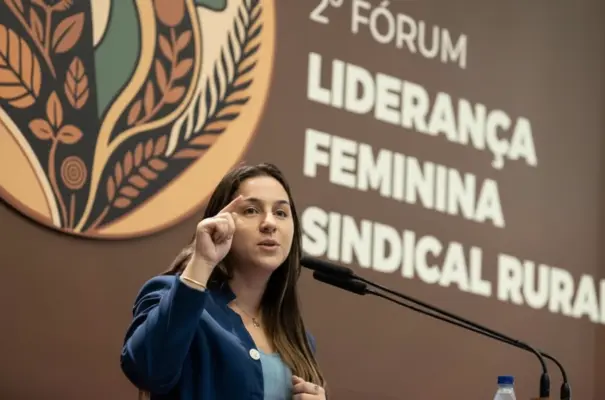
An agronomist, Stéphanie works in management and sustainable development for beef cattle through her company. She is an alumna of leadership training programs for agribusiness, CNA Jovem and Líder MS. She sits on the board of the Rural Union of Três Lagoas/MS and the Sistema Famasul – Federation of Agriculture and Livestock of Mato Grosso do Sul. Today, she presides over the National Commission of Women in Agribusiness of the Confederation of Agriculture and Livestock of Brazil (CNA) and participates in the Porta Vozes do Agro Program. In addition to entrepreneuring in agribusiness, she is a communicator and speaker in defense of the sector, of representation and of leadership development.
If today she occupies institutional leadership spaces, she is keen to recall the beginning: the moment when, at 22, she entered a room with about 20 rural producers to lead a training session. “Imagine: the producer and a girl teaching.” She describes the scene almost with humor. The participants expected “the speaker,” and then she would arrive with her “little backpack,” announcing: “Let’s begin the training.”
The shock was less technical than symbolic: credibility, age, gender. “Woman, young… nobody gives much credibility to what you’re going to do.” And it was there that she began to build a method, not just knowledge. “Look them in the eye,” she says. A firm handshake. And a lesson that became a rule for the rest of her career: listening comes before taking a stance. “One of the things that helped me most was the reverse: learning to listen.”
Credibility: the invisible obstacle
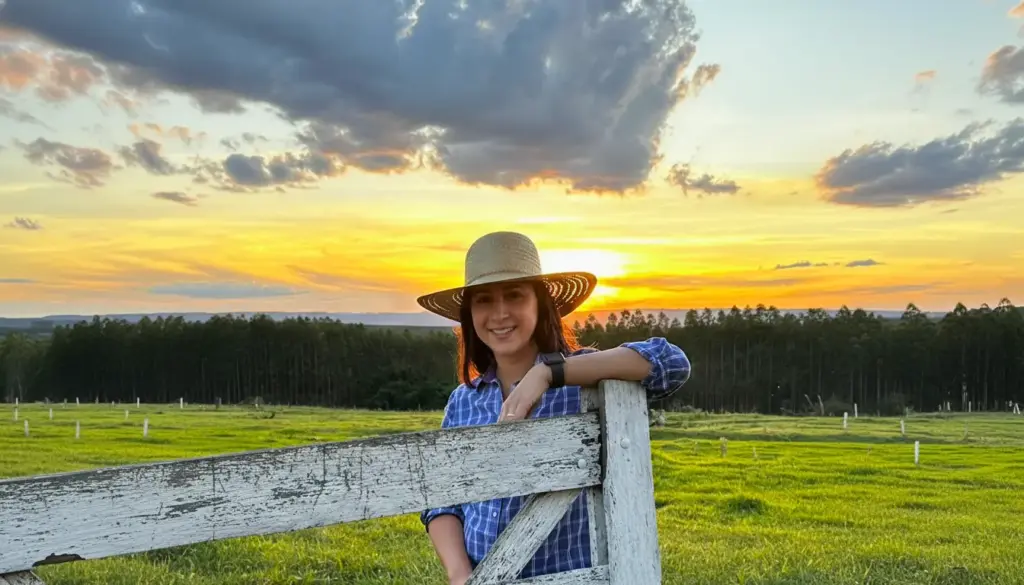
When Stéphanie talks about bottlenecks for women in agribusiness, she races past the ready-made speeches and points to a less visible kind of barrier: the constant testing of trust.
For her, credibility is built with reading the environment, self-knowledge and strategy. At the beginning, for example, she noticed she spoke quickly as a form of defense, because she believed someone might cut her off. Today, she tries to be more objective so as not to be interrupted. “I need to understand what those triggers are.”
The point, however, is not to “change the other.” It is to occupy space with clarity about why you’re there. “I am here because I have competence and because they wanted to hear what I was saying.”
Inside and outside the gate: two fronts, the same challenge
In her view, there are two different arenas. One is inside the gate: women are increasingly present in management, administration, organizing numbers, reports and processes, and also leading teams. The other is outside the gate: the institutional system, where representations, priorities and sector agendas are decided.
And it is precisely there that, according to Stéphanie, the “switch” begins to flip: when a woman recognizes herself as a producer and also as a member and a leader. She says that in the 2017 Agricultural Census, Brazil recorded 19% of women leading rural properties — but there remains doubt about how the data captured different realities (women who manage, wives who also consider themselves producers, family successions).
The turning point that wasn’t “pretty” — but was decisive
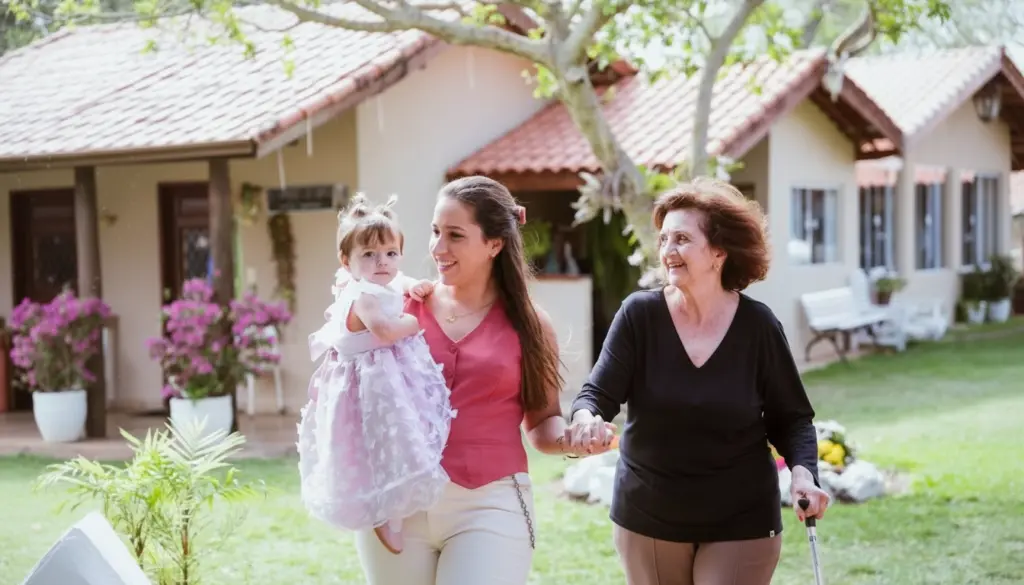
When the conversation turns to family, Stéphanie Ferreira dismantles a common expectation: that succession always happens harmoniously. “My succession story is still being built.”
She recalls that when her grandfather divided the land and her mother received a portion, the message was direct: “Your place is in large multinationals, it’s not for you to return to the farm.” The farm, in that understanding, would not offer a “successful career.”
Stéphanie’s answer was to forge her own path by starting her company. And what came next was not light: pasture recovery and management projects, fertilization, fencing, liming, replanting, team training, explaining “entry height, exit height” (management parameters to determine when animals enter and should leave a paddock based on vegetation height). Again, she was “a girl with a girl’s face” proposing changes to people who had been there for years. But it was there that everything began, as she says: building connections, listening a lot and delivering results.
Stéphanie Ferreira’s references: foundations and influences that shape
At the same time, she names the female foundation of her own story: “100% thanks to my grandmother.” The grandmother appears as a figure of silent resistance — the woman who sustained life in the Cerrado “without water, without power,” sleeping alone on the farm while the grandfather traveled after the cattle. “She was a warrior woman. She always took care of everyone.”
Within the institutional environment, the experience on the National Commission also broadened her repertoire: “it took me out of my bubble and made me get to know a Brazil very different from what I imagined.” For her, there are “many good women out there,” with stories and legacies.
Leadership that doesn’t pay the bills — and yet it happens
This is where Stéphanie’s “altruism” becomes more concrete, without needing an adjective: she explains that acting in institutional leadership through rural unions “is a job, but we don’t get paid for it”. It’s voluntary. Why?
Because, in her view, defending the class doesn’t happen by itself. She cites that the CNA monitors thousands of proposals in the legislature and that many have the potential to negatively impact the rural producer, and therefore leadership is needed to occupy these spaces. “Otherwise your voice will never be heard.”
She knows this call is heavy, especially for women who already carry home, children, career and farm. Even so, she maintains the provocation: “Besides taking care, you’re saying I still need to look out for the collective? Yes. That’s it!”
Not as romanticization, but as a choice: accepting imperfection, recognizing that you can’t balance everything “neatly” and moving forward.
“Be clear about who you are”
Stéphanie Ferreira sums up her strategy in two lines: firmness in her roots and reading the scenario. “Be clear about who you are and don’t stop being who you are. But know how to look, understand the subtext and, strategically, position yourself to achieve the common objective.”
Her story, between the “girl with the little backpack,” the technical consultancy, institutional leadership and recent motherhood, is not about occupying space by quota. It is about occupying it because she delivers, because she adds value and because she chooses to represent, even when that role is not accompanied by remuneration. For her, this is the point that must remain: women have always been in agribusiness. The difference is that now they want, and have, more voice.
Read more: Female leadership in agribusiness: from management to science, a transformation underway