
Share


Food labeling in Brazil does not follow a single logic; it varies according to the nature of the product. In the case of meats, that distinction is particularly relevant. While industrialized foods are regulated based on their nutritional composition and formulation, in natura meat is treated by law as a single-ingredient product, whose main control criteria are not composition but origin, sanitary inspection, and traceability.
It is this difference in classification that explains why the label on a fresh beef cut may seem “incomplete” compared with other foods, even though it is fully compliant with the law.
What the law requires — and why
Labeling rules for animal-origin products are established by the Ministry of Agriculture and Livestock, especially in Normative Instruction No. 22/2005. According to the regulation, packaged meats must include a set of information that ensures identification and control of the product along the supply chain, for example:
- Designation of sale.
- Identification of the establishment (name, address, CNPJ).
- Country and place of origin.
- Official service registration number.
- Sanitary inspection stamp.
- Lot.
- Expiration date.
- Storage instructions.
More than informing “what is in” the product, this set of data answers another question: where this meat comes from and under what conditions it was produced.
Also see the rules that guide international labeling
Single ingredient: the logic that changes the label
One of the central points of Brazilian legislation is the exemption from an ingredients list for foods composed of a single element. The rule is explicit in citing chilled meats as an example of this exception. This means that for a beef cut in natura, the absence of an ingredients list is not an omission, since it aligns with the product’s own definition.
That logic, however, is sensitive to any intervention. Once salt, seasonings, marinades, or solutions are added, the product ceases to be considered “simple” and requires full labeling.
Nutritional information: when the law exempts it
Another point that often raises questions is the absence of a nutrition facts table on fresh meats. Anvisa’s regulation provides that packaged, refrigerated, or frozen meats and fish may be exempt from the nutritional declaration, provided no ingredients have been added that significantly alter their composition.
In this context, the absence of the table also does not indicate a lack of information, but rather a specific regulatory classification: it is a food whose composition is known and has not been altered by formulation.
Front-of-pack labeling: why it does not apply to in natura meat
The introduction of front-of-pack warnings like “high in sodium,” “high in saturated fat,” or “high in sugar” brought a new layer of information for consumers. However, that approach does not apply to all foods, according to an normative instruction published in the Federal Gazette.
Anvisa’s own rule establishes that front-of-pack nutritional labeling is prohibited for packaged meats and fish, provided no ingredients have been added that significantly modify their nutritional profile.
This means that, although meat naturally contains fat, including saturated fat, it does not automatically fall under the warning model designed for industrialized foods. The regulatory logic here is clear: distinguish basic foods from formulated food products, differentiating so-called “real food,” as highlighted by the new American food pyramid.
What the meat label delivers — and what it does not intend to deliver
Unlike processed foods, the label of in natura meat, aligned with the legislations discussed above, does not detail its nutritional composition. Its role is different: to ensure transparency about origin, safety, and sanitary control.
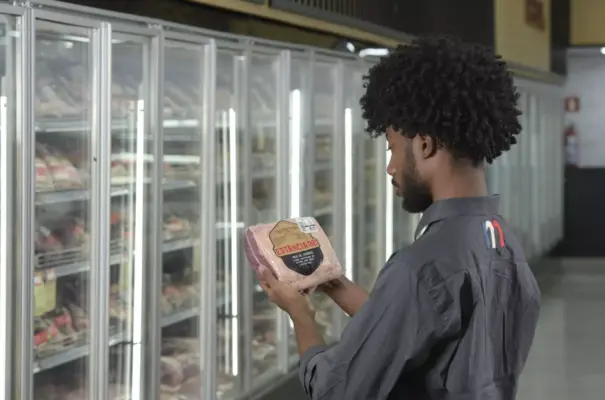
Therefore, when examining the packaging of a beef cut, the most relevant aspect is not the absence of a table or warnings, but the presence of information that allows the product to be traced along the chain. Examples include the Federal Inspection Service (SIF) seal or an equivalent inspection stamp, which identifies the slaughterhouse responsible and compliance with food safety standards; the identification of the industrial establishment (name, CNPJ, and address). In some cases, expanded traceability information may also be available via QR Code or linked to certification programs, which include data such as the animal’s origin (farm or region), production system, as in the cases of grass-fed cattle, information about the production process, such as low-emission and carbon-neutral certifications, or even genetic provenance, like the Angus certification.
When the logic changes: processed meat products
This structure changes significantly for processed meat products. According to Anvisa, items such as bacon, sausage, ham, and industrialized hamburgers are not single-ingredient foods and are considered formulations. As a result, labels must include:
- List of ingredients.
- Mandatory nutrition facts table.
- Front-of-pack labeling, when applicable.
Here, the regulatory logic approaches that applied to other industrialized foods, focusing on composition and nutritional impacts.
Reference links: