
Share


Eating is not always just a biological necessity: in some cases it refers to a cultural and sensory event. In recent years, that dimension of the experience has also begun to shape how meat is chosen and consumed, expanding the very concept of quality.
As chef parrillero Chico Mancuso defines in an interview with Seu Dinheiro, it is a “true revolution” culminating in an increasingly demanding consumer seeking distinctive cuts and high-quality meats. This also reflects the fact that Brazil has become the world’s main supplier of beef and a domestic market with greater purchasing power and appetite for new experiences. However, while premium meat was once defined by flavor and tenderness, with cuts like Wagyu or Angus dominating the image of refinement at the table, today that repertoire is broader—both in variety and in the criteria that underpin perceived value. In other words, the appreciation of premium meat is no longer confined to the cut on the plate. It begins to be built at the origin, based on attributes related to production and sustainability.
Factors such as origin, traceability, animal welfare and environmental impact are now considered in purchasing decisions, reflecting a shift in consumer behavior, especially among younger people. This is shown in the Power of Meat 2026 report, published annually by The Food Industry Association and the Meat Institute. “While not all shoppers actively seek these attributes, many believe there is a relationship between rearing and management practices and the taste of meat and poultry—underscoring the importance of clear, credible measures and ongoing communications around production practices,” the document says.
According to the survey, in 2025, unlike the Boomer generation—older buyers now aged 59 to 75—Generations Z and Millennials (also called Y), who represent young adults aged 18 to 26 and 27 to 42, respectively, show a much greater willingness to pay more and choose types of meat they consider healthier, more sustainable, more ethical or raised in a more humane way.
Although Boomers still have strong representation in the meat consumer market, it is these younger consumers who have driven the sector. Together, Generations Z and Y accounted for 67% of all unit growth in the U.S. meat segment in 2025.
More informed consumer, more complex decision

This contemporary consumer has adopted an increasingly intentional approach when shopping, valuing transparency across the supply chain. Currently, 33% of Americans insist on knowing exactly where their food comes from. This desire for information includes not only where the animals were raised but also the methods used and who the producers involved in the process are, as the Consumer Beef Tracker shows.
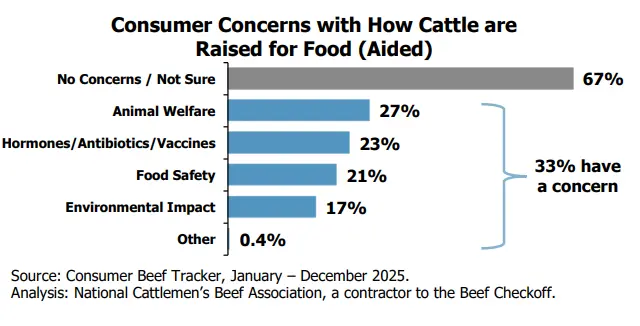
On the other hand, personal practical engagement with environmental sustainability does not keep the same pace. Just over half of consumers (53% in 2026) say they actively try to make better choices for the environment regarding food and packaging.
This behavior gap suggests that although sustainability and transparency are widely valued ideals, shoppers tend to shift responsibility for environmental action to brands and retailers. When ecological issues do weigh on decisions, customers tend to migrate toward companies and meat options already aligned with their values.
Even if the green agenda is less decisive overall, it carries considerable weight among younger people. Production and packaging factors directly influence purchases for this group: local or regional origin products, as well as packaging that uses less plastic, are the most desired sustainability attributes. Organic certification stands out as the most appealing factor specifically for Generations Z and Millennials, which exceed the average in several market demands.
Between price, values and purchase intent
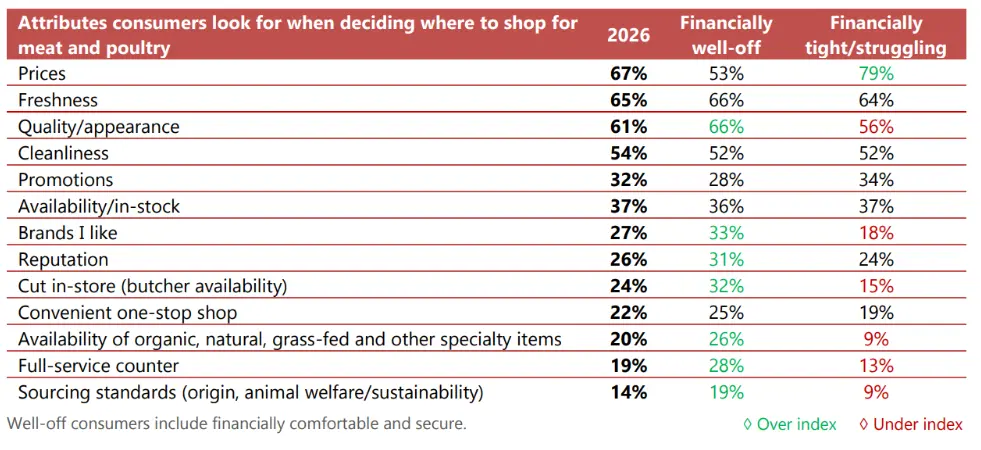
However, economic reality sets the limits of these choices: consumers facing financial hardship are much less likely to prioritize environmental attributes when buying—only 9% mention origin standards, animal welfare or sustainability, compared with 19% among those more financially comfortable (14% overall). In general, retail observes a strong intersection of priorities in which the same consumer seeking sustainability also values health attributes and animal welfare.
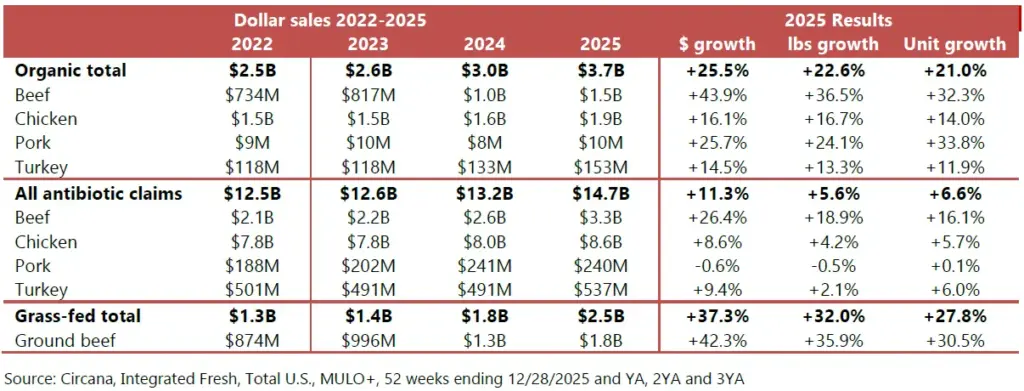
This is reflected directly in sales of products with sustainability or animal welfare claims, such as organic meats or grass-fed options. In the U.S. market, data from the Power of Meat report, based on market information from consultancy Circana for 2025, show that organic meats overall recorded a 25% increase in revenue (reaching US$3.7 billion) and 22.6% in volume last year—beef alone accounted for 43.9% of that revenue increase and 36.5% of the volume. Grass-fed ground beef had an even bigger jump, with sales in dollars up 42.3% and volume up 36%.
This behavioral shift makes the purchase decision a complex balancing of priorities. Today, the three main global factors U.S. consumers consider at the shelf are price per weight (51%), visual quality and appearance of the product (47%), and total package price (41%).
However, when evaluating specific production and welfare attributes, priorities split: 44% seek animals raised domestically, 43% demand meat with no added hormones, 40% look for grass-fed certification and 39% prioritize assurance that the animal never received antibiotics. Humane rearing concerned with animal welfare (31%) is also relevant for part of the public.
From the environmental impact perspective, the biggest purchase demands are for local or regional origin products (42%), organic (39%) and items with reduced-plastic packaging (34%). However, aspects such as use of regenerative agriculture practices in production (20%) and guarantee of carbon neutrality (18%) are also considered.
Despite the strong rise of these agendas, when it comes down to a tiebreaker, quality remains the decisive factor and the main motivator to pay more for a product. This classic quality criterion dominates Boomers’ priorities (44%), while younger consumers, Generation Z (19%), lead the willingness to pay more for brands that deliver added value, transparency and socio-environmental responsibility in their meat.
Overall, the report shows how realms that once seemed parallel in the consumer’s mind—sustainability and its different strands (animal welfare, environmental impact, for example) and meat quality—are increasingly integrated.
Humane treatment has ceased to be merely a moral stance and is now seen as a factor that impacts product quality: 66% of shoppers believe that animals raised with care and compassion result in a more flavorful final product. This perception that animal welfare directly affects taste is even stronger among Millennials, reaching 73% of that generation. It proves that for the new consumer, sustainability, ethics and sensory experience are not isolated or mutually exclusive factors, but interdependent elements that connect closely to form the best meat.
Reference sources:
- Angus, wagyu and more: luxury meets fire and we detail the premium barbecue
- Beef Industry Review and Consumer Insights: February 2026 Edition
- Animal welfare also has an impact on meat quality
- Meats with special attributes gain space in the global market
- The role of Brazil in global food security
- The Power of Meat 2026