
Share


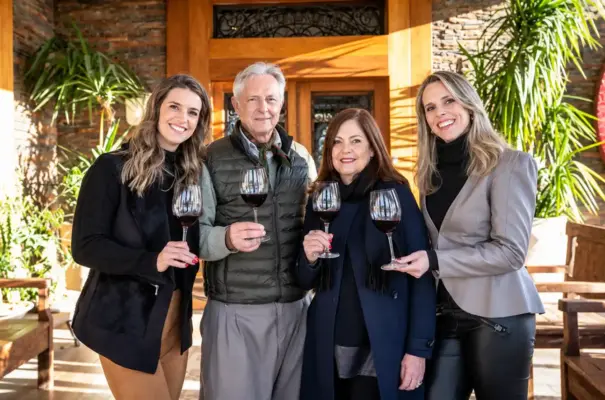
Before wine came rice farming, cattle ranching, and a connection to the land that now spans four generations. For the Pötter family, preserving their roots does not mean following the same paths as those who came before, but forging new ones without losing sight of what brings them together. It is this balance between legacy and renewal that continues to shape the evolution of the family business.
The story in the Gaúcho Pampa began in 1948, when Valter Pötter’s father, Walter Germano Pötter, arrived in Dom Pedrito to grow rice and later added cattle ranching to the operation. Valter joined the business after graduating in 1971 and deepened its diversification, introducing new crops, cultivated pastures and more intensive livestock production.
It was this spirit of experimentation and entrepreneurship that opened the door for his daughters to leave their mark as well. Gabriela, who studied agronomy, proposed planting grapes, something quite different from what the family had been doing. They started with just half a hectare. The area expanded, the first wines were produced and awards followed, driving investment in a facility of their own. “Everything step by step,” Valter sums up.
The ability to change is also reflected in the family’s relationship with the land. “When you are raised in the countryside, born in the countryside, you stay with love, you stay rooted,” Valter says. Over time, this connection also brought the realization that practices needed to be reassessed. This concern led the family to become one of the first in the region to install solar panels, about two decades ago. Today, the energy generated supplies the livestock operation, the winery and the homes, with the surplus sent to the grid. In 2025, Guatambu became Brazil’s first winery with a negative carbon balance: its carbon removals exceed the greenhouse gas emissions from its operations.

There is also one principle that Valter is determined to pass on: dedication, knowledge and working intelligently form the foundation for achieving professional goals. It is a conviction that runs through his career and helps explain a family that values the experience of those who came before while continuing to learn, test and change.
Mariana considers her father’s openness to younger people’s ideas one of the reasons she and her sisters found the motivation to return after studying and, in her case, even working outside the family business. With a degree in psychology, she found a way to bring her own knowledge to the business through people management and wine tourism.
But family ties and values also influenced that choice. Mariana lived on the ranch until she was nine and retains memories of a childhood she describes as “free,” filled with games in the woods and improvised picnics. “I feel very much at home here,” she says. Today, she and her sisters seek to provide their children with some of those same experiences, including maintaining the tradition of gathering the family at the ranch for lunch on Sundays. “These values are all very strong and are passed down from generation to generation.”
In the Pötter family, in fact, the boundary between these values and the way they run the business is a fine one. In business, “each person has their own characteristics, and we complement one another,” Mariana says. For Valter, this is built on “unity,” “living together” and “respect.”
That was how Valter received the four-year-old granddaughter’s answer—ambitious as it was childlike—when the cousins were discussing careers: the future is the Moon! “Then let’s invest in the Moon,” the grandfather said, celebrating her response.
For now, no one needs to decide what place they will occupy in the family’s history. First come togetherness, memories and a sense of belonging. After that, each person can find their own path. In this way, the roots remain firm without preventing new branches from finding where to grow. And, apparently, not even the Moon will be the limit.