

Share


Crop insurance is a way of financially protecting producers when events such as drought, excessive rain, frost or hail cause production losses. But Brazil’s situation presents a paradox: while climate risks are increasing, the share of planted area supported by the main federal program encouraging the purchase of this insurance has been declining.
In 2025, the Rural Insurance Premium Subsidy Program (PSR) — through which the federal government pays part of the policy cost and the producer covers the remainder — supported coverage for approximately 3.3 million hectares, equivalent to just 3.4% of the country’s planted area. This figure refers to the area supported by the program, not the total insured area in Brazil. In 2021, the figure was nearly 14 million hectares, according to data consolidated by the Observatory of Rural Credit and Insurance (OCSR), run by FGV Agro.
The decline is occurring precisely as climate change leaves production more exposed. The World Bank points to changes in temperature and precipitation patterns in Brazil, with reduced water availability and longer droughts, as well as direct impacts on agriculture.
It is against this backdrop that the new rural insurance framework takes effect. Sanctioned on September 29 and published in the Federal Official Gazette on September 30, Law No. 15,526/2026 changes the sector’s rules, including how the subsidy works (the portion of the insurance price paid by the government, that is, the subsidy), the relationship between insurance and rural credit, claims-adjustment deadlines and mechanisms designed to support larger-scale losses.
It is against this backdrop that the new rural insurance framework is advancing. Approved by Congress, Bill 2,951/2024 proposes changes to the sector’s rules, including how the subsidy works (the portion of the insurance price paid by the government, that is, the subsidy), the relationship between insurance and rural credit and mechanisms designed to support larger-scale losses.
For Pedro Loyola, coordinator of FGV Agro-OCSR, the decline in coverage reveals a broader weakness: Brazil has built a robust structure to finance production, but the mechanisms for protecting producers and lenders from the risks associated with this credit have not advanced at the same pace.
In an exclusive interview with the My Minerva Foods portal, Loyola explains why coverage has shrunk, what changed under the new law, what still depends on regulation and what the main obstacles are to expanding access to rural insurance.
Rural insurance: how does protection in the field work?
There are different instruments for reducing the financial impact of risks to agricultural production. Rural insurance is one of them.
In Brazil, the public sector also participates in this protection structure. Two of the main federal policies aimed at mitigating agricultural risks are the Rural Insurance Premium Subsidy Program (PSR) and the Agricultural Activity Guarantee Program (Proagro).
Although both help producers deal with losses, each instrument works differently:
- Rural insurance: this is protection purchased by the producer from an insurer, allowing part of the activity’s risk to be transferred in exchange for payment of an amount known as the premium, which is the price of the insurance. Coverage depends on the type of policy and its terms and may include, for example, losses caused by drought, hail, frost, excessive rain and other events affecting production. If an event covered by the policy occurs and the agreed conditions are met, the producer may receive compensation for covered losses. Insurance may also be linked to rural credit. The rationale is that by protecting the production that generates the funds used to repay financing, the policy helps reduce the risk that a crop loss will undermine the producer’s ability to make payments.
- PSR: this is the program through which the federal government helps producers pay for rural insurance. The public sector covers part of the premium, while the producer pays the remainder. It is a policy created to reduce the cost of purchasing policies offered by the market.
- Proagro: this is a mechanism administered by the Central Bank and linked to rural credit. When financed production suffers losses caused by events covered by the program’s rules, such as natural phenomena, pests or diseases for which no known and economically viable control method exists, Proagro may release the producer from certain financial obligations related to the financing.
Rural insurance for small producers
Protection takes on particular characteristics in family farming. According to Loyola, small producers typically concentrate a larger share of their income and assets in a single farm and crop, reducing their ability to absorb a severe loss. At the same time, the cost of insurance may make public support even more important for this group.
An experience under the PSR itself illustrates this relationship. In 2021, a pilot project aimed at producers enrolled in the National Program for Strengthening Family Farming (Pronaf) offered a subsidy covering 60% of the insurance cost — in other words, 60% of the amount payable to the insurer was covered by the program.
To finance these amounts, R$79.48 million was allocated to the initiative. The entire amount was used and helped pay for approximately 17,300 policies. For Loyola, the result indicates that there is demand when producers find suitable coverage, access to insurance and support to pay part of its cost.
The relationship with Proagro is also particularly important in this segment. FGV Agro-OCSR argues that some producers currently covered by Proagro should be gradually migrated to private insurance, but only where an effective alternative is available. “Cutting off the road before building the bridge is not reform; it is leaving people unprotected,” Loyola says.
More risk, less protection: what explains the decline?
The succession of droughts, floods, frosts and heat waves in recent years has increased perceptions of vulnerability in rural areas. In a webinar held by FGV Agro-OCSR in May 2026, experts emphasized that insurance is no longer seen merely as a way to compensate for losses and has gained importance as an instrument for preserving production’s financial capacity in the face of adverse events.
But this growing awareness has not translated into an expansion of coverage supported by the PSR. For the FGV Agro-OCSR coordinator, the decline results from a combination of factors, listed below.
The nature of the activity: one of the challenges facing rural insurance
A prolonged drought or frost can affect thousands of farms in the same region at the same time. This concentration of losses requires greater financial capacity from insurers and more reinsurance, the mechanism through which they transfer part of the risks they assume. This ultimately affects policy prices.
The lack of predictability in subsidized insurance helps explain low take-up
In Loyola’s assessment, this is one of the main obstacles. Producers and insurers do not know in advance how much funding will be available to subsidize policies or when it will be released. This uncertainty makes planning before planting more difficult and also hampers the market’s organization to assume and distribute these risks.
Annual Budget Law (LOA) data help illustrate the problem. In 2025, R$1.06 billion was budgeted for the PSR. After cuts, R$632 million remained available, of which R$565.4 million was actually used. In 2026, through August, only R$148.6 million had been allocated to subsidy payments. As the infographic below shows, fluctuations in funding have coincided with a sharp contraction in the area served by the program. “The PSR’s historical series looks more like an electrocardiogram of the public budget than a steady curve showing the market’s maturation,” Loyola summarizes.
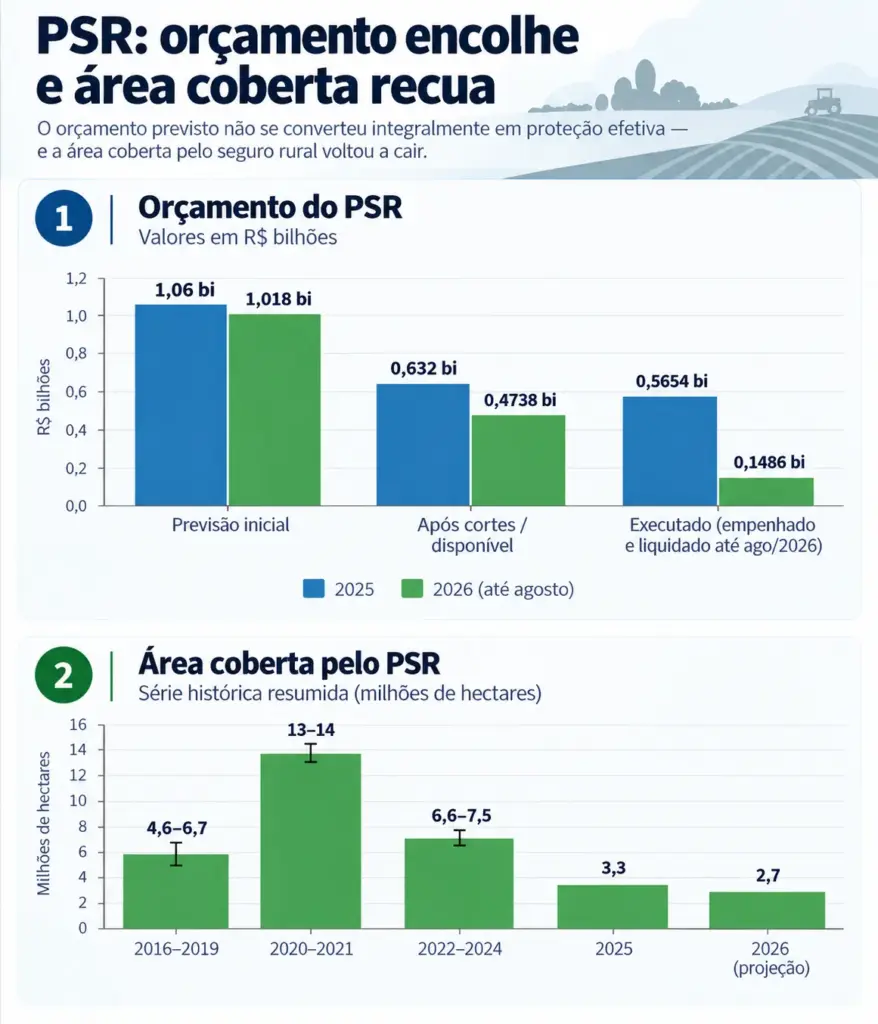
Law No. 15,526/2026 addresses precisely this issue. Under the new rule, the subsidy receives mandatory budgetary treatment, and PSR actions may not be subject to limits on commitments or financial transfers — in other words, they can no longer be contingenced, as occurred in 2025. The obligation, however, is limited to the amount included in the Annual Budget Bill (PLOA) and is conditioned, according to the text, on compensatory measures established in specific legislation.
For 2027, the PLOA, which is still under consideration, provides for approximately R$1.2 billion for the PSR. A simulation by FGV Agro-OCSR estimates that R$2.37 billion would be needed to restore coverage to levels close to those of 2021. These figures may still change during the bill’s consideration by Congress.
The impact of an uneven market
Insurance availability is also uneven across markets. In the grain sector in certain regions of the country, it is more advanced, while activities such as livestock, forestry, aquaculture and horticulture, as well as small farms, still have fewer options or face high operating costs.
A matter of trust
Trust is another obstacle. Deductibles, exclusions and compensation criteria are not always sufficiently understood by producers. Combined with possible delays in assessing losses, negative experiences can weigh on the decision to renew a policy for the following crop year.
The effect of debt renegotiations
Loyola also points to a problem in how the public sector responds to major losses. In crisis situations, uninsured producers may benefit from debt renegotiations and other extraordinary measures. These responses may be necessary, but when they become recurring, they reduce the incentive to purchase protection before a problem occurs.
According to him, this creates a distortion: those who purchased insurance paid in advance for protection, while producers who were uninsured may later receive support to deal with their losses. Loyola compares this mechanism to a kind of “implicit insurance,” provided after the disaster without prior purchase or payment.
The result is the paradox identified by Loyola: “the more the climate convinces producers that they need protection, the more unstable the policy that should help them purchase it becomes.”
The new law seeks to change this incentive by providing for greater integration between insurance and rural credit, including the possibility of favorable terms for operations protected by insurance, subject to regulation.
What needs to change?
Expanding the reach of rural insurance requires more than increasing available funding. In Loyola’s assessment, the policy must become more predictable, those who reduce their own risks must be better recognized and the available protection options must be expanded. Among the main changes, he highlights some already covered by Law No. 15,526/2026:
- Make the PSR more predictable: define funding further in advance and establish a calendar compatible with crop cycles. The new law advances this goal by giving the subsidy mandatory budgetary treatment and preventing limits on commitments and financial transfers for PSR actions.
- Better integrate insurance and credit: ensure that purchased protection is considered by banks when setting financing terms. The law provides for greater integration between the two, with the possibility of favorable terms for protected operations, subject to regulation.
- Recognize those who reduce their own risk: consider factors such as irrigation, verifiable good practices and the recommendations of the Agricultural Climate Risk Zoning (ZARC) when defining insurance terms. The Ministry of Agriculture’s tool identifies, for different crops and municipalities, planting periods associated with lower climate risk.
- Expand insurance availability: develop more products and access channels for activities that currently have fewer options, such as livestock and forestry, while also expanding coverage among family farmers.
- Make compensation faster and more transparent: establish clearer deadlines and use tools such as georeferenced digital reports to facilitate loss assessment and increase producers’ confidence. The new law establishes deadlines: up to 15 days for certain adjustments and up to 30 days for settlement, under the conditions set out in the text.
There is also an issue that is becoming more important in light of events capable of causing large-scale losses: determining in advance how much of the damage will be absorbed by producers, insurers and reinsurers, and when a fund for extraordinary situations should step in. This is the role of the Supplementary Coverage Fund, restructured by the new law.
How technology and data can improve rural insurance

Some of the tools capable of making rural insurance more precise and efficient are already available. Satellite imagery and other monitoring technologies make it possible to identify areas with different levels of risk, improve the calculation of insurance prices and terms, monitor concentrations of exposure and speed up loss assessments. The data also support the development of insurance policies in which compensation can be triggered based on previously defined parameters, such as a specific amount of rainfall or temperature.
Loyola stresses that technology should support decision-making, not replace it with an automatic response that is difficult to explain to producers. For him, Brazil already brings together large volumes of climate, agricultural, credit and insurance data; the challenge is to turn still-scattered databases into useful knowledge for market decisions and public policy formulation. The new law also provides for the creation of public databases on rural insurance operations.
It was precisely this gap that led to the creation of FGV Agro-OCSR: to organize data and produce evidence on the sector. By July 2026, FGV Agro-OCSR had consolidated four studies and six technical notes.
BOX | What can Brazil learn from other countries?
International experiences demonstrate the importance of stable rules and risk-sharing between government and the market. The United States and Canada maintain permanent public-private partnerships, with subsidies and reinsurance mechanisms defined in advance. In Spain, different insurers share risks through the Agroseguro system. Turkey uses a similar national system, TARSİM, which makes it possible to distribute large-scale losses among different participants, including those caused by droughts and frosts.
For Pedro Loyola, these examples show that the so-called culture of prevention depends less on a supposedly greater awareness among producers and more on the existence of predictable rules, permanent products, reliable data and channels prepared to provide protection.
Law No. 15,526/2026: what changed in rural insurance
Law No. 15,526/2026, sanctioned on September 29 and already in force, seeks to make the PSR more predictable, bring insurance and rural credit closer together and strengthen protection against large-scale losses, following the layered approach advocated by Loyola: producer, insurers, reinsurance, supplementary fund and, as a last resort, the public sector. What is already provided for by law:
• Subsidy: it now receives mandatory budgetary treatment, and PSR actions may not be subject to limits on commitments or financial transfers.
• Insurance and credit: greater integration between the two instruments, including the possibility of favorable terms for protected operations, subject to regulation.
• Claims adjustment: new statutory deadlines, including up to 15 days for certain adjustments and up to 30 days for settlement, under the conditions established by law.
• Supplementary Coverage Fund: it is no longer merely a proposal and will follow the structure approved by law, with governance, actuarial criteria and risk-transfer mechanisms.
• Data: creation of public databases on rural insurance operations.
For Loyola, the fund is one of the central points of the change. “The fund does not exist to pay every claim or to socialize underwriting errors. It exists to provide stability to layers of risk that are large, correlated and difficult to absorb through private capital alone.”
Not everything, however, takes effect immediately. Favorable credit terms for protected operations, for example, depend on regulation, while the subsidy obligation is limited to the amount included in the PLOA and conditioned on compensatory measures established in specific legislation. In practice, regulation and budget execution will determine whether the law translates into more protected acreage.
More than a set of targeted changes to the rules, the FGV Agro-OCSR coordinator sees the law as an opportunity to change the logic of agricultural policy: bringing protection forward instead of concentrating the response after losses occur. “Climate risk that is not financed before the crop cycle does not disappear. It returns later, more expensively and in a more disorganized manner, through defaults, renegotiations, Proagro, loss of collateral and public bailouts.”
For him, insurance, credit, farm management, ZARC and reinsurance must operate in an integrated manner. “It is better to finance predictable prevention before planting than an expensive, broad and improvised renegotiation after a crop failure.”
- Banco Mundial — Brasil: Country Climate and Development Report
- Confederação Nacional da Agricultura (CNA) — Conjugação de crises no horizonte
- FGV Agro — Observatório do Crédito e Seguro Rural — Seguro rural e Estado: lições para o Brasil
- Lei nº 15.526/2026 — texto da lei (Legjur)
- Susep — Sancionada Lei que aperfeiçoa marco legal do seguro rural (30/set/2026), republicado pelo CQCS