

Share


World Food Day, observed on October 16, arrives in 2026 amid important but still insufficient progress: global hunger fell for the third consecutive year, yet around 645 million people still experienced food deprivation in 2025. At the same time, approximately 2.7 billion people could not afford to maintain a healthy diet, according to The State of Food Security and Nutrition in the World 2026 (SOFI), a report prepared by the United Nations (UN) Food and Agriculture Organization (FAO) and other international agencies.
The two figures reveal different dimensions of the problem. Ensuring food security means having enough food available, but also ensuring that people can access safe, varied and nutritious products. Added to this is the need to maintain production in the face of extreme weather events and reduce pressure on natural resources.
It is against this backdrop that the FAO chose “Innovate today to nourish tomorrow” as the theme for the 2026 observance. The aim is to highlight the importance of combining science, technology, innovation, traditional knowledge and inclusive approaches to build more efficient, resilient and sustainable agrifood systems and expand access to safe and nutritious food.
For Brazil, one of the world’s major food producers, this discussion is directly linked to agriculture and livestock. The scale of cattle farming helps illustrate the size of this contribution. In 2025, 42.94 million cattle were slaughtered under some form of sanitary inspection, 8.2% more than in the previous year and the highest number in the historical series of the Brazilian Institute of Geography and Statistics (IBGE). This scale places Brazilian cattle farming in a significant position in the food supply and means that productivity and efficiency gains can have a substantial impact. At the same time, it increases the need to reconcile production, the use of natural resources, emissions control and compliance with sanitary and environmental requirements.
Food security is on the legislative agenda: agriculture and livestock as a priority
The importance attributed to agricultural and livestock production also appears in the debate over public policies. Under consideration in the Chamber of Deputies, Bill 2,367/2023 proposes amending the Agricultural Policy Law to establish national agricultural and livestock production as a state priority. In August 2025, the bill was approved by the Committee on Agriculture, Livestock, Supply and Rural Development. During the legislative process, the text received an amendment incorporating issues directly related to the current debate on food production, including food security, sustainable management of natural resources, climate commitments, the promotion of sustainable agricultural and livestock practices, and expanded access to land, credit, markets and infrastructure. The proposal was forwarded to the Committee on Constitution and Justice and Citizenship (CCJ) and still needs to complete the remaining legislative stages before becoming law, but its discussion highlights the increasingly direct relationship between production capacity, food security, economic development and sustainability.
This set of objectives shows that expanding production capacity can no longer be addressed separately from environmental and climate issues. In cattle farming, this combination is directly linked to innovation: producing more efficiently, making better use of areas already in use and reducing impacts per unit of food produced.
Producing more with less – the logic of efficiency
In cattle farming, one way to translate innovation into practice is through efficiency. Some of the research conducted in Brazil seeks to increase the amount of food produced from the resources already in use. Genetics, feeding, animal health and pasture management are among the factors that can affect weight gain, feed efficiency and the time required for an animal to reach suitable slaughter conditions.
Integrated Crop-Livestock-Forestry (ICLF) systems move in this direction by combining different activities in the same area and taking advantage of the benefits that one type of production can provide to another.
The effects can also be seen in environmental performance. In a long-term study in the Cerrado, Embrapa found that integrating crops and livestock can reduce the need for fertilizers and nitrous oxide emissions. Under certain conditions analyzed, the history of grazing and reduced phosphorus and potassium application rates contributed to a 59% drop in cumulative gas emissions. The impact is even more significant because nitrous oxide, emitted mainly by microbial processes in the soil and associated in agriculture and livestock with the use of nitrogen fertilizers and animal waste management, has a powerful effect on global warming.
Another study, conducted in the Amazon, found a favorable carbon balance in models used to restore degraded pastureland. ICLF systems showed the capacity to store carbon while also increasing productivity.
Efficiency also depends on the animal itself. Higher-quality pastures and adequate feeding promote weight gain and can reduce the time to slaughter, lowering methane emissions per kilogram of meat produced. At Embrapa Southern Livestock, the Gas Emissions Test (PEG) identifies cattle with lower methane emissions and assesses characteristics related to feed efficiency, with the prospect of incorporating this information into genetic improvement programs.
These are different paths toward the same goal: combining productivity and efficiency, making better use of available land and resources and reducing environmental impact per unit produced.
Read also: Regenerative cattle farming increases profitability on the farm
Technology also helps determine where meat comes from
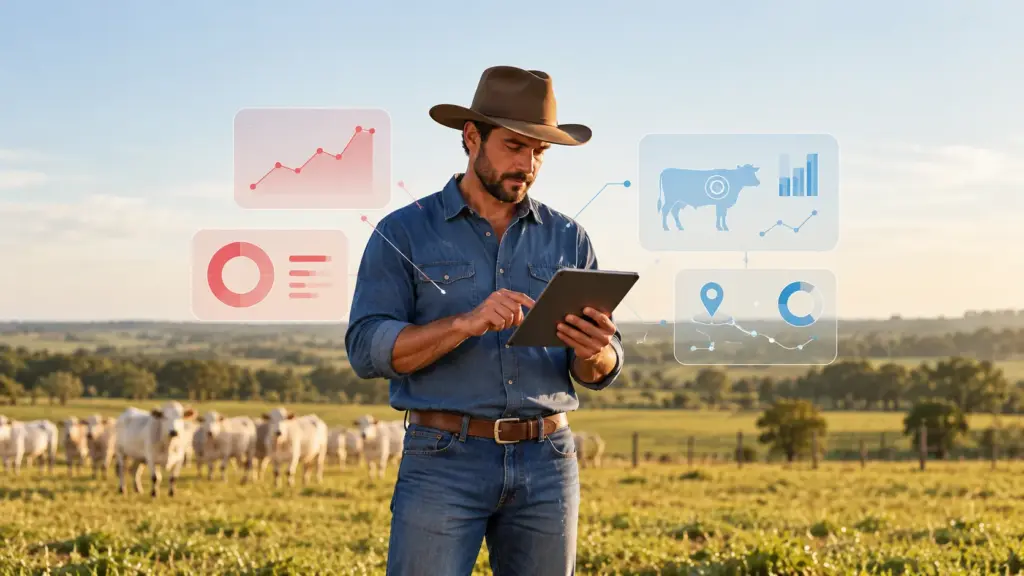
Another area of innovation emerges after — and around — production itself. Digital systems, databases, individual animal identification, satellite imagery and other tools have expanded the ability to track the origin and journey of products throughout the supply chain.
In cattle farming, traceability makes it possible to gather information about animals and the properties through which they have passed and can help with sanitary controls, supply-chain transparency and verification of compliance with environmental criteria.
A study released by Embrapa in 2026 on traceability systems in Brazil’s beef chain highlights precisely this role. The researchers examine traceability not only as a control tool, but as infrastructure capable of connecting slaughterhouses, sustainability protocols and buyer markets. The study also discusses ways to increase the participation of small and medium-sized producers in these systems.
The evolution of these tools accompanies changes in the market itself. Information about provenance, production conditions, compliance with sanitary standards and social and environmental criteria has gained importance in relationships among producers, slaughterhouses, retailers and importing countries.
The technology exists. The challenge is taking it further
The number of available studies and solutions shows that much of the transformation needed in cattle farming has already begun. But developing a technology does not mean it will automatically be adopted.
Implementing improved genetics, restoring pastures, changing management practices, adopting integrated systems or introducing traceability mechanisms requires investment, knowledge, technical assistance and, in many cases, access to credit and infrastructure.
This gap between developing innovation and disseminating it also appears in the FAO’s own message for 2026. In advocating more efficient, inclusive, resilient and sustainable food systems, the organization draws attention to the need to expand access to innovations by combining new technologies with traditional knowledge and solutions suited to different production realities. This is one of the pillars of the FAO Science and Innovation Forum 2026.
For Brazil, this discussion carries added weight because of the sheer scale of its production. A sector that slaughtered nearly 43 million cattle in a single year can increase its contribution to the food supply as it becomes more efficient, reduces losses and emissions, conserves resources, and more accurately demonstrates the origin and conditions of production.
The theme of World Food Day 2026 points precisely to this movement. If millions of people still go hungry and billions cannot afford a healthy diet, innovation cannot be measured solely by the sophistication of a new technology. Its impact is seen when science and knowledge transform the way food is produced and when these solutions actually reach the people who produce it.