
Share


Navigate through the content:
- How meat labels influence purchase decisions
- What meat labels have come to communicate and the evolution of clean label
- Grading, origin and production: the meat labels that weigh most heavily in the choice
- Halo effect: the psychology behind meat labels
- From label influence to production understanding: opportunity and gap
How meat labels influence purchase decisions
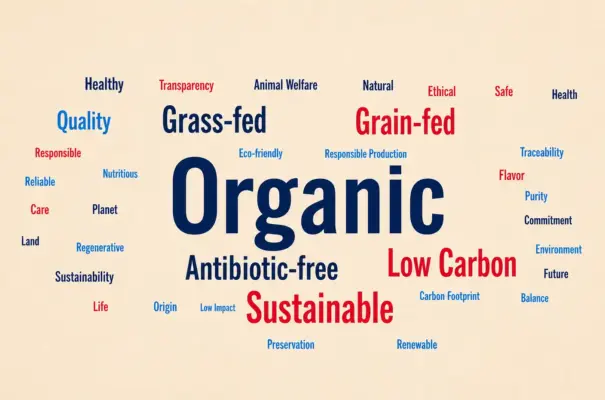
“Organic,” “Grass-fed,” “grain fed,” “Antibiotic-free,” “Low-carbon” … meat labels are no longer the same and reflect a deeper shift: that of consumer behavior. What was once a commodity defined by price and shelf appearance can become a value-added product through the narrative printed on the package.
According to data from the Consumer Beef Tracker, compiled by the National Cattlemen’s Beef Association (NCBA), the market for meat with specific labeling attributes has grown steadily, expanding at a faster pace than conventional beef consumption. According to the study, 77% of U.S. consumers have intentionally made a purchase decision based on information on the label. In addition, there is a willingness to pay US$7.11 to US$7.85 more for cuts of meat with labels such as “USDA Prime” or “breed-specific” compared with the five-year average.
What meat labels have come to communicate and the evolution of clean label
In line with the change in consumer behavior, which has led people to care not only about the final product but also about how food is produced, meat labels have taken on a broader role in communicating attributes tied to quality, origin and production system. In addition to helping consumers understand how the animal was raised and what practices were adopted throughout the production cycle, this information has come to function as a signal of transparency, sustainability, animal welfare and food safety.
This shift is aligned with the rise of the clean label concept, a philosophy based on transparency and simplicity that values products with clear and easily understood information. In the beef chain, this translates into claims related to product origin, the absence of hormones and husbandry methods that prioritize animal welfare. The movement has gained momentum as these attributes are no longer seen only as premium differentiators and are increasingly influencing purchase decisions directly.
In the United States, products classified as clean label are growing at an annual rate of 7.5%, above the 5.9% average observed for the consumer goods market as a whole, according to a NIQ survey. The same study shows that 95% of consumers consider trust in a brand a decisive factor at the time of purchase, reinforcing the role of labels as tools of credibility and transparency.
Growing attention to these attributes is also linked to broader concerns about public health and food safety. One example is the market for antibiotic-free meat, driven by the debate over antimicrobial resistance and the search for proteins seen as more closely aligned with consumer expectations. According to the study Antibiotic-Free Meat Consumer Trends: Insights and Forecasts 2025–2033, published by the MRA portal, this segment is expected to generate US$231 billion globally in 2026 alone.
Grading, origin and production: the meat labels that weigh most heavily in the choice
Attributes related to meat quality are the ones that most strongly influence U.S. consumers. In 2023, 40% of consumers said they had intentionally sought out beef graded as “USDA Choice,” making the official grading system of the U.S. Department of Agriculture (USDA) the most relevant labeling attribute for driving sales.
The importance of this attribute, however, is not uniform across age groups: Baby Boomer consumers tend to place greater weight on official quality grades, while Generation Z shows less interest in this type of information. The data also show a gradual shift in market preferences: although it remains the leading labeling attribute, the relevance of the USDA Choice seal has declined over time, falling from a peak of 46% of consumers in 2019 to 40% in 2023, as claims related to production systems, sustainability and animal welfare gain ground.
Among label information related to the production system, the standout is “Grass-fed,” which has remained the most valued by consumers over the past five years. Meanwhile, the “Organic” and “Humanely raised” seals posted the most consistent gains over the period, reflecting growing concern about sustainability, animal welfare and transparency in food production. Although these attributes still account for a smaller share of the market than quality grades, their growth points to a gradual shift in consumer preferences, especially among Millennials and Generation Z.
Halo effect: the psychology behind meat labels
The effectiveness of label messaging lies in a psychological phenomenon known as the “Halo Effect,” coined in 1920 by Edward Thorndike. When a product is highlighted as organic, for example, consumers tend to transfer that positive perception to other unmentioned attributes, believing it to be a more nutritious and tastier product.
In turn, external validation of the message printed on the label, whether by government agencies or independent organizations, works as a risk reducer and a cognitive shortcut. Rather than researching the origin of each farm, consumers rely on certification to validate their ethical and health values.
From label influence to production understanding: opportunity and gap
If labels have gained ground as a tool for influencing purchase decisions, the data indicate that there is still a gap between the attention given to this information and an understanding of the production systems it represents. Although 77% of consumers say they have already made a purchase decision based on information on labels, only 43% say they frequently or always consider food origin when shopping, while just 28% say they know a great deal about how cattle are raised.
The contrast suggests that these attributes are gaining increasing relevance on store shelves, but there is still room to expand consumers’ knowledge about the meaning of these claims and the practices adopted throughout the cattle production cycle. In this context, transparent communication based on verifiable information is not only a market differentiation tool, but also an opportunity to bring consumers and producers closer together, strengthening trust and contributing to more informed choices.
This is precisely one of the roles of our newsletter. Sign up and receive science-based information about the world of beef directly in your inbox.
- Antibiotic-Free Meat Consumer Trends: Insights and Forecasts 2025-2033
- Beef label claims and their effects on purchasing behavior
- Animal welfare also has an impact on meat quality
- INSTRUÇÃO NORMATIVA Nº 55, DE 1º DE DEZEMBRO DE 2011.pdf
- NIQ’s 2026 Consumer Outlook: Bold Brands Win with Cautious Consumers
- Certified origin beef: guarantee of safety, quality and sustainability from farm to consumer