
Share


Brazil has established itself as one of the main pillars of the planet’s food security. However, the engine that feeds billions of people around the globe is at risk of overheating. By 2050, the intersection between the advance of climate change and the ecological limits of the main productive biomes will create a challenging scenario for agribusiness and food supplies.
This warning was detailed in the document Climate Change in Brazil: State of the Art and Frontiers of Knowledge, published by the Ministry of Science, Technology and Innovation. Featuring experts such as Vanessa Pugliero, Coordinator of Minerva Foods’ Renove Program, the document shed light on an unavoidable reality: the resilience of national agricultural production will depend critically on corporate risk management and the rapid transformation of farming models based on the principles of sustainable intensification. The window for action is narrowing, and the impacts have already begun to knock on the doors of both rural areas and financial markets.
Global climate scenario and pressure on Brazil’s territory
To understand the risks to food supplies in the coming decades, it is necessary to understand the unprecedented rise in average global temperatures. Reports by the Intergovernmental Panel on Climate Change (IPCC) cited in the article indicate that greenhouse gas emissions have unequivocally altered the planet’s energy balance.
Recent evidence shows that 2024 was recorded as the hottest year in global history, marking the first time that worldwide temperatures reached 1.6 °C above pre-industrial levels. In Brazil, the effects of this crisis were reflected in average temperatures 0.79 °C above the recent historical norm, according to the National Institute of Meteorology (INMET), as well as the most extensive and intense drought of the past 70 years, which paralyzed and isolated entire communities and affected more than 4,700 municipalities.
Amazon and Cerrado: critical vulnerability
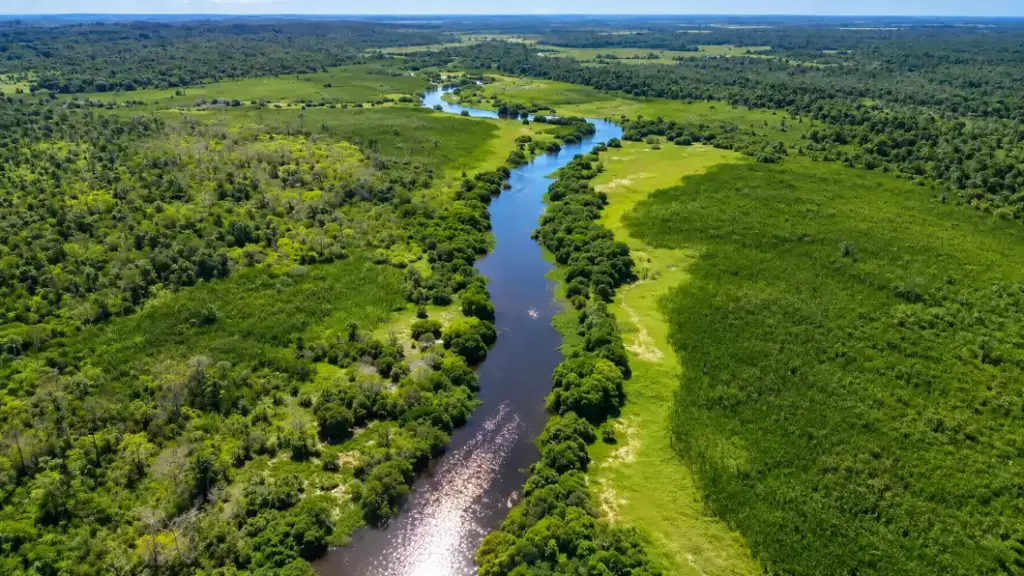
Scientists warn that the eastern portion of the Amazon and the transition zone to the Cerrado have been experiencing systematic delays in the beginning of the rainy season and longer dry periods. This is largely due to accumulated deforestation in the region, which has already affected approximately 21.6% of the biome’s original vegetation cover.
In monitored areas where forest loss is most severe, a 28% reduction in rainfall and a 2.3 °C increase in temperatures were recorded during the driest months of the year. As a result, the degradation cycle is expected to push parts of the eastern and southern biome toward an irreversible ecological tipping point, also known as a point of no return, when degradation advances so far that the forest can no longer recover, even if deforestation is halted.
Meanwhile, more than 50% of the Cerrado’s native vegetation has already been cleared, driven by the rapid conversion of land to large-scale agriculture and cattle ranching. The biome’s progressive aridification (the process of transition to a water-scarce environment) directly threatens aquifer recharge and water availability for irrigating the very grain crops that supply domestic and international markets, since the biome is considered the world’s most biodiverse savanna and plays a strategic role in the country’s water security by being home to springs and contributing to the water supply of some of Brazil’s main river basins.
The problem reaches the crops directly: research on rainfed soybeans in Goiás shows that climate change scenarios will bring more severe dry periods and less excess water throughout the year. Without enough water at the right times, crop losses are likely to rise sharply, making soybean production much more vulnerable and risky in the face of climate conditions.
Risks to food production and impacts on GDP
In short, the loss of arable land as a result of heat and water stress is the main driver of economic and social losses in Brazil’s rural areas. Agricultural projection models indicate that traditional crops and staples of the national diet, such as cassava, are at risk of disappearing from the semiarid areas of the Northeast due to intensifying drought.
The livestock sector, meanwhile, faces a crossroads involving both physical risks and regulatory transition risks. On the physical side, the expansion of pastures in the Amazon, which rose from 12.7 million hectares in 1985 to 59.1 million hectares in 2023, supporting a herd of more than 80 million cattle, exposes animals and pastures to extreme heat waves and prolonged droughts.
Simultaneous heat events and severe drought reduce soil moisture and pasture productivity, while also favoring major fires capable of reaching productive areas and rural infrastructure.
At the same time, pressure to reduce the environmental impacts of agricultural production has been translated into new rules and economic instruments. For the sector, this expands what are known as transition risks: the costs and requirements associated with adapting to a lower-carbon economy.
One example is Bill 3144/2024, which proposes creating a contribution for intervention in the economic domain (CIDE-Pecuária) to finance the Clean Livestock Fund (FUNPECLIMP), with the aim of subsidizing and encouraging the adoption of low-carbon farming techniques.
Another development was the enactment of Law No. 15,042/2024, which established the Brazilian Greenhouse Gas Emissions Trading System (SBCE), aligning Brazilian companies with global carbon credit mechanisms supervised by the United Nations (UN), in accordance with Article 6.4 of the Paris Agreement. This new regulatory environment increases the importance of risk management and socio-environmental information for agribusiness companies and investors, especially in light of international market requirements.
Is it possible to reverse this scenario?
Brazil has the technical and ecological tools to reverse part of this risk scenario. With the large-scale adoption of nature-based solutions, it is possible to neutralize around 80% of Brazil’s net emissions targets by 2050. The transition to integrated production systems, such as agroforestry systems and regenerative agriculture practices, is an essential part of the strategy to achieve this goal. These farming models combine food production with the conservation and maintenance of native vegetation cover, ensuring soil protection and fertility, the active sequestration of carbon in biomass, and the preservation of local microclimatic moisture.
- Digitized Legislation – LAW No. 15,042 OF DECEMBER 11, 2024 – Original Publication
- CLIMATE CHANGE IN BRAZIL: State of the Art and Frontiers of Knowledge
- Brazil’s role in global food security
- Renove Program – Minerva Foods
- BILL No. 3,144 OF 2024
- https://portal.inmet.gov.br/noticias/2024-%C3%A9-o-ano-mais-quente-da-s%C3%A9rie-hist%C3%B3rica-no-brasil