
Share


Brazil has established itself as the world leader in beef exports, but production volume and competitiveness have yet to translate into value to the same extent. In China, for example, U.S. beef can fetch nearly US$ 10,000 per metric ton, while Brazilian beef sells for around US$ 6,000, according to Thiago Bernardino, a researcher at Cepea/Esalq-USP. According to the specialist, part of this difference is related to standards and perceived quality. Food safety, trade agreements, trust and reputation also factor into the equation.
The challenge of turning efficiency into value also arises within the country. In the same interview, Bernardino draws attention to the difference between price and perceived value. “A person may prefer to pay R$ 200 for a tub of whey protein rather than R$ 100 for a picanha,” he says by way of example. The issue, he argues, involves not only income, but also preference, access, convenience, information and the occasion of consumption. For this reason, he maintains that the industry needs to gain a better understanding of consumers, communicate attributes such as quality, standards and origin, and show why the product is worth more.
Turning production efficiency into value, both inside and outside the country, therefore requires more than isolated efforts. The industry brings together different stakeholders and interests, and increasing the perceived value of beef also depends on greater coordination, the production of knowledge and the development of communication capable of strengthening the product’s reputation.
How can this be done collectively and on an ongoing basis? An initiative created in the United States four decades ago offers a relevant case study. The Beef Checkoff Program established a continuous funding mechanism operated by the industry itself for beef research, information and promotion, becoming a benchmark for collective mobilization and industry governance.
Originally established in the 1985 Farm Bill and made mandatory after being approved by 79% of producers in a national referendum held in 1988, the program is based on a continuous funding mechanism operated by the industry itself. Every time a bovine animal is sold in the United States, a mandatory US$ 1-per-head fee is collected. An equivalent contribution is also levied on live animals, beef and beef products imported into the country.
Revenue collection and resource management are handled by the Cattlemen’s Beef Board (CBB), a council made up of representatives of the production sector itself, under the supervision of the United States Department of Agriculture (USDA). The model provides for balanced decentralization: qualified state councils (Qualified State Beef Councils) have the right to retain up to US$ 0.50 of every dollar collected to fund local research and promotion programs. The remaining resources are directed to the national fund to finance larger-scale initiatives.
Integrity and transparency
To ensure fairness among stakeholders and maintain an institutional focus, Beef Checkoff legislation imposes strict rules on the use of funds. The money collected may not be used to promote companies, specific commercial brands or private establishments, nor may it be used for lobbying or political pressure activities.
This safeguard ensures that resources are invested exclusively in enhancing the value of beef as a global category, strengthening demand in domestic and foreign markets. Fund governance is structured through committees made up of board members appointed by the board of directors. In addition to the thematic areas (Promotion, Research, Consumer Information, Industry Information, Producer Communications and International Marketing) and the Evaluation and Operational committees (BPOC), budget management is supported by the Budget & Audit Committee.
This committee is responsible for establishing annual revenue projections and setting the Beef Board budget. To ensure accounting rigor and transparency, the group works alongside independent auditors to evaluate internal controls and procedures, recommends the hiring of the audit firm and submits annual audit reports for consideration by the full board.
What can the American model teach Brazil?
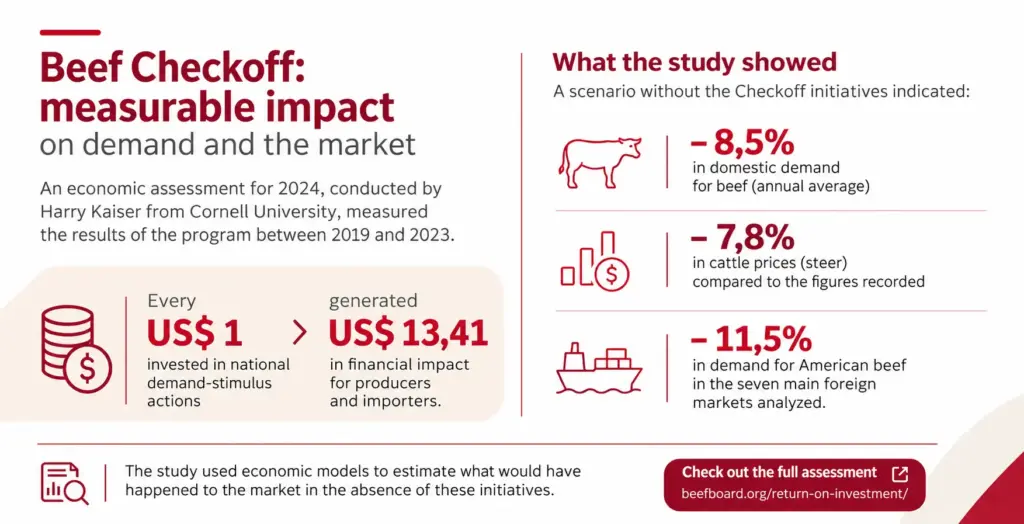
More than a revenue-collection and governance structure, Beef Checkoff has accumulated measurable results, as the infographic shows.
Brazil currently does not have a single, mandatory national mechanism modeled on Beef Checkoff. This does not mean that the industry is starting from scratch. There are initiatives focused on promoting, gathering market intelligence and enhancing the value of Brazilian beef, such as the Mato Grosso Meat Institute (Imac), which operates at the state level, and Brazilian Beef, developed by the Brazilian Association of Meat Exporting Industries (Abiec) in partnership with ApexBrasil to promote the product in the international market.
The North American experience stands out, however, for combining permanent funding, industry participation in governance, rules governing the use of resources and continuity in investments in research, consumer information, promotion and market development. Rather than financing one-off campaigns, the model makes it possible to sustain these efforts over time — and measure their results.
This does not mean that the American model can or should simply be reproduced in Brazil. But given the challenge of turning production scale and efficiency into greater perceived and captured value, both inside and outside the country, the case raises a relevant question: what structure would enable Brazil’s beef industry to address continuously issues that go beyond individual companies, brands or segments and concern the value of Brazilian beef as a product?
The United States experience shows that promotion is only one part of this effort. Consumer and market research, information, the development of new markets, governance and the evaluation of results are also part of the equation for turning production attributes into demand, reputation and value.