Share


Did you know that more than 75% of economic losses related to quality in the Uruguayan beef chain are concentrated in bruising and issues stemming from improper pH or dark cuts? That finding was revealed by the 4th Uruguay Meat Quality Audit and published by the Valor Carne portal. Conducted by INIA in cooperation with the University of Colorado, the study examined 3,207 animals in detail at seven export slaughterhouses to quantify losses from the farm to the packing plant. The results confirmed that the vast majority of quality-related financial losses remain directly linked to animal handling and welfare, both on the farm and in the pre-slaughter stages.
Researcher Dr. Marcia del Campo, lead scientist at INIA Uruguay and responsible for leading the project, argues that integrated diagnostics, which now encompass everything from welfare assessment in the field to slaughter, reinforce a central thesis: animal welfare is, above all, a strategic element in value creation across the livestock chain.
Million-dollar losses measured over time
In this fourth edition, the audit, which continues a methodology systematically applied every five years since 2003 in partnership with the University of Colorado (USA), showed that Uruguay’s beef chain continues to suffer million-dollar losses due to quality problems. Although the latest report does not present a single global figure in dollars, this monetary quantification is a hallmark of the project: the 1st Audit (2002) found that the sector was failing to capture about US$58.5 million a year. The 3rd edition put that loss at about US$30 million per year. In the most recent edition, bruising and improper pH (with resulting dark cuts) alone account for more than 75% of all identified quality-related economic losses.
All these losses share a common source: poor handling in the field, during transport and in the pre-slaughter phase, including facilities with sharp points and edges, excessive use of electric prods, overcrowding in waiting pens, prolonged fasting, long trips without rest, and drivers who are not trained to transport live animals.
The new audit found, for example, that the average incidence of carcasses with at least one bruise reached a striking 76.5% post-slaughter. As Marcia’s review of welfare-promotion strategies in Latin America documents, these factors raise cortisol and adrenaline levels in animals, deplete muscle glycogen and compromise the biochemical process that converts muscle into meat after slaughter.
The practical result shows up in the final product and in the pocketbook. The meat becomes darker, drier, has compromised texture and a shorter shelf life. Financially, carcasses are devalued, with cuts rejected by demanding importers who require pH strictly below 5.8.
The 2024 study statistically confirmed this direct link between physical stress and biochemical quality: animals without bruises recorded only 8.8% rejection due to high pH, while those that suffered four to five bruises saw that rejection rate nearly double, climbing to 15.8%. On the other hand, the survey also brought significant progress: 96.6% of the cuts evaluated showed a normal visual meat color — a historic reduction in dark cuts driven by younger slaughter ages and better feed finishing (especially feedlot diets) — and confirmed that export slaughterhouses operate in compliance with international pre-slaughter animal welfare requirements.
The article “Animal welfare also has an impact on meat quality” details the physiological mechanisms behind this process, explaining how pre-slaughter stress alters the meat’s final pH and affects color, texture and water-holding capacity. At the same time, the article “What lies behind beef quality?” places welfare in the broader context of a chain of decisions that determines what the consumer finds on the plate.
| The Uruguayan case: animal welfare as state policy and an export advantage Uruguay is the only Mercosur country that conducts periodic audits of the meat chain’s quality. The methodology, developed by INAC and INIA in partnership with the University of Colorado (USA), has been applied every five years since 2002 — with the 4th edition published in 2024. The exercise allows the sector to track how losses evolve, identify critical points in the chain and propose evidence-based corrective measures. This systematic approach translates into a real competitive advantage: INIA Tacuarembó studies show that well-structured carcass grading systems and quality criteria allow Uruguay to differentiate its meat in high-value markets (Europe, Japan and the U.S.) with price premiums linked to traceability, welfare and verifiable sensory quality. Marcia del Campo sums up the logic: when producers understand that animal welfare directly affects financial results — less loss, better meat, better markets — adopting good practices stops being a matter of ethical conviction and becomes a business decision. |
Handling without violence: science, not romanticism
The expression may sound gentle, but it has precise technical grounding. What Del Campo and INIA researchers call “handling without violence” is the application of ethological principles — the study of animal behavior — to reduce stress at every point of contact with humans: moving animals through pens, loading, transport and pre-slaughter. The Uruguayan project consolidated this scientific view by expanding assessment beyond the industry and incorporating diagnostics directly at farm level. In doing so, researchers obtained the so-called “full picture” of animal welfare across all links in the production chain.
This includes using facilities designed in line with cattle’s natural behavior, such as curved alleys that take advantage of their instinct to return, proper lighting to prevent shadows from causing refusal to move forward, and non-slip surfaces that reduce falls and fractures. The low-stress handling system developed by American zoologist Bud Williams, and extensively studied by American scientist and activist Temple Grandin, has shown that cattle moved calmly and in keeping with their natural behavior arrive at the slaughterhouse with less glycogen depletion, which directly translates into better meat pH.
Read also: Five domains: the science of animal welfare in practice
Three dimensions of value: economic, product and market
Well-managed animal welfare generates value in three simultaneous dimensions:
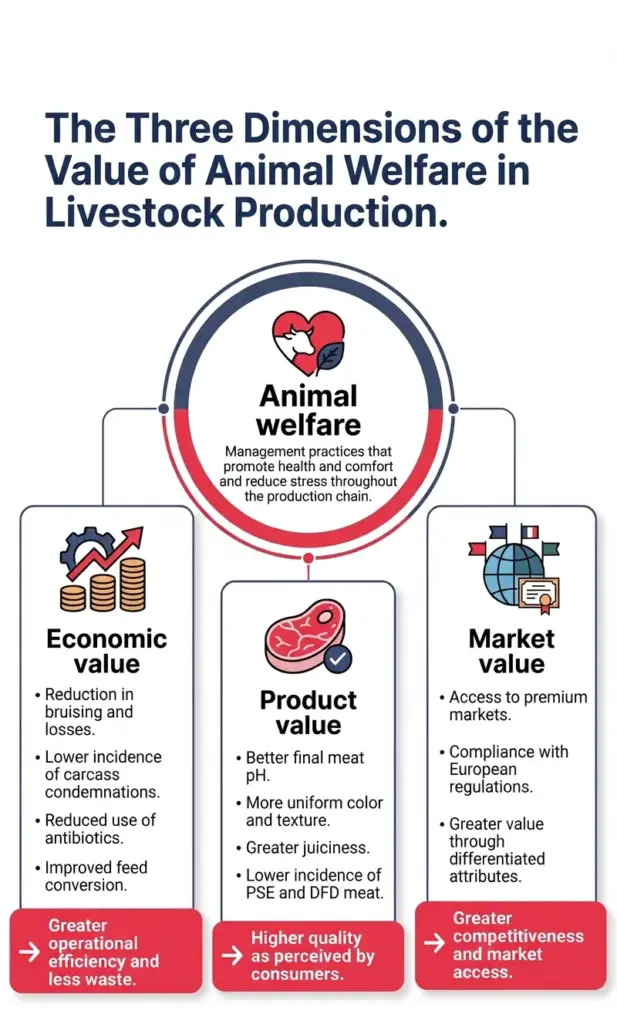
The most visible direct economic impact is the reduction of bruises and contusions. Each bruise identified on the slaughter line means meat is discarded, a cost that falls entirely on the slaughterhouse or on the price paid to the producer.
At the product level, the most frequent quality change is DFD meat (Dark, Firm and Dry), caused by prolonged stress before slaughter. PSE meat (an acronym for Pale, Soft and Exudative), although more common in pigs and poultry, can also occur in cattle, albeit far less frequently. It is a meat-quality defect characterized by a lighter color, soft texture and low water-holding capacity. The problem is associated with a very rapid drop in pH shortly after slaughter, usually triggered by intense stress just before stunning. As a result, the meat loses more liquid, its industrial yield is reduced and it may present poorer sensory quality after cooking.
At the market level, the greater value placed on products with differentiated attributes is reflected in trends across different markets, as shown by new buying habits among Americans and Europeans. In addition, international regulations are turning animal welfare from an ethical differentiator into a market-access requirement in high-quality markets.
International regulatory landscape as a driver of change
Regulation (EC) No. 1099/2009 (protection of animals at the time of killing) requires export slaughterhouses to ensure equivalent standards of protection and humane handling. Although detailed farm-level welfare rules, such as Council Directive 98/58/EC, and internal transport rules in Europe are not automatically applied to trading partners outside the bloc, the European Commission is currently reviewing its laws with proposals to tighten rules on interstate and long-distance transport
According to official Eurobarometer data and European Commission public consultations, there is strong social pressure from European citizens to extend all ethical breeding and handling standards in the bloc to imported products in order to ensure fair competition in the internal market. This trend of linking preferential tariffs to specific production criteria — as in the European Union’s trade agreement with Australia, which ties access for beef to grass-fed production requirements — serves as a commercial warning for Mercosur exporters.
Consumers also shape the changes
Pressure for animal welfare does not come only from regulation, but also from the market. The Power of Meat 2026 report, published annually by The Food Industry Association and the Meat Institute, shows that 67% of American consumers seek information about where food comes from. In addition, attributes such as animal welfare and environmental impact already influence purchasing decisions, broadening the concept of quality beyond taste.
This movement is particularly visible in the growth of welfare-certified products, such as labels like “cruelty-free,” “raised with welfare” and their European equivalents. Research published in Redalyc shows that consumers exposed to information about handling practices are inclined to pay more for certified products, signaling a market opportunity for producers and slaughterhouses that invest in good practices and make them verifiable.
The convergence between welfare, sustainability and traceability is increasingly treated as a single asset. Meats with special attributes are already gaining ground in global premium markets, with animal welfare, in this context, ceasing to be a cost to manage and becoming a sales argument.
Welfare is where ethics and business meet
The message emerging from the work of Marcia del Campo and INIA, and consistently confirmed by data from Uruguay’s quality audits, is that animal welfare does not need to be defended only on moral grounds. It stands on spreadsheets, audit results and access to markets.
When nearly all losses in the meat production chain originate in welfare problems, the relevant question for producers, slaughterhouses and exporters is not “why invest in animal welfare?” but “how much does it cost not to invest?”
- Animal welfare and meat quality: The perspective of Uruguay — ResearchGate (Del Campo et al., 2014)
- Animal welfare also has an impact on meat quality — My Minerva Foods
- Special-attribute meats are gaining ground in the global market — My Minerva Foods
- Current scenario of quality management in the beef production chain — ResearchGate
- Five domains: the science of animal welfare in practice — My Minerva Foods
- Conscious consumption as a determinant of corporate sustainability: can respecting animals be good business? — Redalyc
- Effect of Finishing Diet and Lairage Time on Steers Welfare in Uruguay — PMC / Animals (2021)
- Implementation of grading systems for beef carcass value differentiation: the Uruguayan experience — PMC / Animal Frontiers (2024)
- Measuring quality losses in Uruguay — Valor Carne (3rd INAC/INIA Audit, 2013)
- What is behind beef quality? — My Minerva Foods
- First Audit of the Uruguayan Bovine Meat Chain Quality (2002) — Plan Agropecuario
- Strategies to promote farm animal welfare in Latin America and their effects on carcass and meat quality traits — ResearchGate (Del Campo)
- What is meat in Uruguay? — Animal Frontiers / Oxford Academic (Del Campo, Brito, Montossi, 2017)