
Share


Fats, also called lipids, provide energy, contribute to cell structure and help the body absorb vitamins A, D, E and K. Some fatty acids, such as linoleic acid and alpha-linolenic acid, are considered essential because they must be obtained through the diet.
However, animal or plant origin alone does not determine the nutritional quality of a source. The fatty acid profile, the nutrients that accompany the fat, the level of processing, the amount consumed and the food used as a substitute must be considered together.
What is animal fat?
Animal fat is naturally present in meat, poultry, fish, eggs, milk and dairy products. It can also be consumed in more concentrated forms, such as butter, lard and tallow.
The composition varies among these foods. Meat and dairy products provide combinations of saturated, monounsaturated and polyunsaturated fatty acids, while certain fish contain significant proportions of polyunsaturated fatty acids from the omega-3 family. Therefore, butter, fish and beef should not be treated as nutritionally equivalent sources simply because they are animal-based.
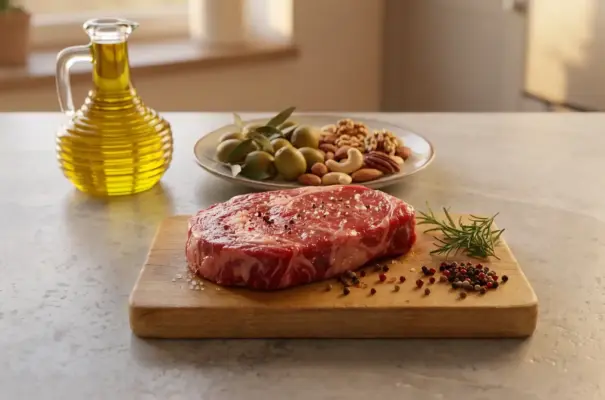
In beef, fat may appear on the surface, between different muscles or within the muscle tissue itself. When it is distributed among the bundles and fibers, it forms marbling. The amount and profile of this fat are determined before the cut is made and reflect factors such as genetics, age, diet, metabolism and production system. The cut merely separates regions that already have different characteristics.
My Minerva Foods explains how intramuscular fat relates to flavor, tenderness and juiciness in the article The secret of marbling in meat.
It is also important to distinguish the whole food from isolated fat. When it is part of meat, milk or fish, fat is consumed together with proteins, vitamins and minerals. Butter, lard and tallow, on the other hand, consist mainly of lipids and do not provide the same overall nutritional profile.
What is vegetable fat?
Vegetable fat is found in foods such as olives, avocados, nuts, peanuts, seeds and soybeans, as well as in oils obtained from these sources.
Many of these foods contain a higher proportion of monounsaturated or polyunsaturated fatty acids. Olive oil, for example, is characterized by a predominance of monounsaturated fat, while soybean, corn and sunflower oils provide significant proportions of polyunsaturated fats.
This does not mean that all vegetable fat is predominantly unsaturated. Coconut, palm and palm-kernel oils contain higher concentrations of saturated fatty acids. The World Health Organization (WHO) itself includes these oils among sources of saturated fat, demonstrating why plant origin cannot automatically be used as a synonym for a better lipid profile.
The food matrix also changes the assessment. Nuts, seeds, peanuts and avocados provide fats along with fiber, vitamins, minerals and other plant compounds. Oils are concentrated sources of lipids and do not necessarily retain all the components present in the original food.
This difference becomes even more relevant in ultraprocessed products. A food does not have better nutritional quality simply because it was prepared with vegetable oil, since it may also contain large amounts of sodium, sugars, saturated fats or other ingredients.
Nutritional differences between animal fat and vegetable fat
The most common difference between the two categories lies in the proportion of fatty acids. Butter, lard, higher-fat meats and whole dairy products tend to contain a higher proportion of saturated fat. Olive oil, seeds, nuts and many vegetable oils generally contain more monounsaturated or polyunsaturated fats.
This trend has important exceptions. Fatty fish may provide significant amounts of polyunsaturated fatty acids despite their animal origin. Coconut, palm and palm-kernel oils contain higher concentrations of saturated fat, even though they are plant-based.
Another difference is the presence of cholesterol, a compound naturally found in animal-based foods and absent from plant sources. This does not mean that every animal food contains the same amount of cholesterol, nor that the effect of a source can be assessed without considering the rest of the diet.
The associated nutrients also vary. Meat can combine fat with complete proteins, iron, zinc and vitamin B12. Fish combines protein with different proportions of omega-3 fatty acids. Seeds, nuts, peanuts and avocados provide fats along with fiber, minerals and plant compounds.
Therefore, a comparison based only on the categories “animal” and “plant” may lead to superficial conclusions. Lean beef, fish, butter, olive oil and an ultraprocessed cookie made with vegetable oil have very different compositions, purposes and levels of processing.
My Minerva Foods explores this broader assessment in the article Caring for beef: how to ensure only benefits?, which considers serving size, frequency, preparation and the composition of the meal.
Comparative nutrient table
The table compares the main sources, the predominant fatty acid profile, the presence of cholesterol and fiber, associated nutrients, energy density and the influence of processing in animal- and plant-based fats.
Because the two columns encompass broad categories, the information represents general trends. The actual profile depends on the specific food, serving size, processing and preparation.
| Compared characteristic | Animal fat | Vegetable fat |
| Main dietary sources | Meat, fish, eggs, milk, dairy products, butter, lard and tallow | Olive oil, avocados, nuts, peanuts, seeds and vegetable oils |
| Predominant fatty acid profile | Varies among saturated, monounsaturated and polyunsaturated fatty acids | Generally contains a higher proportion of unsaturated fatty acids, except for tropical oils |
| Proportion of saturated fat | May be higher in butter, lard, higher-fat meats and whole dairy products | Generally lower in nontropical oils, but high in coconut, palm and palm-kernel oils |
| Presence of monounsaturated fat | Found in meat and other animal-based foods | Present in higher proportions in olive oil, avocados and some nuts |
| Presence of polyunsaturated fat | May be significant in fish, especially fatty fish | Common in seeds, nuts and soybean, corn and sunflower oils |
| Presence of cholesterol | Cholesterol is naturally present in animal-based foods | Cholesterol is not naturally present in plant-based foods |
| Presence of fiber | Meat, eggs, milk and isolated animal fats do not provide fiber | Whole plant foods may provide fiber, but oils do not |
| Nutrients associated with the sources | Protein, vitamin B12, iron, zinc and other nutrients, depending on the food | Vitamin E, minerals, fiber and plant compounds, depending on the source |
| Energy density of fat | Fat has a high energy density | Vegetable fat also has a high energy density |
| Influence of processing | Fresh meat, processed meat, butter and lard are not nutritionally equivalent | Whole plant foods, oils and ultraprocessed products are also not equivalent |
The comparison shows that plant sources such as olive oil, nuts, seeds and avocados generally contain a higher proportion of unsaturated fats. This does not mean that every plant-based product is nutritionally superior to every animal-based food, since fish and tropical oils demonstrate that there are important exceptions.
There is also no significant difference in the energy provided by one gram of fat solely because of its origin. As concentrated sources of energy, both animal and vegetable fats should be consumed in portions compatible with individual needs.
For this reason, the table should be interpreted by considering the food matrix. A serving of nuts is not equivalent to the same amount of oil, just as beef, fish and butter do not provide the same nutrients, even though all contain fat.
Which is more suitable for each profile?
There is no universal recommendation to eliminate all animal fats or freely consume any vegetable fat. The choice depends on the food, the amount, energy needs, health conditions and the overall composition of the diet.
For the general population, olive oil, nuts, seeds, avocados and fish can help increase the share of unsaturated fats. Meat can also be part of the diet, especially when the serving size and preparation help control the total amount of saturated fat.
My Minerva Foods presents strategies for combining meat with grains, beans, legumes and vegetables in the article Ten ways to maximize the benefits of beef in daily life.
People with high levels of low-density lipoprotein (LDL) cholesterol, cardiovascular disease or a higher cardiometabolic risk may be advised to replace some sources of saturated fat with foods rich in monounsaturated and polyunsaturated fatty acids.
The central point of this strategy is substitution. Simply removing a source of saturated fat does not guarantee a benefit if it is replaced with a food of poor nutritional quality. The WHO recommends prioritizing polyunsaturated fats, monounsaturated fats from plant sources or carbohydrates from foods that are naturally rich in fiber.
Children, pregnant women, older adults and people with specific clinical needs may have different energy and nutrient requirements. Broad restrictions on fat, when adopted without assessment, may make it difficult to maintain an adequate diet.
Regardless of the individual profile, priority should be given to variety, appropriate portions and unprocessed or minimally processed foods. Plant origin does not automatically neutralize the effects of an ultraprocessed product, just as the presence of fat does not make all animal-based foods nutritionally equivalent.
What do scientific studies say?
The WHO guideline Saturated Fatty Acid and Trans-fatty Acid Intake for Adults and Children recommends that saturated fatty acids account for no more than 10% of total dietary energy for people aged two and older. The organization advises that the fats consumed should be predominantly unsaturated and that substitutions should take into account the nutrient or food replacing the reduced source.
This guidance reinforces that the comparison should not be limited to the isolated reduction of saturated fat. Replacing it with polyunsaturated fatty acids, monounsaturated fats from plant sources or carbohydrates from foods naturally rich in fiber has different implications than replacing it with refined or ultraprocessed products.
The report Fats and Fatty Acids in Human Nutrition, by the Food and Agriculture Organization of the United Nations (FAO), assesses lipids according to the types of fatty acids and their physiological functions. This approach helps explain why fish differs from butter and why olive oil and coconut oil do not have the same profile, despite belonging to the same origin category.
The opinion Scientific Opinion on Dietary Reference Values for Fats, by the European Food Safety Authority (EFSA), establishes reference values for total fat, saturated, monounsaturated, polyunsaturated and trans fatty acids, and cholesterol. By separating these categories, the institution also avoids an oversimplified opposition between animal and vegetable fats.
The American Heart Association (AHA) recommends replacing foods high in saturated fat with sources of unsaturated fat, such as olive oil and canola or soybean oils, as well as nuts and fish. When meat is consumed, the organization recommends options with lower fat content.
Taken together, the evidence favors dietary patterns with a greater share of unsaturated fats. This does not make plant origin an automatic guarantee of quality, nor does it require the complete elimination of all animal sources. The fatty acid profile, food matrix, processing, amount consumed and substitution made are the most useful criteria for guiding choices.
- My Minerva Foods — Caring for beef: how to ensure only benefits?
- My Minerva Foods — The secret of marbling in meat
- My Minerva Foods — Ten ways to maximize the benefits of beef in everyday life
- World Health Organization — Healthy Diet
- World Health Organization — Guideline on saturated and trans fatty acids
- Food and Agriculture Organization of the United Nations — Fats and Fatty Acids in Human Nutrition
- European Food Safety Authority — Dietary Reference Values for Fats
- American Heart Association — Saturated Fats