
Share


In the European market, the choice of beef is influenced not only by the qualities perceived in the product, but also by how it was produced. Origin, sustainability and practices adopted throughout the supply chain have become part of consumers’ perception of value, making them decisive factors in commercial differentiation and justification for a premium price, according to data from the European Beef Shopper Insight (Wave 7) report, developed by Bord Bia’s market research and consumer insights center (the Irish Food and Drink Board), which mapped the perceptions and habits of meat buyers across multiple countries in the European bloc.
In this context, the grass-fed label (under which cattle feed exclusively on forage and natural pasture throughout their lives) stands out, being cited as a motivator for future purchases by 38% of beef consumers in Ireland, the market leading this interest in the bloc. The phenomenon is even more pronounced in Italy, where 34% of consumers say that grass-fed beef is a purchase motivator, representing a three-percentage-point increase in a single year and establishing the region as one of the markets most receptive to this production model.
Italy’s leading position is due to a highly strategic commercial dynamic: although Ireland leads in absolute terms (38%), Italy stands out as the export market with the “perfect fit” for this credential because of three crucial factors revealed by the study.
The first is the dynamism and rapid acceleration of demand: while interest in Ireland is practically consolidated and stable (+1% year-on-year), demand for grass-fed beef in Italy recorded the most significant growth on the entire continent (+3% over the same period). The second factor is the cultural synergy with local consumer demands. The report’s statistical mapping shows that Italian buyers are the most motivated by farm-to-table traceability, naturalness (meat free from additives) and animal welfare — ethical and quality requirements directly endorsed by the grass-fed label. Finally, Italy has the lowest price resistance in the bloc: only 8% of Italian consumers identify high prices as an obstacle to buying beef, compared with 12% in Ireland and 20% in Germany, creating the ideal scenario for importing lines with extremely high added value.
How do “grass-fed” labels impact the commercial performance of products?
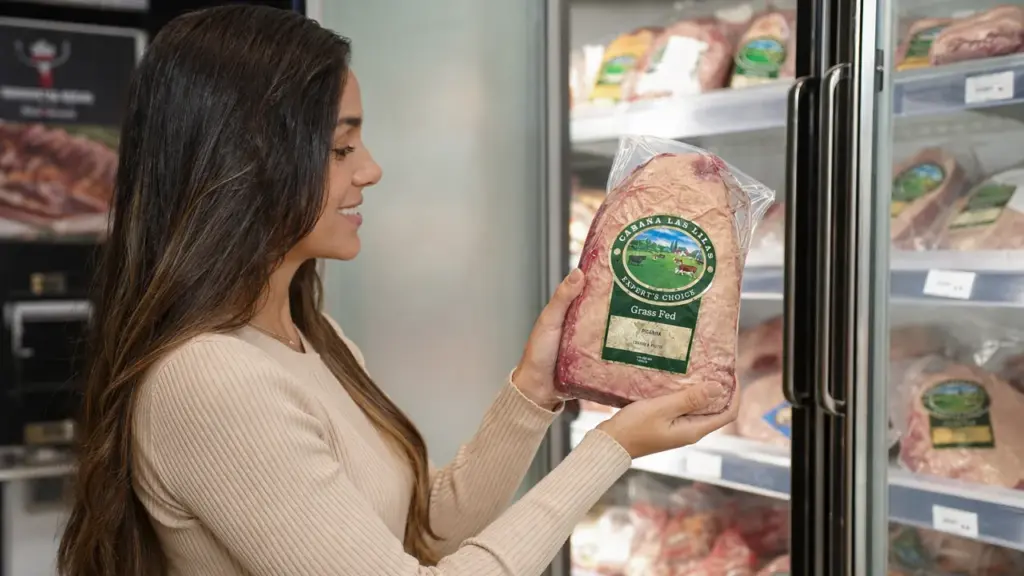
Data compiled by Bord Bia show that the presence of attributes such as grass-fed helps rationalize the product’s value for consumers, justifying why it costs more than local options or competing proteins. In retail, this helps ease consumers’ ethical and environmental concerns, acting as a “feel-good factor” that keeps them engaged in the beef category.
In addition, the strong value European consumers place on high-quality and sustainability attributes serves as an excellent negotiation tool for producers and exporters when dealing with supermarket chains, providing a technical justification for securing more shelf space, higher price tiers (tiering) and greater support in joint marketing campaigns.
Price premium on store shelves
The survey also reveals that the price-premium thesis is broadly validated on store shelves: in Germany, one of the most valuable markets monitored by the study, 77% of respondents agreed with the premise that beef is a protein “worth paying more for.” This perception of superior value is consistent across the continent, reflected in approval rates of 74% in the United Kingdom, 71% in Sweden and 69% in Italy. These robust percentages provide financial support for the strategy of global brands, proving that the European market is ready to absorb and value products with certified high quality.
Sensory appeal and the strategic role of packaging
Bord Bia research shows that shoppers evaluate beef on the shelf through a combination of immediate tactile and visual impressions and informational cues: the physical appearance of the cut (such as the appropriate level of fat and visual freshness) is assessed alongside clear descriptors on the packaging, quality-award labels and brand imagery.
Therefore, ensuring that the physical presentation of the meat is as appealing as possible, combined with packaging that communicates these production credentials clearly, both visually and in text, at the point of sale is essential to triggering purchase and reinforcing the perception of high quality.
The modern European consumer’s “mindset”
Simplistic labels that merely describe the cut or country of origin without detailing production practices fail to establish a bond of trust with an increasingly skeptical and well-informed audience. According to the Bord Bia report, consumers also use production methods as a way to “reassure” themselves and ethically validate their consumption choices. Attributes such as sustainability, traceability and animal welfare are among the greatest differentiators and motivators for future purchases in the European bloc. However, priorities vary by region, as summarized below based on the study’s statistical mapping:
| Region / Countries | Consumer profile | Most valued attributes |
| Italy, Germany and Sweden | Ethics-, origin- and quality-oriented. | Farm-to-table traceability, animal welfare (ethical farming), naturalness (free from additives/preservatives), guaranteed origin and grass-fed production. |
| United Kingdom | Practical and focused on value and convenience. | Value for money, eco-friendly packaging, cooking instructions and recipe suggestions. |
| Belgium and the Netherlands | Focused on ecosystem integrity. | Sustainable production methods and environmental impact. |
Source: Statistical Correspondence Analysis – Future Purchase Motivators / European Beef Shopper Insight
Cabaña Las Lilas: global premium positioning
The practical application of this high-value, differentiated strategy can be clearly seen in the portfolios of major global companies, particularly Minerva Foods, South America’s leading beef exporter. An emblematic example of this strategy is the Cabaña Las Lilas brand. Developed from British breeds with worldwide recognition for excellence, such as Angus and Hereford. As the European market demands, the animals raised for the line’s cuts roam freely on natural South American pastures. This extensive farming method not only directly aligns with Europe’s strict demands for animal welfare and sustainability, but also connects with the central conclusion of the Bord Bia report: transparent production processes focused on natural management serve as the main sales argument because they directly result in a superior sensory taste experience for the end consumer.
In this way, the European beef market has completed a definitive transition: consumers are willing to pay more, but demand clear sustainability, origin and animal-welfare credentials as reassurance. For premium-positioned brands such as the Cabaña Las Lilas Grass Fed line, commercial success depends on translating natural production methods into sensory appeal at the point of sale and a superior taste experience on the plate.