Share


When choosing meat at the supermarket, consumers usually look at the cut, appearance, expiration date and price. There is, however, another important piece of information on the package: the sanitary inspection seal. It indicates that the product was made at an inspected facility and complies with the requirements established for foods of animal origin.
Meat, milk, eggs, honey, fish and processed meat products may only be legally marketed after inspection by a competent public authority. Depending on where the product will be sold, this inspection may be municipal, state or federal: SIF stands for Federal Inspection Service, SIE for State Inspection Service and SIM for Municipal Inspection Service. The difference between them is not the level of rigor, but their scope: each one authorizes the sale of products within a different marketing area. It is precisely this broader reach that makes the SIF the best known (and most relevant) of the three.
What is the SIF and why is it mandatory
The SIF is the federal sanitary inspection system for products of animal origin, linked to the Department of Inspection of Products of Animal Origin (DIPOA) within the Secretariat of Agricultural Defense of the Ministry of Agriculture and Livestock (MAPA), and regulated by the Regulation for the Industrial and Sanitary Inspection of Products of Animal Origin (RIISPOA). It is mandatory for any establishment that wants to sell its products:
- Across state lines (interstate commerce); or
- To other countries (exports).
In other words, a company that sells only within its own municipality may operate with the SIM, while one that sells throughout the state must have the SIE. But as soon as the product crosses state or national borders, the SIF becomes a legal requirement, as established by Decree No. 9,013/2017 (RIISPOA). This broader scope makes the SIF seal a market differentiator, not merely a bureaucratic obligation. It:
- Provides access to national and international markets;
- Is usually associated with larger-scale operations and more robust industrial facilities;
- Requires compliance with additional standards, since exporting companies must also meet the sanitary rules of importing countries—requirements that supplement, rather than replace, SIF standards.
Today, Brazil exports products of animal origin to more than 180 countries, and the SIF seal assures those markets that the products came from facilities under official DIPOA inspection.
How the SIF works in practice
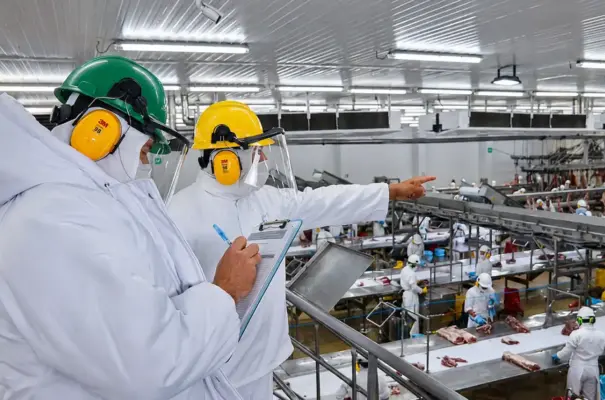
The SIF is not a seal earned once and valid forever. It exists because there is continuous inspection within the industrial facility itself. According to the Ministry of Agriculture, the service operates permanently at registered establishments, monitoring every stage of production. Several points demonstrate the seriousness of this process:
- Inspection is carried out continuously inside the slaughterhouse itself by official personnel affiliated with the Federal Inspection Service.
- Veterinarians and Federal Agricultural Tax Auditors work directly at the facility.
- Each slaughterhouse with SIF certification must have its own associated inspection structure. At large companies such as Minerva Foods, this means that controls are repeated at each facility rather than managed centrally.
- Monitoring covers the entire production cycle: before, during and after slaughter.
What the SIF evaluates
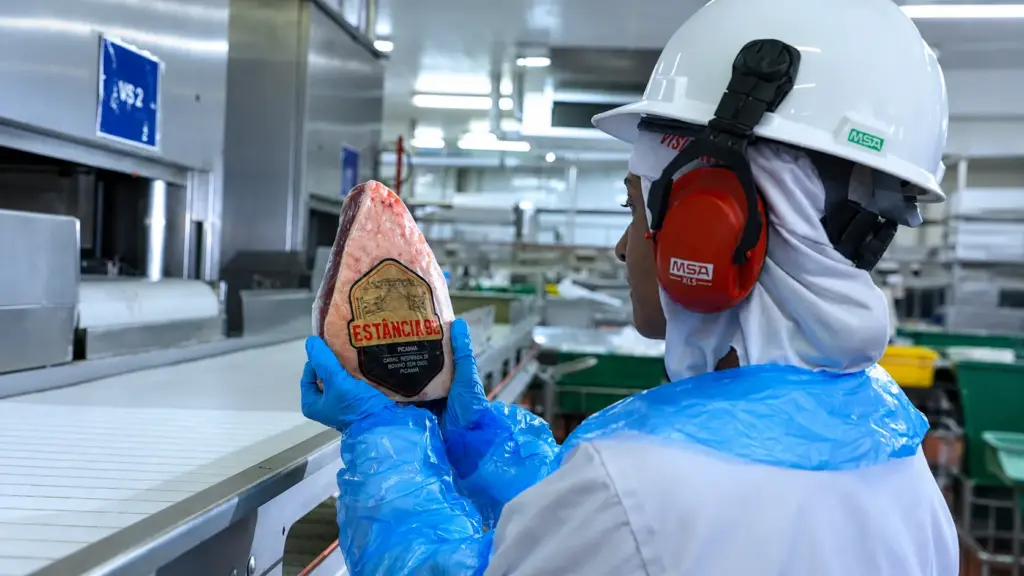
According to Decree No. 9,013, the main criteria verified during inspection include:
- Animal health before slaughter;
- Slaughter and processing conditions;
- Cleanliness of facilities and equipment;
- Temperature control and storage;
- Microbiological and chemical laboratory analyses;
- Companies’ own self-monitoring programs;
- Proper labeling and identification of products.
These requirements are part of the RIISPOA.
Compliant or non-compliant: there is no middle ground
Unlike other evaluation systems, the SIF does not use grades or cutoff scores. Compliance with legal requirements determines whether an establishment is compliant, while irregularities may result in administrative measures established under the RIISPOA, including notices, fines, suspension of activities, closure and cancellation of registration.
What the seal guarantees—and what comes after it
In practice, finding the SIF stamp on the package means that the product was made at an establishment registered with and inspected by the Ministry of Agriculture and Livestock, monitored throughout the entire production process and compliant with the sanitary requirements established under Brazilian law.
For Brazil, as an exporting market, it is also one of the factors supporting international markets’ confidence in Brazilian meat. In a sector increasingly focused on transparency and traceability, understanding what lies behind the SIF seal also means understanding how public health protection works and how the safety of the food that reaches families’ tables is guaranteed.
Learn more!
To understand seals that go beyond this minimum standard—such as certifications of origin, animal welfare or environmental impact—it is also worth reading: