Share


Imagine walking into a traditional parrilla and ordering a generous Bife de Chorizo. A few meters away, at a modern New York-style steakhouse, the waiter recommends the iconic New York Steak. If you choose a refined bistro serving classic cuisine, the menu will highlight a succulent Entrecôte. At an authentic Texas smokehouse, the main course will invariably be Brisket, after spending twelve to eighteen hours in a pit smoker.
As these names gained ground in restaurants, butcher shops and food shows, they also began to raise a common question: do they identify genuinely different cuts, or are they simply new names for meats we already know? The answer involves much more than translation. It has to do with how the carcass is boned, how the cut is presented, preparation techniques and even the food culture of each country.
There is also a curiosity that helps explain this world: many of these cuts originate in the same anatomical region of the animal. What changes is the way each tradition separates, uses and values these muscles, creating products with significantly different characteristics, applications and eating experiences.
Browse the content:
- Different names for beef, new ways of consuming it
- Beef with different names: when is it the same thing, and when does everything change?
- According to Luciano de Andrade, it is important to distinguish two concepts that help answer this question: specialty cuts and premium beef.
- Origin, technique and culture: the triad behind cuts with special names
- After all, does a “foreign” name mean a superior product?
Different names for beef, new ways of consuming it
“In some cases, foreign names identify genuinely different cuts. In others, they are simply names for cuts we already know. What they all have in common is that they represent a new way of consuming beef, in which technique, origin, preparation method and food culture add value to the product,” explains Luciano de Andrade, special lines manager at Minerva Foods.
In addition to making it easier to standardize products intended for international markets, adopting these names serves as a quality indicator. By choosing terms that are internationally established, the industry communicates to consumers that the product was obtained from raw material capable of delivering the gastronomic experience traditionally associated with that cut.
This movement has gained strength in recent years with the expansion of steakhouses, the growing popularity of South American parrillas and American barbecue, as well as the influence of chains such as Outback, which helped familiarize Brazilian consumers with names such as New York Steak, Strip Steak and Prime Rib.
As these names began appearing on menus, in butcher-shop displays and on specialty shelves, questions also arose among consumers. After all, do they represent genuinely different cuts, or simply a new name for cuts we already know? And why use names in English, Spanish or French in a country recognized worldwide for its beef production?
According to the specialist, answering these questions requires looking beyond the name of the cut. It is necessary to understand how each country bones the carcass, which characteristics of the meat are valued and how gastronomy has transformed these products into distinct eating experiences.
Beef with different names: when is it the same thing, and when does everything change?
In practice, foreign names can represent three distinct situations.
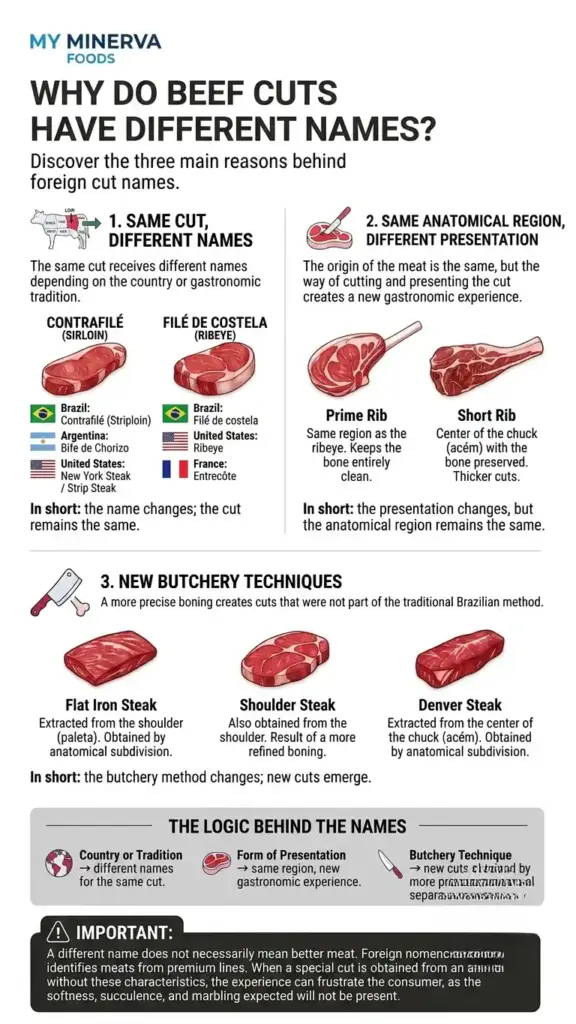
The first is the simplest: the same cut receives different names depending on the country or culinary tradition. Brazilian contrafilé, for example, corresponds to Bife de Chorizo in Argentina and New York Steak (or Strip Steak) in the United States. Our filé de costela is also known as Ribeye in the American standard, or Entrecôte in French cuisine.
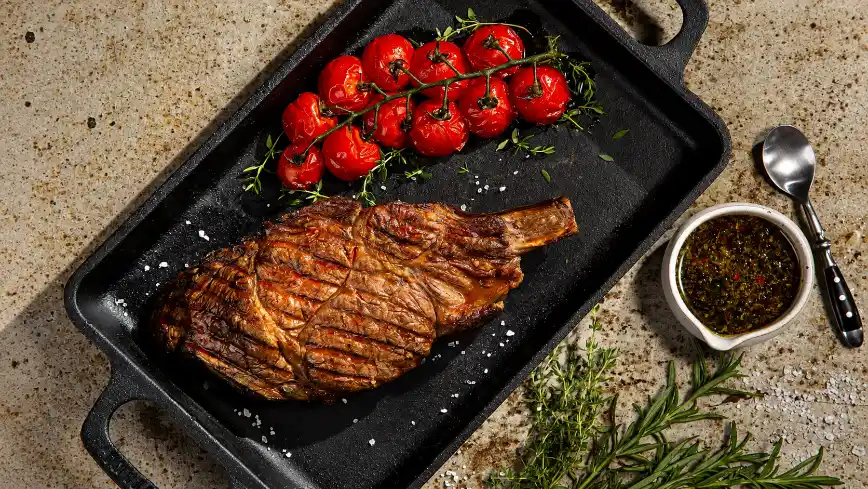
The second situation involves cuts obtained from the same anatomical region but presented differently. Prime Rib, for example, comes from the same region as filé de costela; however, it differs because the technique preserves and cleans the bone, changing the appearance of the dish and the cooking process itself. The same applies to Short Rib, whose bone attached to the center of the chuck is preserved. The cut is sold in thicker portions, suitable for grilling or skewering.
Finally, there are cuts that truly represent new ways of boning. According to Andrade, this is the case with cuts such as Flat Iron, Denver Steak and Fralda Red, which have no direct equivalents in the old Brazilian cutting guide. They result from extremely precise boning, requiring such complex trimming and membrane removal that new muscle groups are isolated, transforming formerly undervalued areas into exceptionally tender delicacies.
Much of this innovation occurred precisely in the forequarter of the animal. Areas such as the shoulder and chuck, historically destined for grinding or slow cooking, began producing cuts valued for grilling, increasing carcass utilization and adding value to muscles previously considered less noble.
| Beef cuts: degree of compatibility between foreign and Brazilian names Different names for beef | Brazilian equivalent | What changes? |
| Bife de Chorizo | Contrafilé | Same cut; only the name changes. |
| New York Steak / Strip Steak | Contrafilé | Same cut; only the name changes. |
| Bife Ancho | Filé de costela | Same cut; only the name changes. |
| Ribeye | Filé de costela | Same cut; only the name changes. |
| Entrecôte | Filé de costela | Same cut; only the name changes. |
| Prime Rib | Filé de costela | The cleaned bone is retained, changing the presentation and preparation. |
| Short Rib | Center-cut chuck with bone | The bone is preserved and the cut is sold in thicker portions. |
| Shoulder Steak (Marucha) | Raquete (shoulder) | Obtained through more refined boning. |
| Flat Iron | Heart of the shoulder | Cut created through anatomical subdivision. |
| Denver Steak | Center-cut chuck (Chuck Roll) | Cut created through anatomical subdivision. |
| Brisket | Beef brisket | In addition to the cut, the name refers to the traditional slow preparation in smokers (pit smokers). |
| Fralda Red | Fraldinha | The name is similar, but “red” refers to the fact that it has no fat cap, only meat. |
Are cuts with different names better, or simply more expensive?
While a specialty cut refers to how the piece is separated from the carcass and presented to consumers, premium beef involves factors beyond technique and the knife: it depends on the quality of the raw material, determined by factors such as genetics, the animal’s age, fat cover and the feed the animal received throughout its life. This means it is perfectly possible to obtain a Flat Iron, Denver Steak or Prime Rib from an ordinary animal. Technically, the cut will remain the same. The problem is that the experience will hardly live up to the expectations created by the name.
These names are used by the industry to identify premium product lines sourced from animals with superior classification. When a specialty cut is taken from ordinary beef and marketed solely through the appeal of its name, consumers tend to be disappointed because the expected tenderness, juiciness and marbling simply will not be there.
Andrade explains.
That is precisely why, according to the specialist, meatpackers such as Minerva Foods reserve these names for premium lines. First, the carcass is classified according to criteria such as age, genetics and fat cover. Only then do certain cuts receive names such as Shoulder Steak, Short Rib or Prime Rib. Thus, while commodity-standard animals go to traditional cut lines focused more on everyday consumption, lots of proven excellence are destined for brands aimed at special occasions or haute cuisine, such as the Estância92 and Cabaña Las Lilas lines. In these premium divisions, refined knife work is combined with high-quality raw material, delivering the tenderness and juiciness consumers expect and validating the product’s added value.
Origin, technique and culture: the triad behind cuts with special names
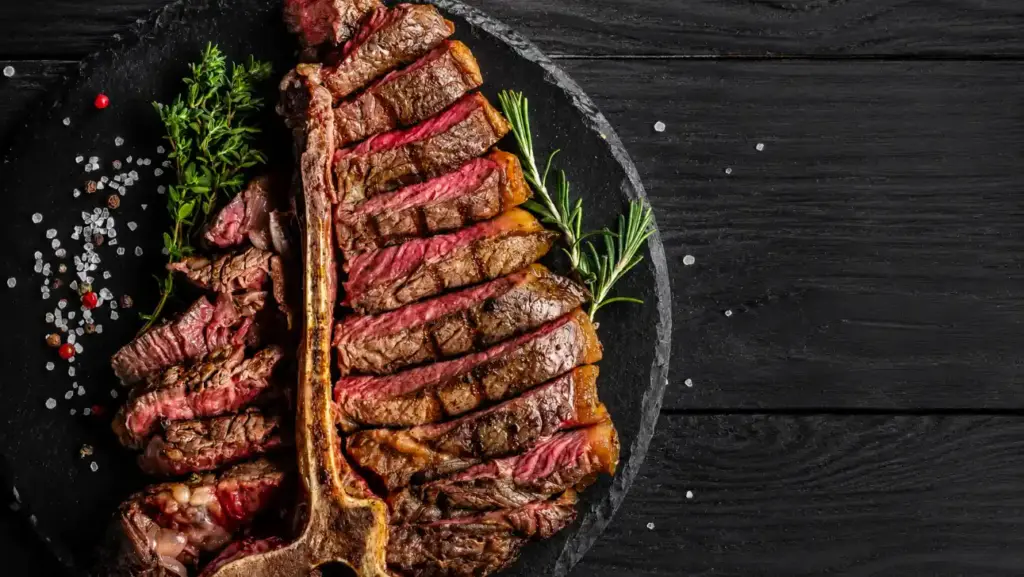
The different names for beef cuts go far beyond a matter of language or marketing. They reflect the evolution of how meat has come to be produced, boned, prepared and valued in different culinary traditions. More than identifying a cut, these names communicate an expected eating experience shaped by the combination of technique, origin and culture.
In this context, knife technique plays a central role. More precise boning makes it possible to isolate muscles, preserve bone structures and create new forms of presentation capable of changing texture, juiciness, yield and the experience at the table itself.
But this transformation is only complete when it is accompanied by raw material of a suitable quality. Specialty cuts taken from premium beef enhance attributes such as tenderness, marbling and flavor. Without this foundation, the sophistication of the boning and presentation will hardly be enough to deliver the experience suggested by the name.
After all, does a “foreign” name mean a superior product?
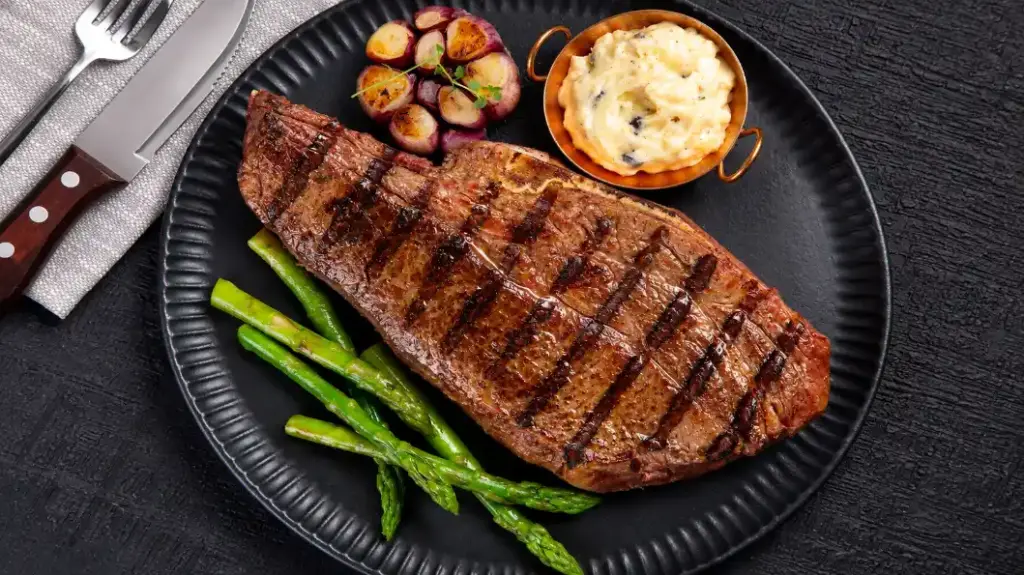
Foreign names do not merely represent a new way of naming beef cuts, but neither do they guarantee a superior product on their own. They reflect a technical evolution in the production chain and a different way of communicating value to consumers—a value confirmed when the name is accompanied by quality raw material, cutting technique and the gastronomic experience that name promises.