Share


“In a first-rate steer, there is no second-rate meat.” Marcelo Conceição, also known as Marcelo Bolinha, has repeated the phrase for more than a decade to explain an idea that runs through his career: more important than the cut is the meat’s origin and how each cut is used.
If the steer is high quality, cuts such as neck, shank, shoulder, brisket or chuck are not inferior cuts. In the view of the gaucho butcher and barbecue expert, they are cuts that require techniques different from those used for picanha or striploin. In other words, you need to know them.
Bolinha says he began using the phrase during an edition of Vitrine da Carne Gaúcha, a project in which he participated for years at the International Exhibition of Animals and Agricultural Implements and Family Farming Fair (Expointer). A producer asked why part of his animals’ carcasses was classified as second-rate meat if some of his best barbecues were prepared precisely with forequarter cuts. “He said: ‘The best barbecues on my farm are made with forequarter ribs, brisket, chuck and shoulder.’ And the slaughterhouse said it was second-rate,” Bolinha recalls. The response eventually became a kind of summary of his work.
A teenager inside the butcher shop
Bolinha’s relationship with meat began before he had any career plans. His father, who came from Pelotas, in Rio Grande do Sul, bought a butcher shop in Porto Alegre in 1986. Bolinha was 14 or 15 years old and had a routine very different from the one awaiting him behind the counter. “I had long hair, a pigeon chest, I was a surfer and always tanned,” he says, laughing. Until one day his father called on him to help out at the butcher shop.
The nickname also came from his father. The original Bolinha in the family was his father, who was short and chubby. The name was passed on to his son and eventually became his professional brand.
It was inside the butcher shop that Marcelo learned the trade. His father, now 80, made a distinction his son still remembers: he said he had never been a butcher, but rather a butcher-shop owner. He did not cut meat. But he knew how to run the business.
Marcelo took a different path. He stayed behind the counter, learned to debone and cut meat, examine a carcass and understand what could be done with each piece. When his father retired in the early 1990s, he remained in charge of the shop. Not long afterward, he began taking that knowledge beyond its walls.
From that decade onward, he began providing consulting services to butcher shops and supermarkets in different states. Rondônia, Roraima, Acre, Tocantins, Minas Gerais and Maranhão became part of his itinerary. The work involved management, utilization and sales, always with meat at its core.
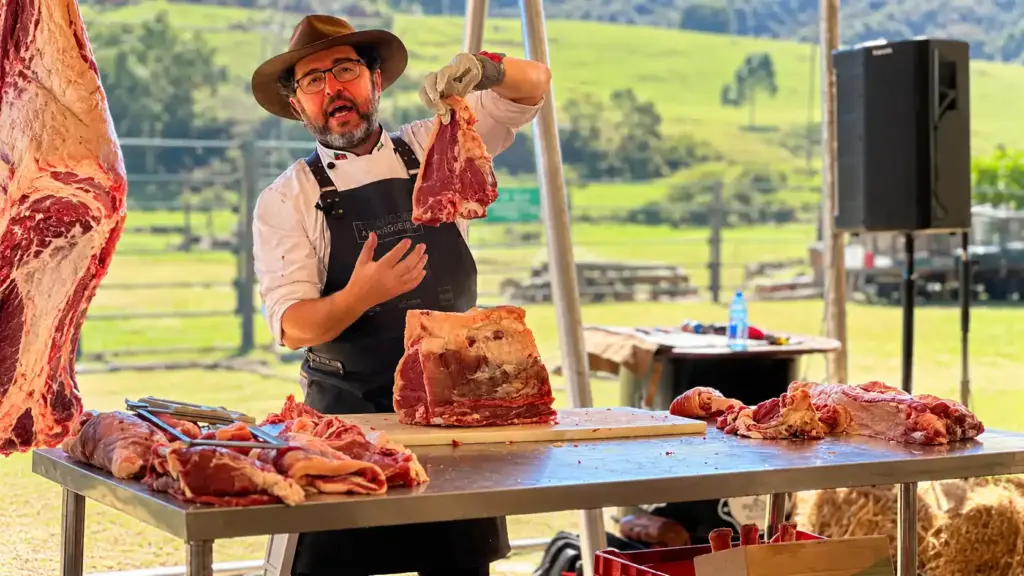
The shift in scale came with Vitrine da Carne Gaúcha, a project in which he brought an entire carcass inside a glass structure and, in front of the public, showed how that meat could be deboned, divided and fully utilized.
Bolinha stood inside the display case, microphone in hand and knife in the other. Outside, specialists in fields such as animal production and veterinary medicine helped answer questions from the audience. “I had an hour and a half to give a presentation on that meat,” he says.
The format transformed an activity normally hidden in the back rooms of butcher shops and slaughterhouses into a public demonstration. The goal was not merely to show knife skills. It was to explain where the cuts came from, how they could be prepared and why less highly valued parts of the carcass also had a place in the kitchen.
Over the years, Bolinha began taking Vitrine to different events, with demonstrations of deboning and the utilization of beef, pork and lamb. At Expointer, he became a regular presence on the program.
Vitrine da Carne Gaúcha also expanded his contact with researchers, veterinarians, ranchers and specialists. Without academic training in the field, Bolinha says he built his knowledge mainly through practical experience, supplemented by the exchanges he accumulated along the way.
New cuts for an old idea
Curiosity about how to make better use of a carcass also led Bolinha to experiment with new cuts and presentations. In 2019, during a demonstration with Angus beef at Expointer, he removed the bone from a T-bone and tied the cut around the center. According to a record published at the time by the Brazilian Angus Association, it was the first time that cut had been made. Chef Bruno Ivanoff, who was taking part in the activity, named it “Dom Pedrito,” referring to the animal’s place of origin.
Bolinha also claims responsibility for creating other forms of presentation that spread through butcher shops. One of them uses the sirloin cap. After being trimmed, the piece is rolled in a way that resembles a snail, highlighting a cut that, according to him, had little demand. “One of the things I am most proud of is the sirloin cap. It was a cut nobody liked,” he says. He says he prepared the cut this way for the first time in 2009 and, years later, saw the presentation become common in butcher shops across the country. Recipes and videos published by third parties do indeed associate the preparation with him.
More than claiming a patent on every cut, however, his career reflects a movement that has gained strength in the Brazilian market: seeking value in parts of the carcass that for a long time ranked behind picanha, filet mignon and striploin in consumer preference. That is where the “first-rate steer” maxim comes back in.
For Bolinha, cutting technique and preparation go hand in hand. A shank should not be treated like picanha. A naturally firmer cut may respond better to another type of cooking. For him, the problem begins when the classification of meat as “first-rate” or “second-rate” becomes synonymous with good or bad meat.
Read also: From the grill to the pot: how to choose the best beef cuts
Barbecue expert, not just a grill cook
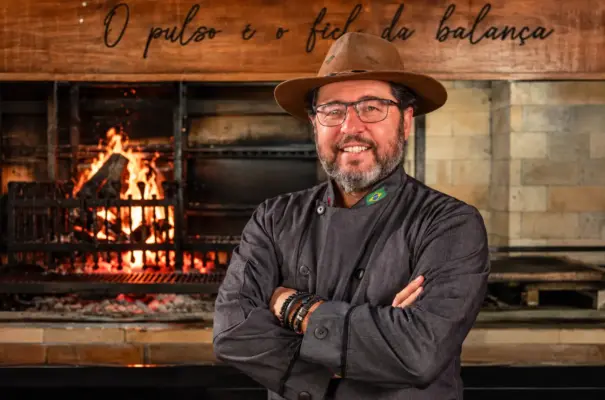
If the butcher shop explains one part of the specialist’s career, barbecue explains the other. Bolinha defines himself as an assador, a term strongly associated with the culture of Rio Grande do Sul and also with the region’s proximity to Argentina and Uruguay. In practice, he says, an assador and a churrasqueiro may perform the same role. The choice of word mainly conveys a cultural identity. “Meat is part of the culture here. It is not just another food,” he says.
At his home, for example, barbecue is not an activity reserved for recordings, courses or events. It is part of the family routine. He says he rarely goes a week without lighting the fire, and that his son has already taken over the grill at larger gatherings, with up to 40 people.
This familiarity also explains his resistance to turning barbecue into a collection of sophisticated rules. The model he advocates is what he calls “rooted” barbecue: well-chosen meat, salt and mastery of the fire. “The main mistake made by an assador or churrasqueiro is not knowing how to control the fire. It is the first thing and the most important thing,” he declares.
There is also a kind of collective oversight around the gaucho barbecue. Bolinha jokes that a mistake made at a family barbecue may be remembered ten years later. Guests do not simply remain at the table: they move closer to the fire, watch the meat, offer opinions and ask about the ribs. In this sense, the barbecue grill is also a place of memory.
Learning to look at meat
The knowledge built in the butcher shop and around the barbecue was also shaped by contact with other realities. After leaving Rio Grande do Sul to work in different regions of the country, Bolinha says he reconsidered assumptions he held about breeds, animal husbandry and quality. Contact with ranchers and different production systems showed that climate, pasture, genetics and regional characteristics affect the result. It also taught him, he says, to recognize the limits of his own knowledge. “I try not to venture into areas I have not studied,” he says.
Today, his work includes courses, lectures, events, content production and consulting for butcher shops, supermarkets and slaughterhouses. He has worked in different countries and continues to operate a meat-processing facility in Porto Alegre, where he produces items such as hamburgers, meatballs, steaks, strips and sausages.
But the principle remains close to that counter where he began as a teenager. For Bolinha, meat sellers need to know how to explain the product in front of them. Why is the fat more yellow? What changes from one cut to another? Which preparation suits a particular piece? What does aging mean? “Customers want a lesson today. If they do not get the information there, they pick up their phone and get a lesson right away,” he says.
What began as an apprenticeship in a butcher shop eventually became a way of transmitting knowledge and bringing together technique and passion, industry and customer, from behind the counter to the display cases.
Bolinha is one of the influencers for Minerva Foods brands Cabaña Las Lilas, Estância 92 and PUL, focusing on sharing his knowledge of cuts, meat and barbecue while valuing the biome, products and traditional techniques of Rio Grande do Sul.