
Share


Concerns about the impact of global meat production and consumption patterns have led to growing interest in “alternative” sources of protein. Among them, we can highlight products made from plant-based raw materials, such as those produced with soy or pea protein. There is also another innovation known as “lab-grown meat” or “cultivated meat,” manufactured from animal cells but without raising or slaughtering animals.
Many invested significantly in these options several years ago. However, investments in some projects have proven increasingly unpromising in the plant-based protein sector, with several companies losing significant market value or even going bankrupt (1). As for “cultivated meats,” the bet is still on, although progress remains very modest compared with the forecasts made ten years ago.
Approximately ten years ago, I began doctoral research at the University of Adelaide, in Australia, and compared various types of meat with these two protein alternatives: plant-based products, which were already on the market, and the promising new entrant, made in a laboratory. Our objective was to understand consumers’ perceptions of these foods and how they would evaluate them comparatively when placed side by side with traditional products (e.g., beef).
In this research, we measured and compared the beliefs of 1,078 Australian consumers regarding beef (conventional), plant-based alternatives (sometimes referred to as “plant-based meat” throughout this article), and lab-grown meat products across six attributes: affordability, healthiness, safety, enjoyment of eating, animal welfare, and environmental friendliness.
And what did we find? Across all attributes, beliefs regarding plant-based meat alternatives were more positive than those regarding lab-grown meat, and, in terms of environmental sustainability, plant-based products were viewed more positively than all the other products.
The survey results for the six attributes are presented in Figure 1:
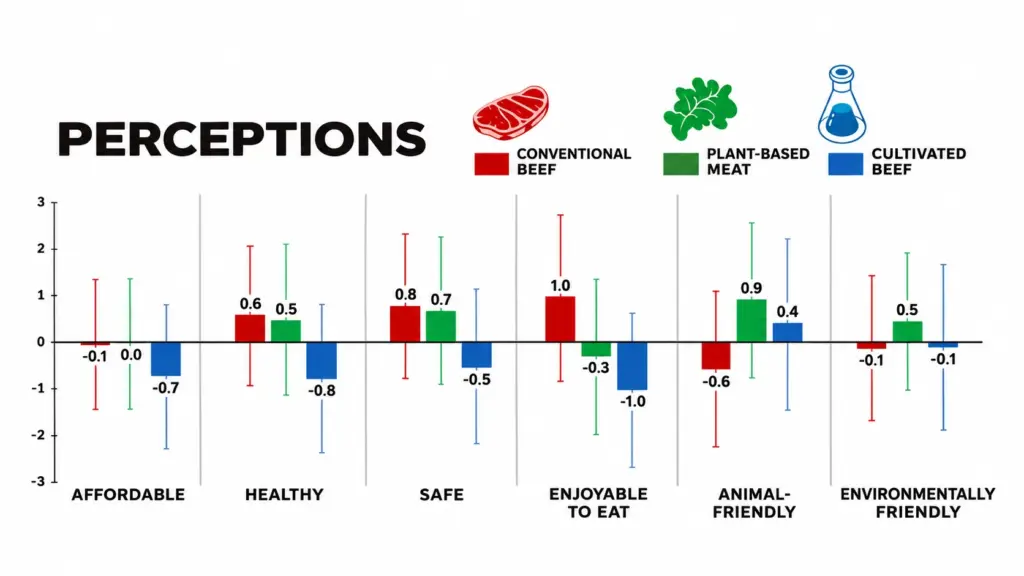
To our surprise, when compared with beef, some attributes of plant-based “meat” were rated more favorably or showed no statistically significant difference—in other words, the average person did not see them as all that different. This was the case with healthiness: beef (0.6) versus plant-based meat (0.5).
Although the numerical difference in healthiness was small, it presents an opportunity for the beef industry. There is a chance to communicate and clarify all the health benefits of its product, especially when compared with a plant-based option that does not contain the same macro- and micronutrients and may be classified as an ultra-processed product. Several studies and the recent U.S. dietary guidelines recognize the fundamental role of animal products in human health and food security, and place beef in a prominent position (3-5).
As for environmental sustainability, or how “environmentally friendly” the option would be, the results were markedly different, with a negative average for beef (-0.1) and a positive one for plant-based meat (0.5). At first, we might think that this negative view is a regional factor resulting from the research having been conducted in Australia. However, based on my experience observing the public debate on the subject—especially when considering the urban population—I believe that the result would have been similar even here in Brazil. The criticism and scrutiny that the beef cattle industry has always faced are global, and the effort to have this activity seen as a potential ally of the environment will also need to be global. Although Brazil already has good practices and several examples of sustainable tools in use, we still have significant room for improvement. As I mentioned in a previous article on My Minerva Foods, A bridge between the countryside and the city, more regenerative production can be a major ally in improving this perception.
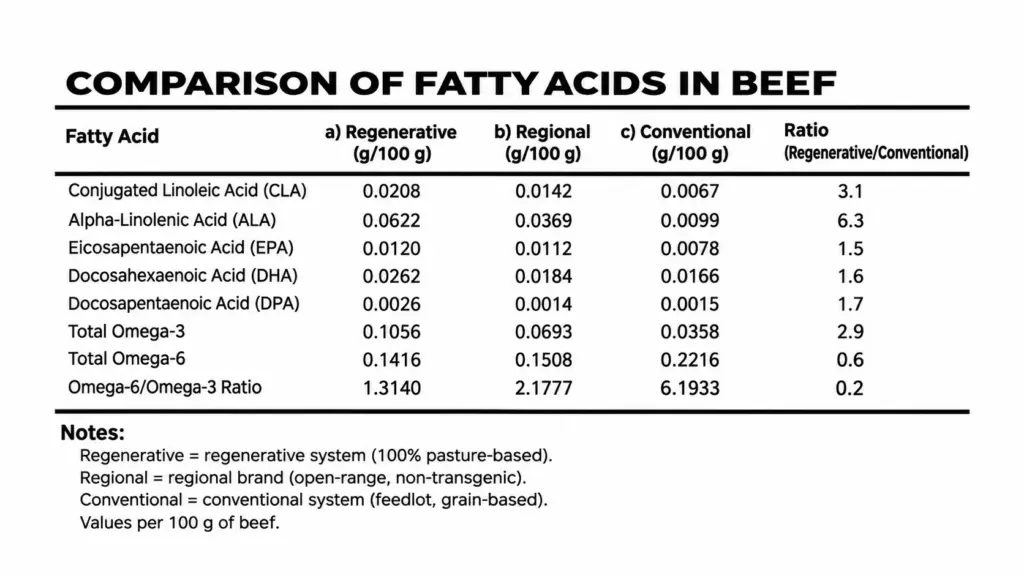
Researchers have already understood that there can be significant differences in the environmental and nutritional results of livestock farming depending on the region and how the animal is raised. A recent study in the United States compared the nutritional profile of beef samples according to the animals’ production system ((a) regenerative (b) regional (c) conventional) (6). And guess what they found?
Beef from the regenerative farm produced very positive results for our health! It contained three times more omega-3 fatty acids and more than six times more of the essential omega-3 fatty acid alpha-linolenic acid (ALA) than conventional beef. It also contained from more than half to nearly three-quarters more of the three long-chain omega-3 fatty acids (EPA, DPA, and DHA), as well as two-thirds of the omega-6 fatty acids, resulting in an omega-6-to-omega-3 ratio five times lower than that of conventional beef (1.3:1 versus 6.2:1), something experts tend to view as highly positive.
DHA and EPA are important nutrients for health and well-being. They help maintain a healthy brain, contribute to the body’s proper functioning, and are associated with cardiovascular health benefits and the regulation of the body’s inflammatory processes (7- 8).
The survey results for all the comparisons conducted are presented in Table 1:
For all these reasons, when people ask me what the future of meat will be—perhaps even expecting me to mention lab-grown meat—I answer: the future is regenerative and, consequently, healthier for all of us.
My work involves bringing this kind of knowledge to more people and, in doing so, perhaps helping them recognize beef as a very healthy and sustainable choice. This change in perception is essential for the prosperity of farmers and for the continuity of the livestock sector as a whole.
If you enjoyed reading this article and became curious about the subject, I invite you to follow my research, “Regenerative livestock production: practices and voices,” as part of Nuffield’s global program, supported by Minerva Foods.
- Famous plant-based company has already lost more than 90% of its value
- Consumers’ attitudes towards lab-grown meat, conventionally raised meat and plant-based protein alternatives
- Diana Rodgers and Robb Wolf (2024), Our daily meat: understand how veganism lied about the harmful effects of meat and discover how good it is for you and the planet.
- Nutrient-dense foods and diverse diets are important for ensuring adequate nutrition across the life course
- Considering the nutritional benefits and health implications of red meat in the era of meatless initiatives
- Soil health and nutrient density: preliminary comparison of regenerative and conventional farming
- Omega-3 polyunsaturated fatty acids protect against inflammation through production of LOX and CYP450 lipid mediators: relevance for major depression and for human hippocampal neurogenesis
- Omega-3 fatty acids reduce depressive symptoms only among the socially stressed: A corollary of the social signal transduction theory of depression.