Share


Browse the content:
- What defines the best meat for barbecue
- What are the best meats for barbecue? Top 3!
- Best cuts for affordable barbecue
- INFOGRAPHIC
- The best meat for barbecue also depends on the preparation
- Bonus tips for the best barbecue
- So, what is the best meat for barbecue?
What defines the best meat for barbecue
Barbecue goes beyond simple cooking. It is a tradition and a kind of collective ritual among friends and family that spans generations, so much so that it even has a day especially dedicated to it. But what is the best meat for barbecue?
Although the question seems simple, the answer depends on a series of factors. First of all, it may vary according to personal taste. Preparation techniques, the way the meat is placed on the grill and even small tricks all contribute to an excellent barbecue.
What are the best meats for barbecue? Top 3!
Choosing the best meat for barbecue depends on understanding the characteristics of each cut. In technical terms, three elements make a difference in the final result: external fat, intramuscular fat and collagen. Taking these aspects into account, the three best meats for barbecue are:
- Picanha: stands out for its classic fat cap. According to the Brazilian Beef Cuts Book, prepared by the Brazilian Association of Meat Exporting Industries (ABIEC), the cut is taken from the rear part of the bovine and retains an outer layer that helps protect the meat during roasting. “Its fat cap guarantees flavor and juiciness. It is also a versatile cut, which can be prepared whole or as steaks,” says Luciano Andrade, special lines manager at Minerva Foods.
- Bife ancho: also known as ribeye, its main characteristic is marbling – the interspersed fat that is responsible for enhancing tenderness and juiciness. The fat distributed among the muscle fibers melts during cooking, increasing juiciness and delivering a softer texture.
- Costela: in this cut, the highlight is collagen. For that reason, it requires slow, prolonged cooking. With constant heat, the collagen turns into natural gelatin, creating the texture that gives the feeling that the meat falls apart with every bite. It is the melting of collagen that turns the tough fibers into meat that comes easily off the bone.
Best cuts for affordable barbecue
Over the last decade, Brazilian barbecue has undergone an important transformation. The space once dominated only by traditional cuts, such as picanha and ribs, began to incorporate Argentine influences, North American smoking techniques and a growing appreciation for marbling.
It is in this context that cuts once considered “second-tier” have gained prominence when properly prepared. The Barbecue Revolution series, published by Exame magazine, showed how cuts such as chuck and brisket can reach a high gastronomic level with proper control of cooking time and temperature.
INFOGRAPHIC
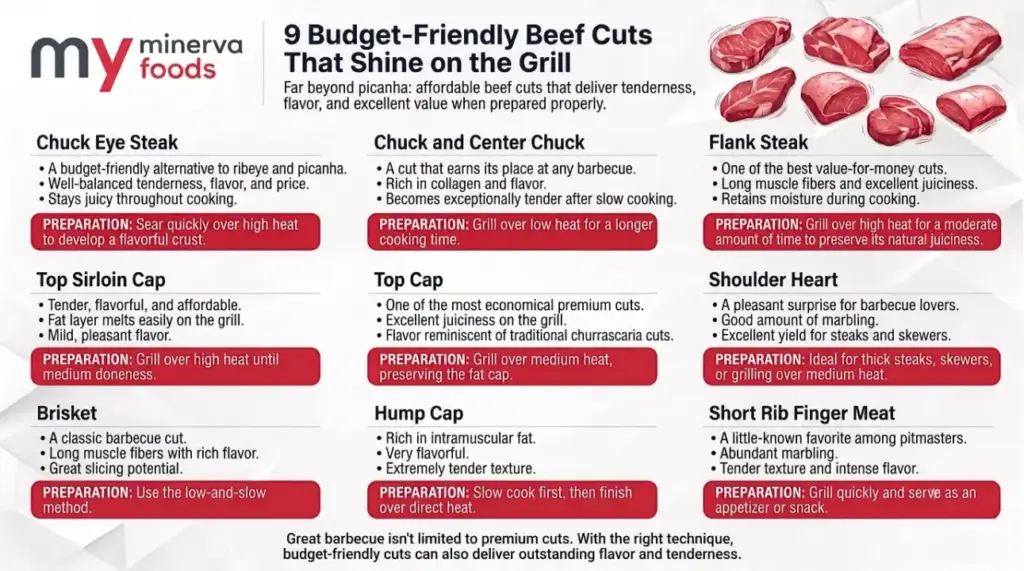
Click here to learn about the other beef cuts.
ENUMERATED LIST FORMAT
- Chorizo steak: an option with a fat finish similar to picanha and a cut that is extremely juicy when grilled.
- Chuck (and chuck eye): according to Menu magazine, based on guidance from specialist José Almiro, the genetic improvement of Brazil’s cattle herd has transformed chuck, once limited to the pot, into one of the tastiest and most tender meats for the grill.
- Flank steak: pointed out by the newspaper Estado de Minas as the true “queen of value for money”, it has long fibers and retains a lot of moisture on the grill. The tip for this cut, corroborated by the cooking website TudoGostoso, is to slice the cut always across the grain.
- Sirloin cap tail: the perfect middle ground between premium quality and economy. The O Gastrônomo website notes that its fat cap melts easily under the heat of the grill.
- Shoulder eye: classified by Estado de Minas as “the surprise of the grill”, it is very affordable. When properly trimmed of excess sinew, it offers a balance of marbled fat that prevents it from drying out over the coals.
- Brisket: the star of Texas barbecue (brisket). Fibrous, it is ideal for the low and slow technique and the use of aluminum foil.
- Zabuton: the Tv Churrasco channel recommends the same covered-cooking technique used for brisket for zabuton, so that its abundant marbling cooks the meat from the inside out.
- Top sirloin cap: super economical, it delivers a juicy result that often directly recalls the flavor of major steakhouses.
- Hidden cut – bananinha: according to ABIEC, the “bananinha do contrafilé” (known internationally as rib fingers) has an intense, buttery flavor.
The best meat for barbecue also depends on the preparation
Just like the cooking technique, the way the meat is brought to the fire also affects the final result of the barbecue:
- Whole cut: Larger cuts or whole pieces are best suited to slow cooking over lower heat, an excellent strategy to retain juices and keep internal moisture.
- As steaks: this enhances the flavor of the seared crust (Maillard reaction), since it greatly increases the area of meat in direct contact with the fire. Taller cuts, one to three fingers thick, are ideal.
- On a skewer: this promotes even cooking and constant exposure to heat, helping form a golden crust on the outside while preserving juiciness inside the meat.
Bonus tips for the best barbecue
In addition to slicing against the grain of the meat with a very sharp knife, there are other tips that will certainly make the difference so that your barbecue is your best barbecue. Check them out:
- Dry the meat before the fire: to help achieve a perfect sear, before putting the cut on the grill, dry it with paper towels. If the meat is wet, it will end up cooking in its own steam instead of creating the protection needed to preserve the meat’s grooves.
- Don’t keep turning the steak: to ensure a good sear, place the meat on the grill (which should be very hot) and leave it still for 1 to 2 minutes on each side so a perfect crust forms.
- Pay attention to the right moment for salt: apply the salt shortly before putting the meat on the fire or only after searing; salting too far in advance draws out internal juices and dries out the cut. And if you want to try something new, how about learning about the varieties of this seasoning and choosing the one that best suits your barbecue?
- Control the heat intensity: before grilling, hold your hand about 10 cm above the grill and count how many seconds you can tolerate the heat. If you need to pull it away before 5 seconds, the fire is too strong and it is worth waiting a bit. If you can keep it there for more than 20 seconds, the temperature is too low to sear the meat properly.
- Respect the resting time: never cut the meat as soon as it is done cooking. Let the cut rest for 3 to 5 minutes. This pause is crucial for the internal juices to redistribute through the fibers, keeping it juicy when served.
- Go for marinades: the technique not only infuses deep flavor into the meat, but also helps tenderize the fibers, making it an excellent strategy for turning simple, more affordable cuts into chef-quality dishes. See here options to try at your next barbecue!
- Plan ahead: set aside time to organize the barbecue, starting with the type of event and the guest list, as this will allow you to get the amount of meat, variety of cuts and side dishes right. The calculation should take into account the proportion of men, women and children, the full menu and even the time of the event.
So, what is the best meat for barbecue?
There is no single answer. The best meat is the one prepared in the most appropriate way for its characteristics, that fits the budget and matches the experience one wants to create. The perception of what the best meat for barbecue is can also vary according to the culture of each region, whether within the same country, as we can see in this piece, or according to the customs of different nations. In the end, barbecue is a combination of science, technique, tradition and the memories and sensations it can awaken in each person, but certainly, taking into account the techniques for a chef-worthy barbecue, delivering a special experience can be much easier.
Want to receive more tips like these directly in your email? Subscribe to our newsletter
- The roots of Pantanal cuisine
- 5 Tips for a Falling-Apart Brisket – Tv Churrasco
- An Introduction to the Maillard Reaction: The Science of Browning, Aroma, and Flavor
- Cow in the shade, free-range chickens: animal welfare is on the rise
- Brazil reaches a new level in beef exports
- Animal welfare also has an impact on meat quality
- Beef – production and quality assessment
- Can you make barbecue with chuck? Chef teaches how to prepare this front cut over the coals
- Barbecue Day: tradition, history and the ritual that spans generations
- Brazilian Beef Cuts Book Brazilian Beef Cuts Book
- Barbecue Revolution: turning chuck into picanha
- Techniques for a chef-worthy barbecue
- Are you having a barbecue and don't know the ideal amount of meat? We'll help you!Are you having a barbecue and don't know the ideal amount of meat? We'll help you!