
Share


People working in agriculture are often told that they need to connect with those who consume the food they produce so that farmers are more highly valued and less often portrayed as villains. The importance of this communication—this “bridge” between rural and urban communities—is underscored by the growing number of people with little connection to rural life who spread narratives based on negative perceptions of agribusiness.
Over the years, through my academic research and work with the agricultural sector, I have encountered remarkable livestock and farming initiatives in Brazil and abroad. Unfortunately, these stories are often not shared with consumers in the way they deserve. Sustainable practices that have long been adopted on farms are frequently not recognized as such by the public, while myths about livestock production continue to spread without the attention and clarification they require.
Livestock production is essential from economic, social, and nutritional perspectives, and it also plays an important role in achieving better environmental outcomes. Yet, in Brazil, public opinion still seems to overlook the available evidence. Strengthening communication with consumers is therefore essential—an area that has been neglected or insufficiently addressed by the sector for far too long.
Beef sits at the center of this debate, whether the discussion is about human health, the environment, or ethics. In parts of Europe, North America, and Oceania, its consumption is even expected to decline over the coming years. Against this backdrop, I have begun a research journey with Minerva Foods and Nuffield Brazil that includes visits to farms in search of answers to two central questions:
What are the best regenerative beef production practices in southern Brazil, Uruguay, and Argentina?
What are the most effective ways to communicate the positive economic, social, and environmental impacts of these regenerative practices to farmers and the wider public?
By answering these questions, I hope to strengthen the support available to livestock producers, helping them communicate more effectively with society while sharing practices that are well suited to our regional realities. But what exactly are regenerative agriculture practices?
Regenerative agriculture
When it comes to on-farm practices, there are production methods that reduce environmental impacts, promote ecosystem regeneration, and have the potential to generate a range of additional benefits. However, these approaches are still neither widely adopted nor widely understood. My research focuses in particular on six core principles of regenerative agriculture, illustrated in the figure below.
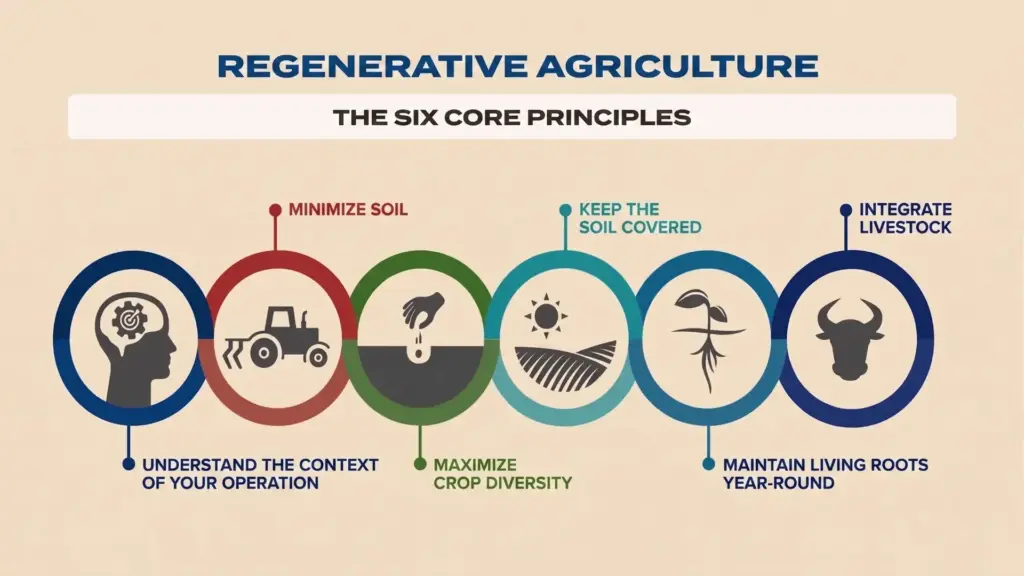
Since each of these principles includes a series of practices, the choice was made to investigate some that are already recognized for increasing the resilience of production systems and others that are also part of Minerva Foods’ Renove program.
Although Brazil has already adopted many of these good practices and offers numerous examples of sustainable tools in use, there is still considerable room for improvement. It is also clear that the benefits generated on the farm extend to consumers. In addition to having access to high-quality beef (a direct benefit), consumers also help support local economies, conservation efforts, biodiversity, and many other positive outcomes (indirect benefits) associated with more regenerative production systems.
Moreover, the impact of a well-informed and engaged community in driving cultural change can be significant. For this reason, I believe it is essential to identify and better understand the most effective livestock production practices—not only to improve beef production methods, but also to work alongside producers in sharing this knowledge and fostering a more informed public dialogue about cattle production in Brazil. The research will also highlight producers who are already leading by example, promoting these practices both within the farm gate and beyond it.
The global Nuffield agricultural research program
The health and environmental sustainability of foods produced through conventional livestock systems are facing increasing public scrutiny. At the same time, regenerative agriculture and innovative livestock production methods are aligned with growing consumer concerns about the perceived negative impacts of beef production.
This research therefore aims to identify, document, and promote regenerative practices that can help address the ongoing public criticism directed at the livestock sector, while also supporting producers in improving their production systems and communicating the value of their work more effectively to Brazilian society. The following figure provides an overview of the project and the main topics it covers:
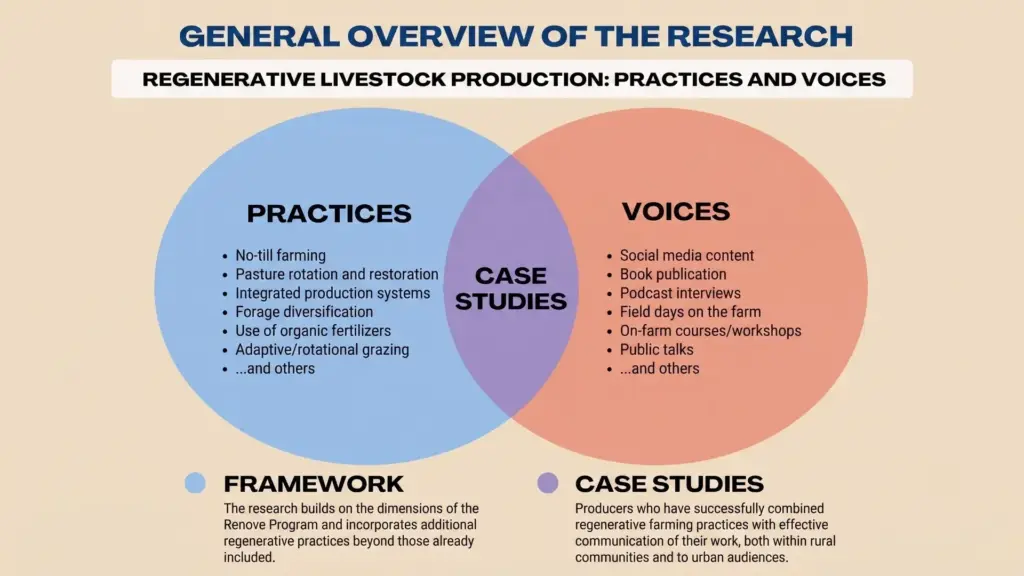
The case studies will be selected throughout the visits to the countries included in the research. Those that stand out most for their communication efforts will be interviewed in depth, and their stories will be shared through video productions or episodes of the In Defense of Meat podcast.
Promoting this type of awareness can help drive cultural change and influence consumer demand by encouraging people to recognize beef as a healthy and sustainably produced food. In the long term, this may help reverse the decline in beef consumption in developed countries and reduce support for legislation that could negatively affect rural producers.
As one of the world’s leading players in both the domestic and international beef markets—and currently the world’s largest producer and exporter of beef—Brazil has a vital role to play in shaping this conversation. Changing public perception is essential to ensuring the long-term viability and prosperity of rural producers, as well as the future of the livestock sector as a whole. By bringing producers and consumers closer together, we all stand to benefit—for our health, our planet, and our future.
I invite you to follow this journey over the coming months as we discover and share the success stories of livestock producers who are helping shape a more regenerative future.
Will you join me?
- Marca Agro do Brasil (2022), Pesquisa: ‘Perceptions about Agribusiness: what does the Brazilian think’.
- Diana Rodgers and Robb Wolf (2024), The Meat We Eat: understand how veganism lied about the harms of meat and discover how it is good for you and for the planet.
- OECD/FAO (2025), OECD-FAO Agricultural Outlook 2025-2034.
- Nuffield Brazil is part of the Nuffield International Farming Network and brings together agribusiness professionals who believe in leadership, sustainability and innovation to develop the sector.
- ABIEC – Brazilian Association of Meat Exporting Industries (2026), Beef Report (2026).