
Share


For many Brazilians, barbecue brings to mind large cuts of meat, coarse salt and a weekend gathering. In China, however, the scene may be different: a table with skewers of meat, seafood, vegetables and other ingredients chosen to share with friends. In many regions, going out for barbecue is a dinner option like any other, with no need to wait for a special occasion.
Known as shaokao, Chinese barbecue can be found at street stalls and restaurants, but it does not follow a single recipe. Ingredients, seasonings and serving styles vary from place to place. This diversity helps explain how an ancient technique remains part of everyday life and how it has developed into a large-scale economic activity.
A history that goes far beyond restaurants
Preparing food over a fire is an ancient practice in Chinese territory. One example is the ceramic grill found at a site belonging to the Majiabang culture in Zhejiang, dating back around 7,000 years and now part of the collection at the Shanghai Museum. This artifact demonstrates the antiquity of cooking techniques, although it does not mean that the barbecue served today already existed with the same ingredients or flavors.
The history of skewers also has its own records. This study brings together ancient texts, depictions of cooking and banquet scenes, utensils and traces of meat prepared on skewers. According to the author, zhi (炙) was the term used for the roasting method. The evidence shows that preparing small pieces of meat over a fire was already part of Chinese culinary tradition before the influences that would help shape some modern styles.
Why is barbecue part of everyday life in China?
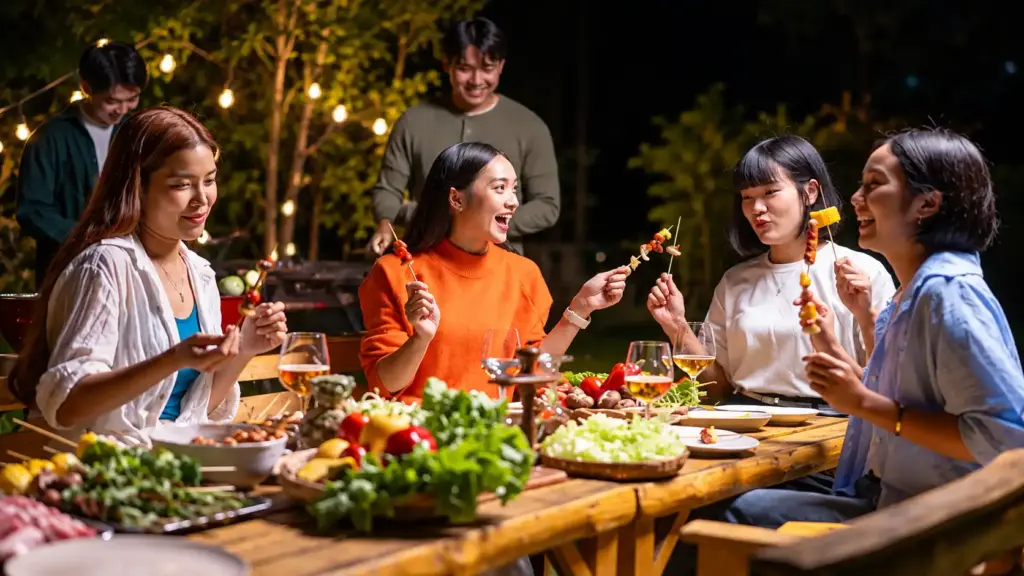
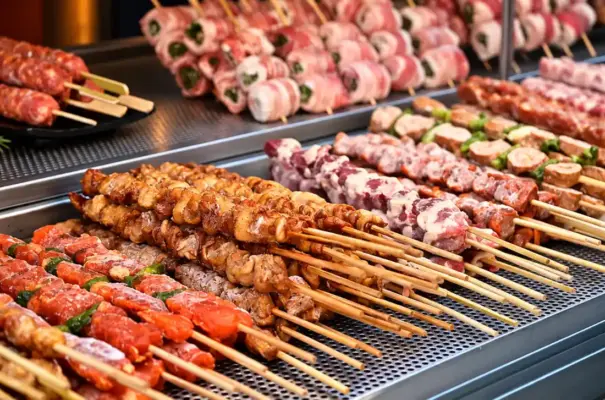
In China, barbecue is an affordable dinner option and an informal way to meet friends and family. Skewers encourage this shared experience, since it is possible to order small portions of different types and try several flavors in the same meal. Depending on the establishment and region, the selection may include beef, lamb, chicken, pork, seafood, offal, vegetables, mushrooms and soy products.
The preparation method also changes the experience: many ingredients are cut into small pieces and grilled quickly. Spices such as cumin and chili pepper may define the flavor, but this does not characterize all Chinese barbecue, since there are different ways of seasoning, grilling and serving the food.
Many styles in a single country
Regional variety can be seen both in the food and in the way it is eaten. Lamb skewers and cumin are the hallmark of Xinjiang, while other regions use their own ingredients and flavor combinations.
In Zibo, in Shandong province, customers even take part in the final stage of preparation: the skewers arrive partially grilled and are finished over small braziers at the table, then combined with a thin pancake, scallions and side dishes. This experience gained traction on social media and drew crowds of visitors to the city in 2023.
These examples show why referring to “Chinese barbecue” can conceal important differences: each region adapts the preparation to the ingredients available, local preferences and its own social customs.
A large and competitive market
Barbecue’s presence in consumers’ daily lives is reflected in industry figures. According to the 2026 Barbecue Industry Development Report, published by Xinhua, the Chinese market generated 268 billion yuan in 2025 (around R$209.31 billion), up 4.3% from the previous year. Of that total, 158 billion came from the skewer segment and 110 billion from the grilled-meat segment. The market is expected to exceed 280 billion yuan in 2026.
The same report recorded 409,000 barbecue establishments in February 2026, following a peak of approximately 517,000 in September 2024. The decline in the number of stores shows that this is also a competitive market, in which the popularity of the meal does not guarantee that every business will remain operational.
Barbecue has become a school subject
In the city of Yueyang, in Hunan province, barbecue has also found a place in professional training. The Yueyang Barbecue College began accepting applications in March 2026 for a program combining practical skills and management knowledge, created in partnership with Yueyang Open University and the local industry association.
The curriculum goes beyond learning how to grill meat: students study ingredient selection, charcoal management and flavor development, as well as restaurant operations, cost management and entrepreneurship. It is training designed both for those who cook and for those who intend to work in other parts of the business. The initiative shows that, for Chinese people, barbecue is an art to be taken seriously.
- Grelhador de cerâmica de ~7 mil anos, cultura Majiabang — 华西都市报 (Huaxi Dushi Bao)
- Cooking meat in ancient China: luan, zi, and the origins of the kebab — Journal of the Royal Asiatic Society
- Relatório de Desenvolvimento da Indústria de Churrasco 2026 — Xinhua/news.cn
- Barbecue college in Hunan welcomes its first students — China Daily
- Zibo's special barbecues attract thousands of hungry folks — China Daily