
Share


Who hasn’t had the frustrating experience of placing a beautiful steak in a frying pan, expecting that cinematic sizzle and a golden crust, only to be surprised by the bottom of the pan filling with a grayish liquid? Within seconds, what should have been a perfect sear turns into meat steamed in its own juices, resulting in a tough texture and a pale appearance.
Many consumers end up “blaming” the butcher or supermarket, assuming the product is low quality or has even been “injected” with water to make it weigh more on the scale. But science actually explains this phenomenon. Find out why it happens below and what you can do to avoid it at home.
According to Science of Meat, an Exploratorium project, temperature causes important changes in meat proteins during cooking. When meat is placed over a heat source, these proteins begin to undergo a process called denaturation, in which their original structure changes.
One way to visualize this process is to imagine muscle proteins as long, folded structures. As they heat up, they partially unwind and begin interacting with one another differently. At the same time, the muscle proteins contract, reducing the space available to hold water.
As the internal temperature of the meat rises, particularly from approximately 60°C to 65°C onward, this contraction intensifies and promotes the expulsion of some of the water retained in the muscle tissue. The effect can be compared to squeezing a wet sponge: as its structure is compressed, some of the liquid stored in its internal spaces is released.
As the space available between the structures of the muscle fibers decreases with heating, some of the water trapped within them is no longer retained in the tissue and moves toward the surface of the meat. If the rate at which this water is released is greater than the pan’s capacity to evaporate it, the liquid accumulates at the bottom of the pan.
The three culprits behind excess water
If releasing water is an unavoidable biological process, why does meat grill perfectly on some days while, on others, it creates a veritable soup in the pan? Most of the time, the problem lies in the thermal dynamics of cooking. Three main factors accelerate and worsen this loss of moisture:
1. Overcrowding the pan
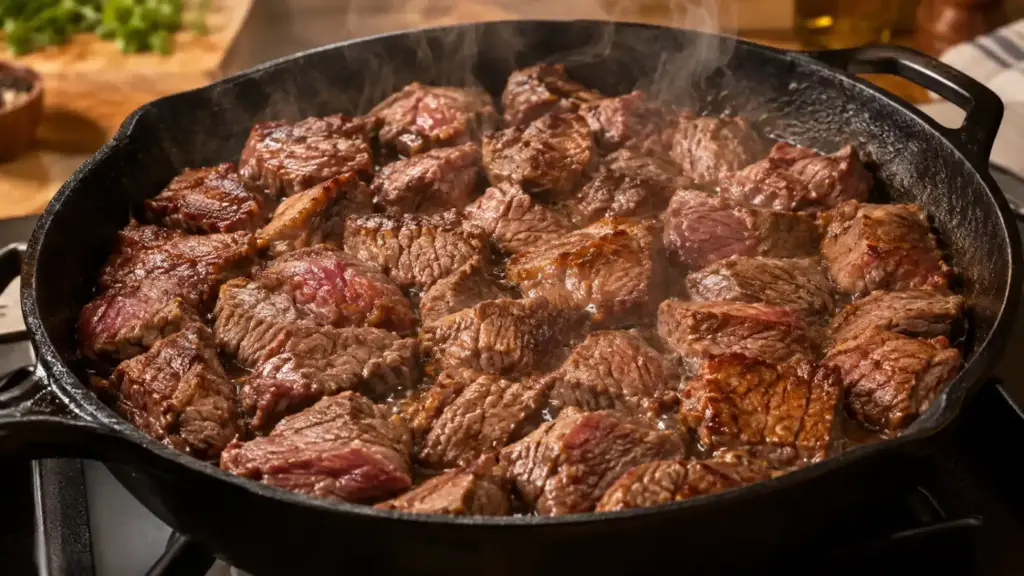
This is the most common mistake. According to food science experts, when you place a large quantity of food in a frying pan at once, the temperature drops instantly. For the famous Maillard reaction — the chemical process that creates that golden, flavorful crust on meat — to occur, the surface must be at least 140°C. Cooking physics studies explain that if the pan cools because of an excess of cold meat, the water squeezed out by the fibers does not evaporate immediately. It accumulates, bringing the temperature down to 100°C (the boiling point of water), which results in meat that is boiled, not grilled.
2. The impact of improper freezing
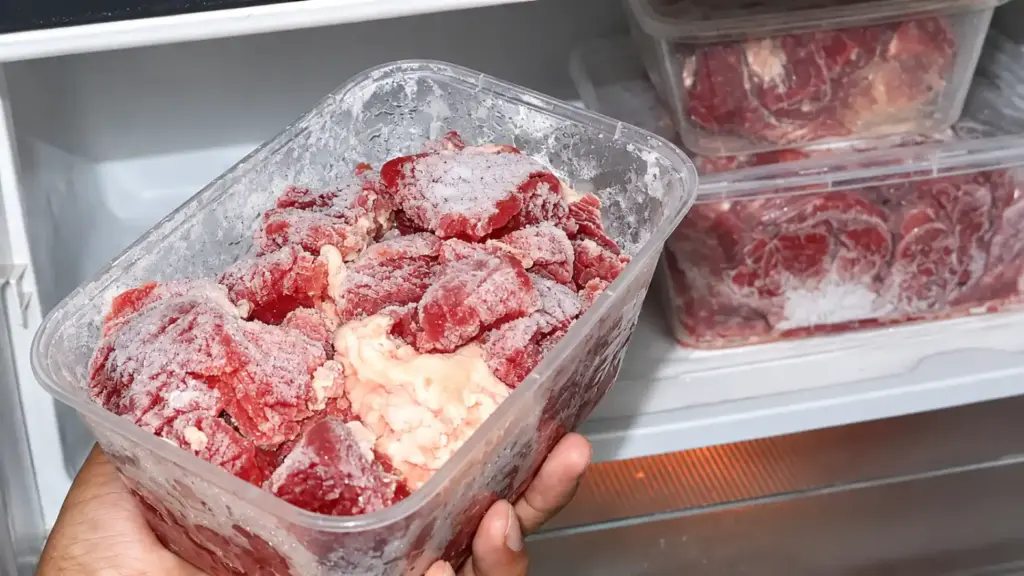
When freezing occurs slowly, as is common in household freezers, larger ice crystals form inside the muscle tissue. These crystals can cause greater damage to the fiber structure and reduce the meat’s ability to retain water after thawing. As a result, the so-called drip loss increases: the liquid that accumulates in the packaging or container during thawing. During cooking, this lower retention capacity can also contribute to more water being released into the pan.
Rapid freezing, which is more common in industrial processes, favors the formation of smaller crystals and tends to better preserve muscle structure and water retention.
To reduce this effect at home, the tip is to freeze meat in smaller, well-wrapped portions, leaving space for cold air to circulate and help speed up the freezing process. Freezers with a quick-freeze function can also be used. In addition, to preserve the meat’s structure, its ability to retain water and its safety, repeated thawing and refreezing cycles should be avoided.
3. Meat taken straight from the refrigerator
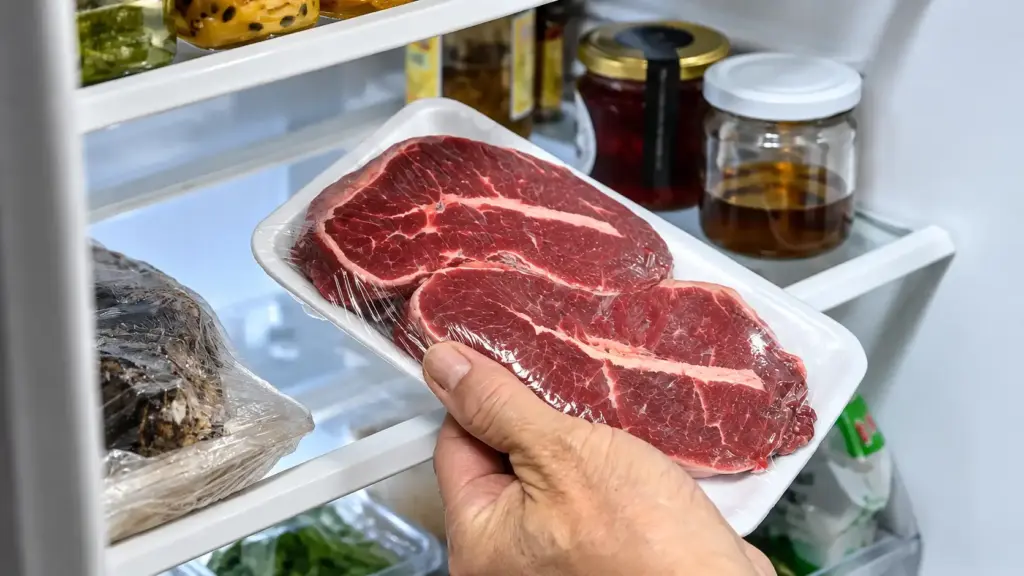
For a long time, placing a steak at 4°C in a hot frying pan was considered inadvisable because of the thermal shock it would cause: the interior of the meat takes longer to heat up, while the outer surface contracts quickly. This imbalance was associated with water escaping before the exterior had sealed. Hence the recommendation to let the meat rest on the counter for around 15 to 20 minutes before cooking.
However, Serious Eats points out that this resting period barely changes the internal temperature of the steak. Although the idea is widely accepted in popular cooking, culinary laboratory tests found that a steak removed from the refrigerator at 3.3°C and left on the counter for 20 minutes reached a core temperature of only 4.3°C — an increase of just 1°C. This makes the practice ineffective for preventing thermal shock or changing the uniformity of cooking. Instead, other steps taken before the pan can help.
Before the pan: two steps that make a difference
In addition to controlling the temperature during cooking, it is worth paying attention to the moisture already present on the surface of the meat before it reaches the heat.
Dry the meat before grilling
If there is visible liquid, remove the excess with a paper towel. A review published in 2025 in the journal Foods shows that water availability is one of the factors affecting the Maillard reaction: under highly moist conditions, excess water can delay the browning process. This is because, in practice, the water on the surface must first evaporate before the temperature of the meat can rise and promote crust formation.
If you have time, salt it in advance (h4)
The technique known as “dry brining” consists of salting the meat and keeping it in the refrigerator before cooking. According to Serious Eats, the salt initially draws moisture to the surface, forming a solution that is gradually reabsorbed by the meat, while some of the water evaporates and the exterior becomes drier. For cuts such as steaks, the recommendation is to do this at least around 45 minutes in advance or, preferably, overnight.
If there is not enough time, the best alternative is to salt the meat immediately before placing it over the heat. Leaving a salted steak to sit for just a few minutes can produce precisely the opposite effect: during this interval, the salt begins drawing water to the surface, but there has not yet been enough time for the liquid to be reabsorbed. For this reason, Serious Eats recommends avoiding the window between approximately 5 and 45 minutes before cooking.
BOX | The 75% rule
The muscle tissue of mammals and birds is not a block of pure protein. The basic distribution below helps explain the formation of liquid during certain cooking methods involving some cuts of meat. According to the Science of Meat website, animal muscle tissue is composed of:
- 75% water.
- 20% protein.
- 5% fat and carbohydrates.
Although these nutritional values are generic, since each cut and species has specific characteristics, the distribution provides a useful illustration of the diversity of the food’s composition.
The water present in meat is stored at three different levels within the muscle tissue:
- Bound water: this is a very small amount (around 5%) that is chemically bonded to the protein molecules themselves and does not move easily.
- Entrapped water: this is retained in the small spaces between the structures of the muscle fibers, which are formed by proteins such as actin and myosin. In these spaces, the water is held by its interaction with these structures and by the attraction between its own molecules, a phenomenon associated with capillarity and surface tension.
- Free water: this is water that flows easily out of the tissue when cell membranes are broken or cut.
This means that, in a cut containing around 75% water, one kilogram of meat may contain approximately 750 grams of water naturally present in the muscle tissue. During cooking, whether on the grill, in the oven or in a pan, some of this water may be lost as heat alters the structure of the muscle proteins and reduces the meat’s ability to retain it, a phenomenon described in studies on water-holding capacity and cooking losses.
The amount of water that remains in the tissue after cooking directly influences the perception of juiciness: greater losses during cooking tend to reduce this sensory attribute, although the relationship is not absolute and also depends on the structure and characteristics of the cut. Fat also contributes to this experience, helping with lubrication and the sensation perceived during chewing. Therefore, properly preserving water and fat during a barbecue or roast helps produce the moist, juicy texture so highly valued in meat. Controlling cooking time and temperature is one of the main ways to limit these losses: the higher the internal temperature rises and the longer the meat remains exposed to heat, the greater the contraction of the fibers and the expulsion of water tend to be. Avoiding cooking beyond the desired doneness and removing the meat from the heat at the right moment therefore helps preserve both moisture and some of the fat.
Read also: How to store meat to preserve its quality?