
Share


Creatine is a compound produced by the body from amino acids and also obtained through food. Most of it is stored in the muscles, where the creatine-phosphocreatine system contributes to the regeneration of adenosine triphosphate (ATP), a molecule used as an immediate source of energy during intense, short-duration efforts.
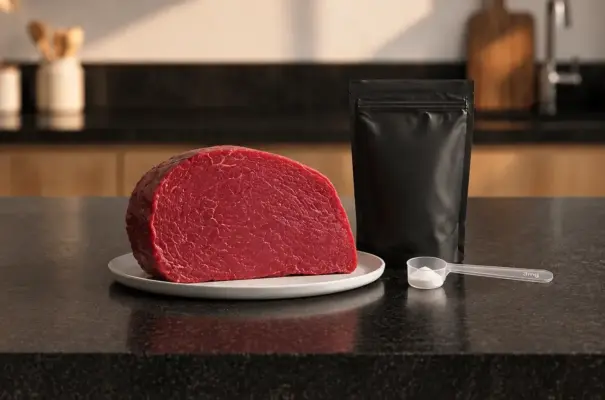
Meat and fish are among the compound’s main dietary sources. Creatine can also be consumed through supplements, generally in the form of creatine monohydrate. Although the molecule performs the same function after being absorbed, food and formulated products differ mainly in concentration, nutritional matrix and context of use.
What is natural creatine from meat?
Natural creatine from meat is the compound found in the muscle tissue of animals. For this reason, beef, pork, poultry and fish contribute to its intake as part of the diet.
The study The Concentration of Creatine in Meat, Offal and Commercial Meat Extracts found approximately 30 millimoles of creatine per kilogram in raw samples of beef, chicken and rabbit meat. This amount corresponds to about 4 grams per kilogram, although it should not be interpreted as a fixed value for every species, cut or preparation.
The concentration may vary among foods and be altered by processing and heat. Some creatine may be converted into creatinine during cooking, meaning that values measured in raw meat do not automatically represent the amount present in the portion ready for consumption.
In beef, the compound is consumed within a food matrix that also provides complete proteins, heme iron, zinc and vitamin B12. Its contribution should therefore not be assessed in isolation, but together with the other nutrients present in the meal.
My Minerva Foods explores this relationship in the article Meat in an athlete’s diet: muscle recovery and performance, which presents the role of meat as part of a broader dietary strategy.
What is creatine in supplement form?
Creatine supplements are produced in concentrated form and marketed mainly as powders, although they may also come in capsules, tablets and other formats. Creatine monohydrate is the form most extensively studied in research on physical performance and increases in the body’s creatine stores.
In scientific protocols, a common strategy uses between 3 and 5 grams per day. Some studies include an initial loading phase, with larger doses divided over a few days, but this phase is not mandatory. Daily consumption of a smaller amount can also gradually increase muscle stores.
The main practical advantage of supplements is that they allow people to consume a standardized dose without requiring large amounts of meat or fish. At the same time, the product provides mainly creatine and does not reproduce the combination of proteins, vitamins and minerals found in food.
This difference helps define the role of each option. Meat is part of the usual diet, while supplements concentrate the compound to serve a specific purpose, particularly in contexts in which the doses studied would be difficult to achieve through usual portions of food alone.
My Minerva Foods discusses the complementary role of these products in the articles Post-workout: are protein supplements the best strategy? and What athletes’ nutrition teaches us about protein and supplements.
Nutritional differences between natural creatine from meat and supplements
The main difference does not lie in creatine’s function after absorption. The molecule from meat and the molecule provided by supplements participate in the same energy system in the body. What changes is the amount consumed, the form of consumption and the matrix accompanying the compound.
The study Absorption of Creatine Supplied as a Drink, in Meat or in Solid Form compared a 2-gram dose of creatine provided in solution, in meat or in solid form. Creatine from meat was readily absorbed and had bioavailability similar to that of the solution, although it produced a lower and more prolonged blood peak.
Meat provides a variable dietary amount of creatine and is part of a complete meal. Supplements, in turn, make it possible to reach the doses used in scientific trials with just a few grams.
Considering the estimate of approximately 4 grams per kilogram in some raw meats, about 1.25 kilograms would be needed to obtain 5 grams of creatine. This calculation is merely illustrative, as the concentration varies among foods and may be altered by preparation.
In addition, meat should not be consumed in large amounts for the sole purpose of reproducing a supplemental dose. The appropriate amount of food must take the meal, energy needs and overall dietary pattern into account. Supplements, on the other hand, should serve a defined purpose and should not act as substitutes for the nutrients provided by food.
Comparative nutrient table
The table compares the origin, main sources, creatine concentration, associated nutrients, form of consumption, absorption, influence of preparation and purpose of natural creatine from meat and creatine supplements.
The values represent general characteristics. The concentration in meat varies according to the species, tissue, processing and cooking, while the amount provided by supplements depends on the formulation and the dose indicated on the label.
| Compared characteristic | Natural creatine from meat | Creatine supplement |
| Origin of creatine | Naturally present in animal muscle tissue | Obtained through industrial production for use in formulated products |
| Main sources | Beef, pork, poultry and fish | Generally provided as creatine monohydrate |
| Creatine concentration | Moderate concentration that varies according to the food | High concentration standardized per dose |
| Approximate amount | About 4 grams per kilogram in some analyzed raw meats | Frequently used in daily doses of 3 to 5 grams |
| Associated nutrients | Complete proteins, heme iron, zinc and vitamin B12 | Generally isolated creatine, unless combined with other ingredients |
| Form of consumption | Integrated into meals | Consumed as powders, capsules, tablets or other forms |
| Creatine absorption | Readily absorbed after meat is consumed | Readily absorbed after the product is ingested |
| Blood peak after consumption | May produce a lower and more prolonged peak compared with the solution | The dissolved form may produce a higher and faster blood peak |
| Influence of preparation | Processing and heat may reduce creatine or convert it into creatinine | Does not depend on culinary preparation |
| Primary purpose | Contribute to habitual dietary intake | Increase intake in a concentrated and standardized form |
| Evidence for physical performance | Usual portions do not directly reproduce the doses used in trials | Widely studied at standardized doses, especially in the monohydrate form |
The comparison shows that both sources provide absorbable creatine. Supplements are not advantageous because they contain a different molecule, but because they concentrate in a small portion an amount that would require consuming a large volume of meat.
Meat offers a lower concentration of creatine per serving, but provides the compound as part of a matrix that includes proteins and micronutrients. Supplements provide a higher concentration, but do not replace this nutritional composition.
It is also important to interpret the estimate of 4 grams per kilogram with caution. The figure comes from specific samples of raw meat, does not apply to every beef cut and should not automatically be applied to cooked meat.
Which option is best suited to each profile?
Creatine from meat may contribute to the diets of people who consume animal-based foods as part of a balanced eating pattern. In this context, it comes with high-biological-value proteins and important micronutrients, but a usual serving generally does not provide the doses used in supplementation protocols.
Creatine monohydrate has more consistent evidence for improving performance in exercise involving repeated, intense and short-duration efforts, such as weight training, sprints and activities combining strength and power. The benefit tends to be smaller in predominantly aerobic and prolonged activities.
For this reason, supplements tend to attract greater interest among athletes and people who engage in strength or high-intensity exercise. Even so, their use does not replace training, an adequate diet, rest and individualized guidance.
Vegetarians and vegans generally have lower dietary intake of the compound because its main sources are animal tissues. This does not mean that everyone in these groups needs supplementation, but dietary patterns may be considered when evaluating potential benefits and usage strategies.
Supplementation is also being studied among older adults and in different health contexts. However, results depend on the population studied, dose, duration, presence of exercise and outcome analyzed. For this reason, benefits observed in one group should not automatically be generalized to the entire population.
Creatine intake from food is part of the usual diet. The decision to use concentrated doses, however, should take into account one’s goals, health conditions and other products being consumed.
People with kidney disease, specific health conditions, ongoing medication use or questions about dosage should seek medical or nutritional guidance before starting supplementation. Assessment is especially important when the product will be used over an extended period or combined with other supplements.
What do scientific studies say?
The position stand International Society of Sports Nutrition Position Stand: Safety and Efficacy of Creatine Supplementation in Exercise, Sport, and Medicine, from the International Society of Sports Nutrition (ISSN), concludes that supplementation increases muscle creatine concentrations and may improve performance in high-intensity exercise. The document identifies creatine monohydrate as the form with the largest body of scientific evidence.
The technical document Dietary Supplements for Exercise and Athletic Performance, from the National Institutes of Health (NIH), also links supplements to improved performance in activities involving intense efforts and short recovery periods. The institution notes that studies generally use concentrated amounts, unlike those obtained from a usual serving of meat.
The study The Concentration of Creatine in Meat, Offal and Commercial Meat Extracts confirms the natural presence of the compound in meat. By recording approximately 30 millimoles per kilogram in certain raw samples, the research also shows that dietary concentration is lower than that provided by a usual supplemental dose.
The study Absorption of Creatine Supplied as a Drink, in Meat or in Solid Form demonstrates that creatine present in meat is absorbed by the body. The difference between the sources therefore does not lie in an alleged opposition between an active “natural” form and an “artificial” one, but in the concentration, behavior after ingestion and components accompanying each option.
The article Effect of Cooking Conditions on Creatinine Formation in Cooked Ham assessed the influence of different cooking conditions on creatine and creatinine concentrations. The results reinforce that temperature and preparation time can alter the relationship between these compounds, which is why values from raw meat should not be transferred directly to the finished food.
Taken together, the evidence indicates that beef contributes creatine within a nutrient-rich food matrix. Supplements make it practical to reach the standardized doses associated with the effects observed in trials. The two sources play different roles and do not automatically replace one another.
- My Minerva Foods — Meat in an athlete’s diet: muscle recovery and performance
- My Minerva Foods — Post-workout: are protein supplements the best strategy?
- My Minerva Foods — What athletes’ nutrition teaches us about protein and supplements
- International Society of Sports Nutrition — Safety and efficacy of creatine supplementation
- National Institutes of Health — Dietary Supplements for Exercise and Athletic Performance
- The Concentration of Creatine in Meat, Offal and Commercial Meat Extracts
- Absorption of Creatine Supplied as a Drink, in Meat or in Solid Form
- Effect of Cooking Conditions on Creatinine Formation in Cooked Ham